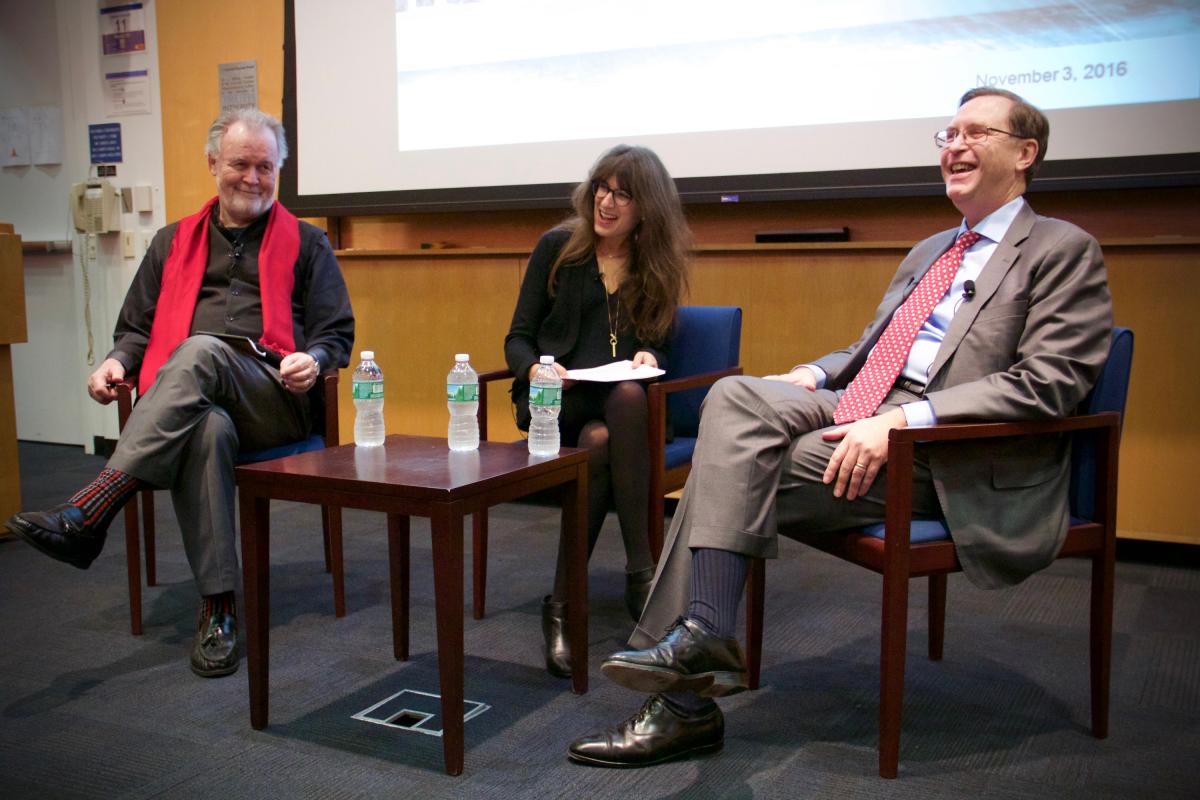
Regardless of who they voted for, most people can agree that populist ideology has loomed large in this year’s US presidential election. Defined generally as a political movement by ordinary citizens to regain control of their government from a small circle of powerful elites, populism isn’t going anyway anytime soon — and the most dangerous thing to do would be to assume that it will, say Columbia Business School Dean Glenn Hubbard and Professor Ray Horton, who discussed the topic and its impact on the US political and economic landscape in a debate moderated by George A. Wiegers Fellow Kim Gittleson ’17 on Thursday, November 3.
“This is not historically unique. America has had populism waves repeatedly,” explained Hubbard, noting the examples of Andrew Jackson, seventh president of the United States and outspoken populist (who earned the nickname “King Mob”); William Jennings Bryan, the 1896 and 1900 Democratic presidential nominee who promoted anti-imperialism, anti-elitism, and fighting big banks and trusts; and George Wallace, former governor of Alabama and four-time US presidential candidate (as a Democrat in 1964, 1972, and 1976, and as an independent in 1968) who is oft remembered for his Southern segregationist stances.
“We’ve had populists who’ve tapped into exactly [what’s happening now]: a group of citizens who feel that the ‘other’ — whether the other is somebody who doesn’t look like you, worship like you, come from the same country as you — is taking what you have,” Hubbard continued. “I think what we see now is people genuinely hurting. They have been left behind. You see more and more Americans saying, ‘I don’t think my son or daughter is going to be as well off as I was,’ and I think that leads to real political concern and a view that government doesn’t have their backs. These pressures are only going to grow. [After the election], my guess is that Republican and Democratic elites are going to say, “Now we’ll just go back to business as usual,’ and I think that’s a mistake. The biggest risk is that we pretend it didn’t happen.”
Ray Horton agreed. “It’s absolutely clear that what [President-elect Donald] Trump is harvesting is going to continue going forward,” he said. “The rise of authoritarianism in Europe during the Depression led to Fascism. I wouldn’t argue we’re anywhere close to that [now], but I quite agree that if we don’t begin to address these concerns, they’re going to escalate.”
So what led to these feelings of frustration, lack of opportunity, and unrest in the first place? Hubbard stressed that the slow growth of the US economy is a major factor. “Societies that grow more rapidly, and are inclusive in that growth, are prosperous broadly,” he said, citing The Moral Consequences of Economic Growth, written by one of his former Harvard professors, Benjamin Friedman. “Societies that do not? Societies that see racism, anti-semitism, social unrest: we are headed in that direction.”