
On his first day of orientation at Columbia Business School, Michael Coleman ’05 met a clustermate with whom he would embark on a decade-long journey to create a critically acclaimed film. (Foxcatcher, based on the true story of two Olympic wrestlers and their disturbing relationship with a multimillionaire, was an award season mainstay.) “I’d always heard people say that you might find your future business partner at Columbia, and in my case, it turned out to be true,” says Coleman, who now counts movie producer Tom Heller ’05 among his closest friends.
Like Coleman and Heller, many alumni came to Columbia for an MBA and left with a collaborator with whom to realize a long-held dream or develop a new venture. Others find like-minded business partners through the Columbia Business School network long after they graduate. As the partnerships featured here capture, the experience of going to Columbia Business School is as much about what happens outside the classroom as what happens within.
Ariel Shtarkman ’07 & Allen Lin ’08
Ariel Shtarkman ’07 and Allen Lin ’08 didn’t actually know each other at Columbia Business School. (Though looking back, Lin thinks he remembers seeing Shtarkman, who has distinctive strawberry-blond curls, around Uris Hall.) It was only when they were more than 8,000 miles away from Morningside Heights, in Hong Kong, that they connected — and, eventually, formed a business.
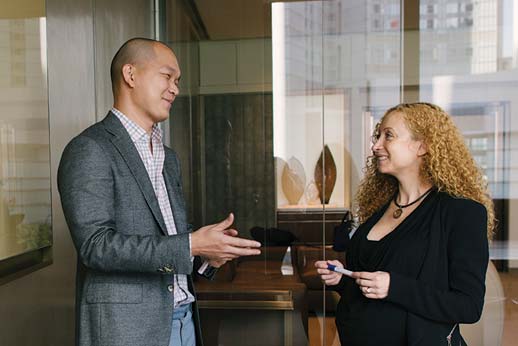
Shtarkman had moved to the city to work for ING Investment Real Estate Management, and was hoping to meet other Columbia Business School alumni. “I was still relatively new to Hong Kong, and I wanted to connect with the local Columbia Business School community and meet like-minded professionals,” she says. She went to a Columbia Business School alumni event at Kee Club, in the city’s Central District, where a mutual friend introduced her to Lin, who manages his family’s assets through a family office called Integrity Capital Management. The two became fast friends, bonding over shared interests in the real estate market, good food — and Columbia Business School.
“I am quite passionate about Columbia,” says Shtarkman, who grew up in Tel Aviv and came to New York for Columbia. She and Lin began working together to establish the Columbia Business School Alumni Network in Hong Kong, where there are about 400 alumni, sometimes holding events at 001, a bar Lin owns. Now, six years after meeting, they are leading their first business venture together — Atom Assets, an online platform that helps match Asian family offices with carefully curated real estate investment deals, mostly in the United States.
While working on Columbia events over the years, Shtarkman and Lin had talked on and off about a partnership, but the idea began to gel in March 2014, when the two met for sushi to celebrate their birthdays. Lin had been investing in real estate through his family office since 2005 and, he says, “I had been thinking for a while about how to bring together my real estate experience, board member role at Metis Financial, and my family office position. I realized that there’s a gap in the market for family offices and private wealth to access real estate deals.”
Lin explains, “Most family offices in Asia do not have the resources to find deals or operating partners in the United States, a laborious and time-consuming process. Also, the complex US tax laws can be a huge turnoff.”
Shtarkman told Lin, “I have that missing piece.” She had left Citibank (where she worked after ING) in 2012 to found a boutique advisory and investment firm, Orca Capital, through which she sources and structures real estate deals. Her expertise in real estate and countless connections to developers and operators in the States were what Lin needed. “If a particular investor in Asia doesn’t have an established relationship with a US operator on the ground, they are not going to be able to close and commit to transactions in the tight timelines that are prevalent in the market,” explains Shtarkman.
They launched Atom Assets in early 2015 and worked with Metis Financial to create an online platform where invited participants can choose from among investment deals vetted by Shtarkman and Lin. More than two dozen families are lined up to invest; the partners hope to have about 100 within the first year. Lin says the enthusiasm for Atom Assets has been strong. “Every time we mention it, people say, ‘Can I sign up right now?’” Indeed, the appetite for real estate investment among Asian family offices is growing. A UBS/Campden Wealth survey found that in 2013, real estate investment accounted for 16 percent of the portfolio of Asian family offices, compared with just under 9 percent the year before.
For Shtarkman, Lin closed a gap as well: he brings to the table access to his firm’s capital, not to mention relationships with other family offices. “The culture in Asia is that family offices want to invest with like-minded families; they want to know someone in the deal who is exactly in their shoes,” says Shtarkman.
Adds Lin, “Family offices in Asia want to do deals with each other. These relationships are built primarily on trust, which is a major factor in Asia as compared to the rest of the world.” They also say that they are the same as — and different from—one another in crucial ways. “Both of us have strong real estate backgrounds and are generally on the same page when it comes to company direction and development,” says Lin. “We are also open to debate with each other and formulating a solution based on our combined ideas.”
However, Shtarkman acknowledges that she is the extrovert of the pair. Lin agrees. “She’s in charge of networking,” he says. “I am more into developing strategic direction and dealing with the US taxes. We have a lot of complementary characteristics, so we have a great partnership.”
Noha Waibsnaider ’02 & Dawn Techow ’02
Noha Waibsnaider ’02 and Dawn Techow ’02 might never have met if not for an e-mail that went out in the winter of 2001 asking for volunteers to organize a fledgling social entrepreneurship competition at Columbia Business School. Techow recalls that first meeting taking place in “a large classroom with just three of us”—two of them Waibsnaider and Techow. They spent the year building the contest from the ground up.
At the time, they recall, comparatively few fellow students shared their interest in entrepreneurship or social responsibility. Techow had come to business school by way of advertising, thinking, “There must be a way to bring business skills to nonprofits.” Waibsnaider had worked in marketing but, when riots broke out amid the 1999 World Trade Organization meeting in Seattle, found herself “sympathizing with the protestors and thinking the only way things will genuinely change is from the inside.”
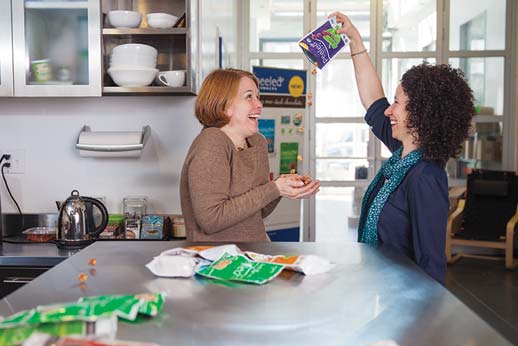
Now Waibsnaider is the founder and CEO of Peeled Snacks, which makes organic dried fruit and trail mix that is sold in 15,000 stores nationwide, including Whole Foods, Target, Starbucks, and through Amazon’s grocery service. (Author’s note: Apple-a-Plenty, a mix of raisins, walnuts, dried apple, and dark chocolate, might have fueled the writing of this story.) Until recently Techow was the COO, overseeing everything from sourcing mangos to handling inventory planning. Over the summer, she launched her own consulting firm, Relish Food Project, which coordinates sampling events at stores, a process that, between hiring and training people and coordinating product to arrive on time, is surprisingly time consuming, yet crucial. “For many natural foods products, tastings are the best marketing tool you have,” explains Techow. “They allow customers not only to try the product but also to interact and connect with the brand.”
Techow’s company now takes care of that crucial function for Peeled Snacks. “Each event ends up taking a ton of time, and they are literally taking all of that off our plate,” explains Waibsnaider. “Relish Food Project was able to do 50 events in just a month,” she adds, significantly more than the five or 10 Peeled Snacks was able to do with one in-house person.
These days, it seems like every would be entrepreneur is launching a socially responsible food business. But when Waibsnaider and Techow entered Columbia in 2000, the trend was still brewing. Everything changed their second year.
“I think 9/11 was a big part of it. At the Business School, it was the first time that everyone was like ‘Wow, what happened? Who are we in the world?’” remembers Waibsnaider. One month later the Enron scandal broke, she says, and “social responsibility suddenly became a bigger topic in business schools. People were talking about it. Classes were cropping up around it.”
After graduation, Waibsnaider worked for food and household products company Unilever. Witnessing the amount of high-fructose corn syrup, salt, oil, and preservatives (she remembers a meaty pasta sauce with a two-year shelf life) in the food was an eye-opener. “I would go down to the lab and talk to scientists, and they’d say, ‘I wouldn’t eat that stuff,’” she recalls. “I thought people deserved better.” Waibsnaider grew up in Israel, where dried fruit and nuts are popular snacks. She launched Peeled Snacks in 2005. Meanwhile, Techow worked for several organizations, including the American Museum of Natural History.
In 2008, Waibsnaider was preparing to go on maternity leave and needed someone to run Peeled Snacks. She and Techow had stayed in touch, so she included Techow in the mass e-mail she sent out with the job posting.
“I remember being like, ‘I’ll send this around. Actually, I’d like to do it,’” says
Techow; Waibsnaider remembers hoping Techow would say just that. When the two talked, they realized the partnership was a good fit. “I had a lot of admiration and respect for the company,” says Techow. “It was all the things we had talked about in school.” Plus, having planned the Columbia social entrepreneurship competition, the two knew they worked well together.
“I’m more extroverted and Dawn is more introverted,” says Waibsnaider. “At Peeled Snacks, I was more focused on fundraising and PR and marketing, and she was managing internally. We’re very complementary that way, which enabled me to not worry about the ops, because I knew she would kick ass and get things done.”
The first year of working together proved challenging. Waibsnaider’s baby came early, leaving Techow in charge of Peeled Snacks on her very first day. Then the economic collapse occurred, and banks began recalling the company’s loans. “We called the winter of ’08–’09 the winter of hell,” says Waibsnaider.
Then, in 2009, Starbucks called, wanting Peeled Snacks to be part of a national rollout of nutritious food options in the coffee chain’s stores. To this day, they are not sure how Starbucks learned of Peeled Snacks. It could be thanks to the samples the team had been sending to a friend whose bottled-water company, Ethos, had been acquired by Starbucks. Or the right executive may have picked up a bag at an airport, where Peeled Snacks has a large presence.
However it happened, it was a gamechanger. The company has won numerous awards from magazines for promoting healthy eating, including the Healthy Food Award from Fitness, Best Snack Award from Health, and the Eaties Award from Parenting. Waibsnaider herself was named a 2013 White House Champion of Change — the same year Inc. magazine named Peeled Snacks one of the country’s fastest-growing companies.
The company is now hitting its stride and is well positioned as food businesses become increasingly popular investments. It now has seven employees and shares a sunny loft space in the hip, semi-industrial neighborhood of Gowanus, Brooklyn, with Mother-in-Law’s Kimchi and A&B American Style pepper sauce. The white brick walls are decorated with painted rectangles of bright yellow, turquoise, and magenta and are well stocked with snacks bearing such signature catchy names as Cherry go-round, Pine-4-Pineapple, and Much Ado About Mango (for which it uses 1,500 tons of mangos each year). The mango concoction is the company’s most popular snack and the No. 1 organic snack at Google headquarters.
The two remain involved in Columbia, speaking on entrepreneurship panels and now advising the competition they helped to launch. Waibsnaider also credits management professor Michael Preston of the School’s Entrepreneurship Program for counseling her to start an advisory board, on which he serves.
The company continues to grow, and Waibsnaider says she still believes the widest possible distribution can effect the broadest change, even if it means eventually selling the company.
“It’s a social enterprise. First and foremost I feel good about our snacks,” she says. “My vision is huge distribution, to make healthful snacks as widely available to as many people as possible.”
Tom Heller ’05 & Michael Coleman ’05
When Michael Coleman ’05, a former tech entrepreneur, was applying to business school, there was one thing he knew for sure: he wanted to go somewhere he could also work on his movie, for which he so far had only the germ of an idea and the life rights to a chilling story. That meant New York or Los Angeles. So it was serendipitous that one of the 60-plus students in his cluster turned out to be Tom Heller ’05, who introduced himself to the class as a screenwriters’ agent and movie producer. That evening, at a mixer in Uris Hall, Coleman, Diet Coke in hand, approached Heller with his story about two Olympic wrestlers, brothers, and their relationship with a troubled heir to the du Pont fortune.
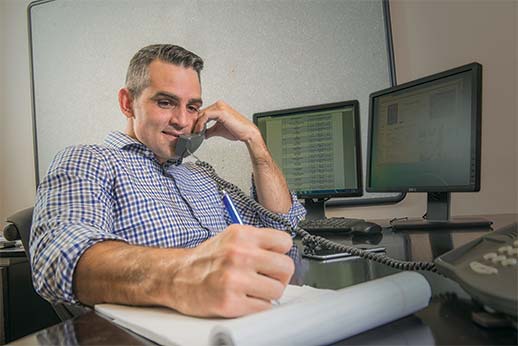
Heller is used to strangers’ screenplay pitches. “I was initially skeptical, thinking it was going to be some strange idea, but I found it fascinating right away,” he says.
Thus began a partnership and decadelong journey to make the thriller Foxcatcher, released in November 2014 to glowing reviews. The film stars Steve Carell as John du Pont, who sponsors an Olympic wrestling team at his estate.
Coleman had already been working on the project for a year and a half when he met Heller. He had been considering making a movie and had long been intrigued by the story of wrestler brothers Mark and Dave Schultz, played by Channing Tatum and Mark Ruffalo in the film, and their entanglement with the eccentric du Pont. (Foxcatcher was the name of the estate where du Pont formed the wrestling team for which he recruited the Schultzes.) Mark Schultz had coached Coleman’s brothers at Brigham Young University. “I did some research on the story and could tell that it had some pretty compelling elements. But it wasn’t until my brother Jared sent me a short autobiography Mark had written that I realized it could be something special,” Coleman recalls. “Everything that had been written about Foxcatcher focused on du Pont and Dave. Mark’s autobiography had a more personal story — his difficult family life, his bond with his brother, the inner demons that drove him, the pain he suffered physically and emotionally as a wrestler. In Mark I saw someone I thought audiences could root for, despite — and because of — his flaws.”
In the summer of 2002, Coleman met with Mark Schultz over pizza and told him the idea he had for the movie. “At the end he was crying,” recalls Coleman. “At that point, I was convinced that this movie had a chance.” Mark Schultz agreed to give him an option on his life rights, but that was as far as Coleman got before Columbia. “I hadn’t made much headway,” he says, “because I didn’t have many connections in the industry. I didn’t know how to navigate it.”
But Heller did. The two started meeting for lunch and coffee in Uris to discuss the project. “It had a lot of very interesting elements — true crime, a famous old family, the Olympics,” says Heller. “It was a compelling brothers story, and I thought that the character of du Pont, an eccentric multimillionaire, was fascinating.” While at Columbia they worked and reworked the treatment and pitched it to countless people who might be able to make it happen—from writers and directors to producers and investors. “Because we were on campus every day we’d keep talking about it, and because we didn’t have class on Fridays we’d fly out [to LA] early Friday morning and meet with different people,” recalls Heller.
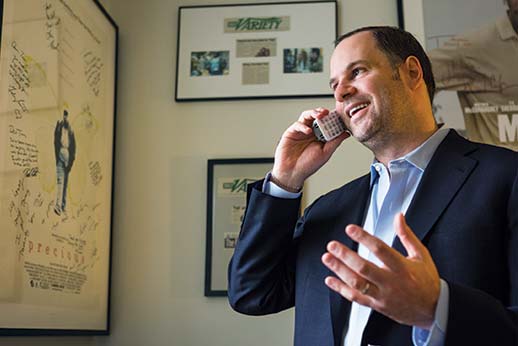
Tom Heller ’05
Heller also says the two made an ideal team. “We have very complementary skills,” he says. “Mike was a tech entrepreneur and a strong salesman. When we were in the room pitching the story, he was skilled at selling someone on an idea. Meantime, I had a lot of relationships in the industry, and I knew who we should be meeting with.”
In 2006, about a year after graduation, Heller took a gamble and approached the director Bennett Miller at a DVD signing at the old downtown Tower Records, on the corner of Broadway and East 8th Street. Miller had directed the much-acclaimed Capote the year before, and the dark, eerie movie had exactly the feel Heller and Coleman wanted for Foxcatcher. The director agreed to look at the treatment and presentation they had put together. He signed on several weeks later.
For the next eight years (a length of time Heller calls “a very extreme case”) the partners helped develop the movie, mostly by helping Bennett Miller learn everything he needed to know about wrestling. “We set him up on a number of research trips to events like the Dave Schultz Memorial and the New York Athletic Club wrestling tournaments,” says Coleman. “We took him to visit the Olympic Training Center to meet a number of people who knew Mark and Dave from their time at Foxcatcher. We also connected him with John Giura, a former teammate of Dave’s at Foxcatcher, who ultimately became the coordinator for all the wrestling in the movie.”
In the meantime, Heller also produced seven additional movies, including the critically acclaimed Precious, 127 Hours, and Mud. Coleman worked as a strategy and marketing executive at such companies as UBS, Booz Allen Hamilton, and Overstock.com. The two are close friends, attending one another’s weddings and getting together as often as they are able, although Coleman recently moved to Las Vegas, where he is doing digital marketing for Bank One. Heller is in New York and building his own production company.
The two did not see the final cut of Foxcatcher until its premiere in Cannes in May 2014, says Coleman. “It had been such a long, drawn-out process. It was kind of stressful right up to the end.” Still, the movie received a 15-minute standing ovation at the festival, an early bellwether for a film’s success.
“It was worth the wait,” says Heller. “It was the film Mike and I always envisioned when we were talking about it in school.”
Did you meet your business partner at Columbia Business School, or are you both alums? Share your story with us by emailing columbiabusiness@gsb.columbia.edu.