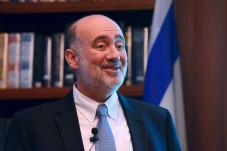
 If ever a country had the odds stacked against it, it’s Israel, according to Ron Prosor, chair of International Diplomacy at the Interdisciplinary Center Herzliya. At the recent Ira L. Rennert Speaker Series talk titled “Startup Nation: How Israel Turned Its Liabilities into Assets,” the former Israeli ambassador to the United Nations and a previous director general of the ministry of foreign affairs enumerated Israel’s drawbacks: “We live in a tough neighborhood. We lack water. We are a country of immigrants. Our economy is small,” he said. “Israel is a land of liabilities.”
Yet even as a nation of “no milk, no honey, no money,” Israel has managed to create an economy that ranks #1 in the number of per capita scientists and engineers in the workforce, #2 as a home of global startup hubs and research centers and #4 among all countries for patents granted.
How the Draft Creates Entrepreneurs
Prosor, in the first of three lectures slated for Columbia Business School’s 2016—2017 academic year, credited a combination of Israel’s people, government, and circumstances with the 68-year-old country’s entrepreneurial successes. It all begins, he said, with unifying the populace to tackle Israel’s problems. Case in point: the mandatory military service required of Israeli men and women over the age of 18.
The system was created, of course, to insure Israel’s homeland security. But it also serves as a training ground for skills that soldiers carry over into later life. New inductees are channeled into fields where they exhibit talent; for example, “the government has gotten good at identifying which students would do well in physics and material science within the military,” Prosor says. “It identifies who has leadership skills.”
While the military innovated to meet immense need, it passed some major advances along to private companies to implement, thus spurring entrepreneurship. Since the local market isn’t big enough to support world-class companies, many began to export out of necessity. “The country’s economy is so small [population: 7 million] that companies making cutting-edge technology need to sell outside Israel,” said Prosor.
By Prosor’s count, some 150 defense companies employ 50,000 Israelis and generate $3.5 billion in annual revenues. He highlighted several major innovations stemming from the military’s defense research and now sold by private Israeli companies, including an emergency hemorrhagic bandage developed by an Israeli military medic. First employed during peacekeeping missions in Bosnia and Herzegovina in the 1990s, the bandage is now used by numerous military and law enforcement agencies around the world and helped save the life of US Congresswoman Gabby Giffords when she was shot in 2011.
Although the government funds defense projects outright, it also encourages venture capital for private enterprise. Its yozma (Hebrew for “initiative”) approach doubles any investment funds. Prosor estimates 70+ venture funds poured $3.6 billion into Israeli companies in 2015, the highest per capita rate in the world.
New Liabilities
Prosor suggested three hurdles that Israel should add to its list of problems in the 21st century:
-
Between 20 percent and 25 percent of the population isn’t high-tech users or innovators. The opportunity involves pulling Orthodox Jews, Arabs and other less inclined groups into Israel's startup culture. That, says Prosor, means targeting better education to this non-participating demographic.
-
Israel’s economy remains firmly linked to the United States. Although Prosor doesn’t expect any decline in its relationship with America, “we have to broaden trade to markets that insure growth,” he said, specifically mentioning China, India, and Vietnam. A particular global opportunity could involve driverless cars that require not just new technology but new regulations to cover legal and insurance issues. “Israel can become the testing ground of how new regulation will work” in an era of driverless cars, he predicted.
-
The BDS Movement, meant to apply boycott, divestment and sanctions to pressure Israel to withdraw from Palestinian territories and the Golan Heights. Prosor also worries that the disintegration of nation states in the Middle East could lead to greater acts of terrorism aimed at Israel and elsewhere, which in turn could disrupt not just the business marketplace but society in general. “Non-state actors like ISIS and Hezbollah have more firepower than many nations, but without the responsibilities of governments," he said.
Still, Prosor remains convinced that Israel knows how to turn its liabilities into opportunities. Paraphrasing former Israeli president Shimon Peres, he said: “The biggest contribution that Jews have made to the world is dissatisfaction.” Rather than create a fatalistic sense of despondency, though, the trait has spurred innovation.
Similarly, he credited the prototypical Jewish mother as Israel's not-so-secret motivator. “Every Jewish mother is convinced that her son or daughter is a genius,” he shrugged. “If they fail, the mother says, ‘Okay, the world will find out. Try again.’ What other cultures might consider a great failure, a shunda, in Israel becomes a challenge.” This dogged can-do approach, said Prosor, has “created what we have. It has made Israel a startup nation.”