 What do you do if you’re a young, hip Cuban Libre and passionate about starting your own clothing brand in a country that demonizes capitalism? The State says you can’t advertise, hire workers or open a retail outlet, and getting raw materials is next to impossible.
If you’re cofounders of Clandestina, you capitalize on both the country’s history and its newly minted liberalizations as Cuba opens its borders. The company aims to bring to the new Cuban market “the social and cultural legacy of a past Cuba — the revolutionary and glamorous periods together,” executive director Leire Fernández said in a recent presentation at Columbia Business School’s Entrepreneurship and Competitiveness in Latin America program, in which she was a participant. (Associate Professor Eva Ascarza and Professor Mark Cohen were the company’s advisors.)
Launched around the designs of creative director Idania del Río in 2013, Clandestina has continually strengthened its business model as the cofounders found ways to work through myriad roadblocks.
Today the company makes and sells posters, cotton bags, jewelry, and casualwear — including its signature T-shirts — from two retail outlets in Cuba and through partners in the United States.
99% Diseño Cubano
Fernández, a Spanish citizen working for UNESCO in Cuba, and del Río, a 2004 graduate of Cuba’s Institute of Design, first realized they might have a business when, in 2011, President Raúl Castro began licensing owners of private restaurants, beauty salons, and other sole proprietorships to hire workers. So called cuentapropistas (self-employed persons) were permitted under a 1990s law, but letting them add employees goosed the number of entrepreneurial businesses from an officially recognized 157,000 to 357,000 within a year, and the movement has reached a half-million by now.
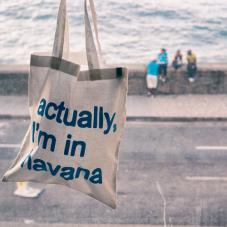
As they waited to obtain their license, del Rio and Fernández built a business model based on del Río’s T-shirt designs. With silkscreen logos boldly declaring slogans such as “99% diseño cubano” (99% Cuban design) and “Actually, I’m in Havana,” “our brand represents a core and revolutionary vision of design, which is at the heart of all Clandestina products,” explained del Río.
The first 3,000 finished products were manufactured in the Dominican Republic and imported back to Cuba for sale at the art gallery operated by del Río. (The name of her gallery and the company’s brand was inspired by the film Clandestinos, which chronicles young Cuban revolutionaries.)
Production in another country was cumbersome, especially given Cuba’s import laws. But Cuba had — and still has — a shortage of skilled workers and, even more troubling, not enough cotton or textile material to support manufacturing.
Both problems were solved by leveraging resources in their backyards. The entrepreneurs hired a group of elderly seamstresses from del Río’s hometown who had worked in a textile factory that closed more than 20 years ago. For raw materials, Fernández and del Río shopped in Cuba’s ubiquitous “rag stores,” which sell used clothing by the pound that the government has bought overseas. Del Río reimagines the second-hand dresses and university T-shirts as Clandestina products, and the seamstresses dismantle and reconstruct them, silk-screening each with the company’s slogans and logo.
Tapping a local investor, bought and outfitted an old house outside Havana to serve as their factory. They opened their storefront in Old Havana in early 2015.
“We Need Better Smuggling”
Since the company’s early days, the entrepreneurs have supplemented their textile supply by transporting additional old clothing, mostly from the United States, in suitcases and scrounging any materials they can find. Fernández, as a Spanish citizen, can legally buy imports from America.
Noting that 80 percent of Clandestina’s products derive from “upcycling,” Fernández admitted that “supply remains a big issue” as the company moves to double production this year. “We need better smuggling,” joked del Río, who said, more seriously, that Clandestina is in talks with suppliers in the United States.
Marketing primarily to Havana’s souvenir trade, the two put out feelers to guidebook publishers and travel websites to include their shop and even wrote their own tourist handbook, The Clandestina Guide to Havana. They also struck up a partnership with Carnival Cruise Lines to direct passengers to their storefront. They note proudly that customers have included such famous names as Madonna and Tilda Swinton. President Obama reportedly bought T-shirts for Sasha and Malia during his historic visit to Havana in March 2016.
Clandestina also went international last year, opening sales outlets in Miami with Fathom Cruises and Books & Books, as well as contracting for some US production.
Still, said del Río, “the local customer is our future,” noting that Cuba’s emerging middle class appreciates Clandestina’s “humor and political statements.” The company’s pricing policy makes the product affordable. A Che T-shirt, for example, is offered to locals for one-third of the $17 that tourists pay.
This year’s goals include stepping up e-marketing and social media exposure through a newly designed website and cheeky blog posts. They also plan to open a third retail outlet and formalize training of new hires.
Clandestina’s methods of operation will undoubtedly change, and the founders are ready for that, whatever direction the wind blows. As they pursue growth, they are intent on adhering to their core principles. Says Fernández: “Our culture is to enjoy Havana and the current Cuba….Recycle, up-cycle, do a high social-impact business.”