The Center on Global Brand Leadership and the New York American Marketing Association (NYAMA) are pleased to release the results of a major new study on the changing practices of large corporations in:
- data collection and usage,
- marketing measurement and ROI, and
- the integration of digital and traditional marketing.
The BRITE-NYAMA Marketing Measurement in Transition Study was authored by David Rogers, Executive Director of BRITE, and Columbia Business School Professor Don Sexton. Results were first released at the Center’s fifth annual BRITE conference on May 5, 2012. The findings have been reported in numerous publications, including the top front-page story of Ad Age.
The study’s results focused on 3 main findings:
- The failure of “Big Data” for marketing
- Marketers are quick to adopt the newest digital tools, but struggle to measure them
- ROI – marketers know they need it, but cannot agree on its meaning and implementation
The full report can be viewed at http://j.mp/MarketingROIstudy.
FINDING: THE FAILURE OF BIG DATA FOR MARKETING SO FAR
The researchers found that marketers’ desire to be data-driven is not yet matched by a consistent effort to collect the data necessary to make these real-time decisions. 29 percent report that their marketing departments have “too little or no customer/consumer data.” When data is collected by marketers, it is often not appropriate to real-time decision making. 39 percent of marketers say that their data is collected “too infrequently or not real-time enough.” Furthermore, marketers today are still much less likely to collect new forms of digital data like customer mobile device data (19 percent collect it), and social media data (35 percent), than they are to collect traditional customer survey data on demographics (74 percent) and usage (60 percent).

FINDING: MARKETERS ADOPT NEW DIGITAL TOOLS, BUT STRUGGLE TO MEASURE THEM
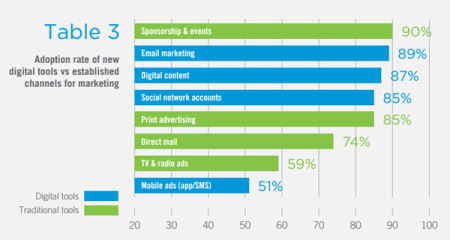
Marketers are also struggling to measure the impact of the newest digital tools, despite the widespread adoption of these applications. 51 percent of marketers said they use mobile ads (in-app, or SMS); 85 percent use social network accounts (brand accounts on Facebook, Twitter, Google+, and Foursquare). Yet these tools are among the least likely to be measured for ROI despite their profusion of data. Only 14 percent of the social networking users are tying them to financial metrics, and only 17 percent of those using mobile ads are tying them to financial metrics. By contrast, 41 percent of email marketers measure their results with financial metrics. In addition, as number of marketing tools expands, the challenge of measuring and comparing them grows. 60 percent of companies report that comparing the effectiveness of marketing across their different digital media is “a major challenge.”
FINDING: ROI – MARKETERS KNOW THEY ALL NEED IT, BUT CAN’T EVEN AGREE WHAT IT IS
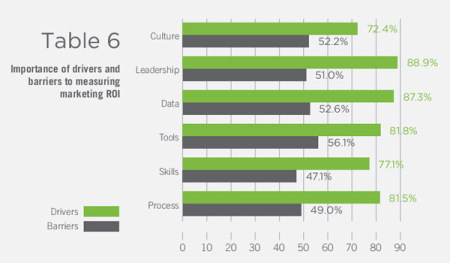
The study also revealed that there is confusion about the meaning and significance of ROI among marketers. Specifically, 31 percent of respondents said that they believe simply measuring the audience you have reached is “marketing ROI.” 57 percent are not basing their marketing budgets on any ROI analysis, and 28 percent are basing marketing budgets on gut instincts. 21 percent are using financial metrics for “little” or “none” of their marketing budget and seven percent are spending most or all of their marketing budget with “no metrics” at all. However, marketers are under pressure. 70 percent say that their marketing efforts are under greater scrutiny than in the past.
CONCLUSIONS: FIVE IMPERATIVE ACTIONS FOR CMOS
After its analysis of the dynamic and challenging environment for marketing today, the report recommends that Chief Marketing Officers should focus on five key leadership imperatives: Set objectives first; Design metrics to ensure marketing is linked to these objectives; Gather the right data for those metrics; Communicate to the entire organization what your objectives are and how they are being measured; and Evaluate and reward employees in part on how well objectives are achieved.
Read the complete findings and conclusions at http://j.mp/MarketingROIstudy.
# # #
METHODOLOGY
253 corporate marketing decision makers, director-level and above, were surveyed online between January 27 and February 8, 2012. These professionals are employed at large companies (90 percent have a global annual revenue of over $50 million; 45 percent are over $1 billion). Respondents were from b2c and b2c companies in diverse industries. The study was made possible with support from Research Now and GreenBook.
ABOUT THE RESEARCH PARTNERS:
The Center on Global Brand Leadership was founded at Columbia Business School in 1999 and has grown into the leading global forum on brands. The mission of the center is to turn the research and intellectual capital of academia’s foremost thinkers on branding into practical tools and insights for real-world application. The Center has worked with a wide range of sponsor companies to develop a variety of thought leadership including: conferences, case studies, videos and webinars, and sponsored research. The Center’s flagship BRITE conference on brands, innovation, and technology presented was founded in 2008 and is presented each spring at Columbia University. BRITE ’12 speakers included John Hayes (CMO, American Express), Marc Speichert (CMO, L’Oreal USA), and Bob Garfield (host of On the Media, editor for Ad Age).
The New York American Marketing Association (NYAMA) helps marketing professionals navigate to success in today’s dynamic business environment. We serve the marketing community by giving members opportunities to push the boundaries of marketing, expand their skills and exchange ideas with other experienced professionals. The BRITE/NYAMA study is one example of how we are contributing to the advancement of marketing.
Research Now is the leading global online sampling and online data collection company. With over 6 million panelists in 38 countries worldwide, Research Now enables companies to listen to and interact with real consumers and business decision makers in order to make key business decisions. Research Now offers a full suite of data collection services, including social media sampling, and operates the Valued Opinions(tm) Panel and e-Rewards(r) Opinion Panels. The company has a multilingual staff located in 24 offices around the globe and has been recognized for four consecutive years as the industry leader in client satisfaction.
GreenBook® brings stimulating, practical, and timely resources to marketers and market researchers on both sides of the table. Through its targeted multi-media platform, GreenBook offers effective marketing and lead generation opportunities to businesses that communicate with buyers and users of market research.