
Here in the United States, we’re all too familiar with the concept of “road rage,” often finding ourselves lambasting other drivers for their blatant disregard for the rules and safety of the road, only to be met with expletives, hand gestures, and even indifference.
As we know, this problem isn’t unique to the U.S. But countries tackle these perils in various ways. Columbia Business School, with the support of the Center on Global Brand Leadership, recently published “Cheyef Halak: Driving Social Change in Lebanon,” a case study on how one country took on this challenge, but with a greater purpose in mind—to build an advocacy program inciting overarching social change.
In 2011, LBCI, a popular television network in Lebanon, with then Interior Prime Minister, Ziad Baroud, and Impact BBDO, created the award-winning Cheyef Halak campaign. Cheyef Halak integrates marketing and social media with sardonic messaging to address reckless driving in Beirut. But it isn’t solely about negligent drivers. Rather it used this topic as a launching pad to address a range of issues encompassing internal corruption and civic responsibility.
Described as a “civic movement based on citizen journalism,” Cheyef Halak is a platform on which Lebanese citizens photograph and report irresponsible and dangerous behaviors of individuals who consider themselves above the law. Pictures and videos of violators in action are posted on Cheyef Halak’s Facebook page and Twitter feed, creating what has been referred to as a “Wall of Shame.”
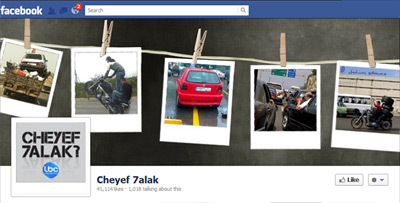
The phrase itself means “Do you see yourself?” but is more commonly understood in sarcastic terms as “Are you proud of yourself?” Instead of taking a patronizing tone, however, the campaign incorporates commercials and outreach embodying a more satirical personality, using irony and humor to engage its audience.
Through traditional and emerging media, the campaign took off with measurable success. Within its first seven months, citizens captured over 2,300 road incidents and posted 100 videos. By the end of 2011, its Facebook page had attracted 27,000 “Likes” and its videos had garnered 68,000 views, now at more than 41,000 and 131,000, respectively. Not bad for a country with only 4.1 million people, about half the size of New York City’s population. It also won the 2011 Gemas Effie gold award for best use of corporate social responsibility, as well as several awards from MENA Cristal and Dubai Lynx.
Support for the cause has caught on with schools and other institutions. And in December 2011, the collected photos and videos were submitted to the current Interior Minister for potential use in policy initiatives.
LBCI and Impact BBDO must now consider challenges as they look towards the campaign’s future. The founders are taking into consideration long-term sustainable impact, keeping messaging fresh and inspiring, raising funds, and whether they can effectively broaden the effort to tackle other areas of political and social strife.
The team remains confident that its initiatives will continue to grow, and as Prof. Asim Ansari and his fellow case writers note, “[The campaign] had empowered everyday Lebanese to become change agents able to track, report, and capture violators when state agencies were unwilling to do so.”
“Cheyef Halak: Driving Social Change in Lebanon” was a collaborative effort written by Columbia Business School’s Prof. Asim Ansari, Prof. Kamel Jedidi, Ziad Naamani (MBA ’12), Prof. Scott Schriver, and Prof. Olivier Toubia.