
The most important decisions a leader makes are never straightforward. Whether you’re charting a corporate strategy or making tough budget cuts, multiple criteria come into play. Without some means of evaluating and prioritizing these criteria it’s nearly impossible to act with intent and integrity.
That’s why gaining clarity about your own personal values is crucial. Paul Ingram, a Chazen Senior Scholar and the Kravis Professor of Business at Columbia Business School, has developed a simple (but profound!) exercise that can help pinpoint your top values. This knowledge can help you make better decisions that will bolster both your personal and professional goals.
Ready to give it a try?
- Think about a current workplace situation, or one from your recent past. It could be Why is this situation important to you? Does it provide (or test) your integrity, your performance, your loyalty? Put a concise label on why this situation matters.
- Now, come up with three other words that describe why this situation is personally important. Write each of these values on a separate Post-It note.
- Next, rank your values from most important to less important. Although all are crucial to you, one or two will inevitably bubble up to the top of the list.
Here’s an example: Cheryl works as the executive director of a 20-person local nonprofit agency devoted to alleviating food insecurity among lower-income families. She’s getting ready for a meeting with the organization’s board. Thinking about the dynamics of the relationship with her board, she came up with four values that are important to her.
- Respect: It’s important that the board see her as a capable professional who is committed to helping the organization grow and achieve its mission.
- Integrity: She wants to be proud of the work she does
- Performance: She wants to produce results that will improve the lives of the people whom the nonprofit serves.
- Expertise: She wants to make sure she has the tools and knowledge to produce optimal results.
Now, think about an important decision you’re facing. In Cheryl’s case, she has been asked to chair a committee for a national association dedicated to the issue of food insecurity. She’s honored to be asked, but she’s not sure she has the time.
Cheryl will write her your two choices — accept the position or turn it down — at the top of the page on which she has listed her values. She’ll think about each choice and on a scale of 1 to 7, decide how completely each of her values will be satisfied, with 1 being the lowest (not satisfied at all) and 7 being the highest.
Here’s how her worksheet looked:
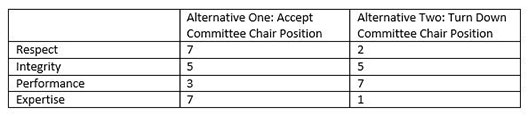
Of course, both choices have their merits. Chances are, she’ll advance in her career no matter which option she chooses. Satisfying her values isn’t the only determinant of good decision making. Her level of commitment — how completely she’ll follow through with excellent execution — matter a lot.
She’s excited about the possibility of making an impact on the national level but is worried she’d be shortchanging her employer. She wants to be “all in” in everything she does.
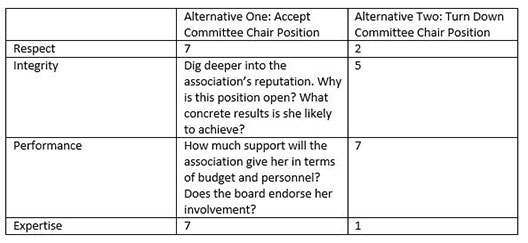
Cheryl should look again at the option that scored highest for her: accepting the committee chair position. Looking at that scored lowest within this option (for her, these were integrity and performance). Are there steps she can take to make the project more palatable and bump up the scores?
Leadership, says Ingram, is sometimes characterized as “bringing others with you.” A requirement for that connection is authenticity. Surfacing your values is an important step in self-awareness — and in motivating others.
ABOUT THE RESEARCHER
 Paul Ingram
Paul Ingram is the Kravis Professor of Business at Columbia Business School, and Faculty Director of the Advanced Management Program, Columbia’s flagship... Read more.