Official Logo of Columbia Business School
Academics
  • Visit Academics
  • Degree Programs
  • Admissions
  • Tuition & Financial Aid
  • Campus Life
  • Career Management
Faculty & Research
  • Visit Faculty & Research
  • Academic Divisions
  • Search the Directory
  • Research
  • Faculty Resources
  • Teaching Excellence
Executive Education
  • Visit Executive Education
  • For Organizations
  • For Individuals
  • Program Finder
  • Online Programs
  • Certificates
About Us
  • Visit About Us
  • CBS Directory
  • Events Calendar
  • Leadership
  • Our History
  • The CBS Experience
  • Newsroom
Alumni
  • Visit Alumni
  • Update Your Information
  • Lifetime Network
  • Alumni Benefits
  • Alumni Career Management
  • Women's Circle
  • Alumni Clubs
Insights
  • Visit Insights
  • Digital Future
  • Climate
  • Business & Society
  • Entrepreneurship
  • 21st Century Finance
  • Magazine
CBS Photo Image
Steel
  • More 

Steel Sector Overview

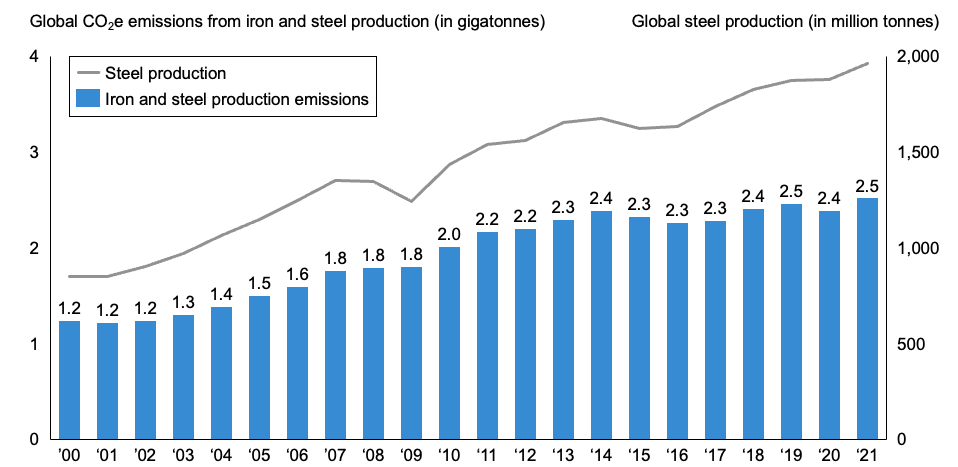
Global steel emissions have more than doubled since 2000 (from 1.2 gigatonnes in 2000 to 2.5 gigatonnes in 2021). 

Jump to main content

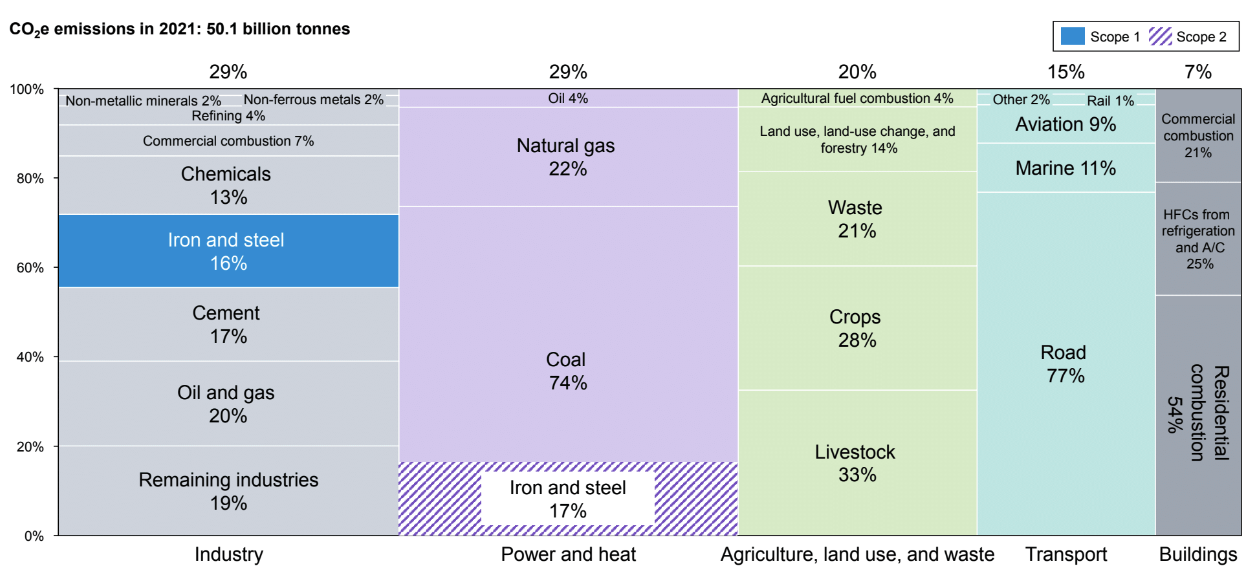
The global steel sector is responsible for approximately 6% of global CO2e emissions

  • Global steel emissions have more than doubled since 2000 (from 1.2 gigatonnes in 2000 to 2.5 gigatonnes in 2021). However, emissions have started to decouple from production levels since 2016
  • Without intervention, emissions are expected to continue growing due to rising demand from emerging economies. Reaching net zero by 2050 would require a 25% emission reduction by 2030

Steel is currently produced through three main production routes that all emit CO2:

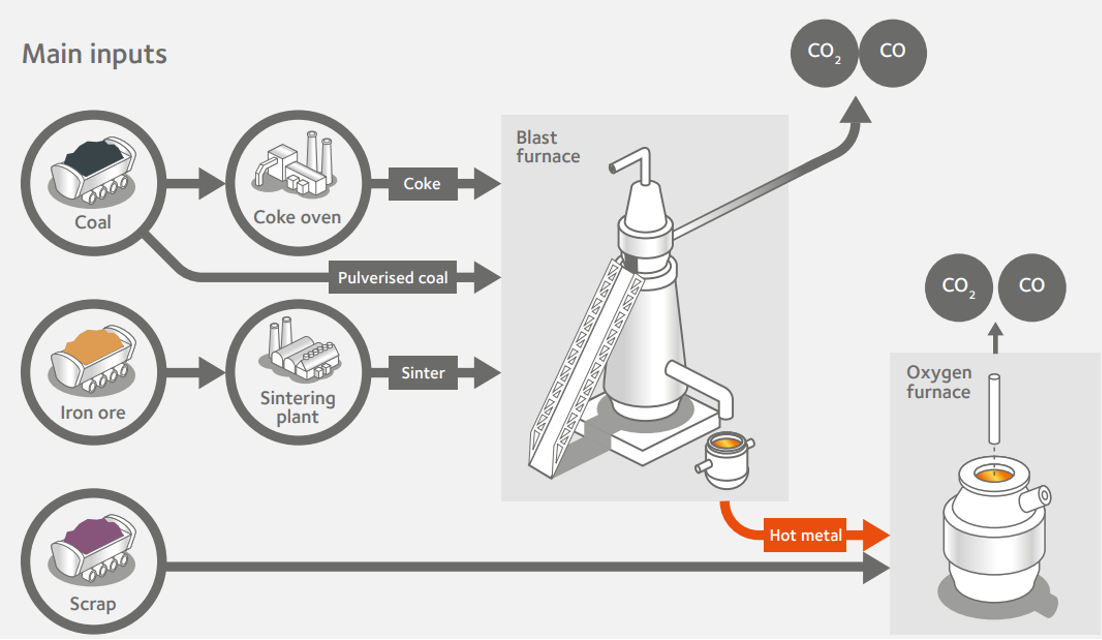
  • Blast Furnace – Basic Oxygen Furnace (BF-BOF):73% of global steel production. Uses coke and limestone to produce pure iron from iron ore in a blast furnace, which is then turned into steel in an oxygen furnace
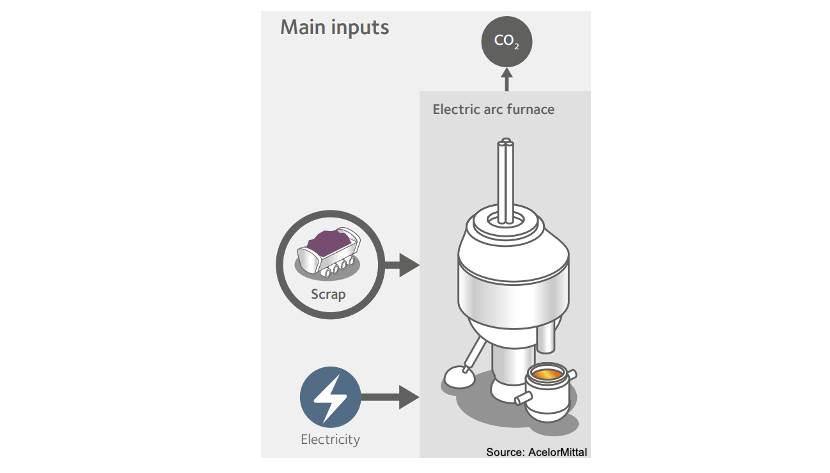
  • Scrap Electric Arc Furnace (Scrap EAF): 22% of global steel production. Scrap metal is melted in an electric arc furnace using electrical energy
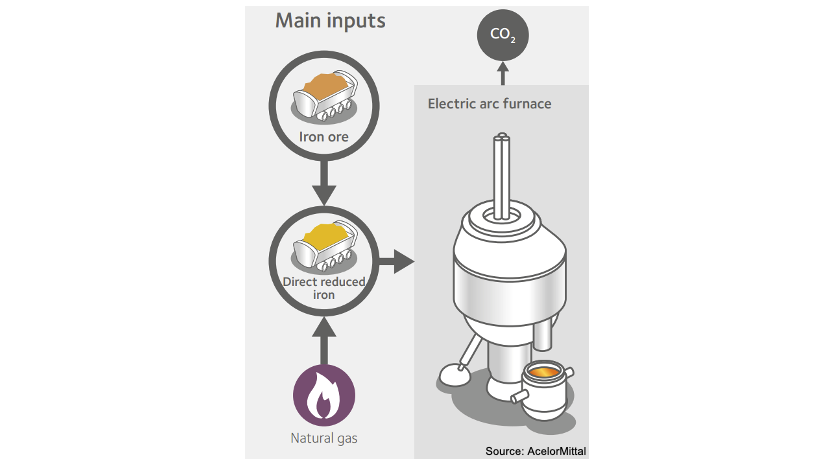
  • Natural Gas-based Direct Reduced Iron – Electric Arc Furnace (NG DRI-EAF): 5% of global steel production. Iron ore is turned into iron using natural gas, which is then melted in an EAF to produce steel

On average BF-BOF is the cheapest production method ($390 vs. $415 for Scrap EAF and $455 for NG DRI-EAF). However, regional variations in costs (such as raw material and fuel) make all three methods competitive

  • Downstream activities after crude steel making (e.g. refining, casting, rolling) represent less than 20% of the total steel production emissions
  • Because steel is a 100% recyclable material, increased use of scrap metal can help to decarbonize the steel sector

CKI Team analysis: Credit Mimi Khawsam-ang, Max de Boer, Grace Frascati & Gernot Wagner (18 December 2023); share/adapt with attribution. Contact: gwagner@columbia.edu

CBS Photo Image

Steel sector scope 1 and 2 emissions ~10% of global emissions

CBS Photo Image

Citation:

Source: Scope 1 emissions from Rhodium Group ClimateDeck (September 2023); Scope 2 iron & steel estimate from IEA (2023) Credit: Mimi Khawsam-ang, Max de Boer, Grace Frascati & Gernot Wagner (18 December 2023); share/adapt with attribution. Contact: gwagner@columbia.edu

Global CO2e emissions decoupled from steel production post-2016

Global steel emissions have more than doubled since 2000, with emission growth decoupled from production growth after 2016

CBS Photo Image
Note: Close to all of the iron produced globally is used for the production of steel. Source: Rhodium Group ClimateDeck, World Steel Association, McKinsey – Decarbonization in Steel,
IEA – CO2 Emissions, Reuters – China 2021 Steel Output. Credit: Mimi Khawsam-ang, Max de Boer, Grace Frascati & Gernot Wagner (18 December 2023); share/adapt with attribution. Contact: gwagner@columbia.edu

Observations:


  • In recent years, the steel industry has made efforts to reduce its carbon footprint with more energy-efficient processes and technologies
    • Though not enough by itself, recycling rates have improved (sitting around 80%-90% globally) 
    • Better manufacturing yields have made supply chains more efficient 
    • Enhanced control processes and predictive maintenance strategies have led improvements in operational efficiency

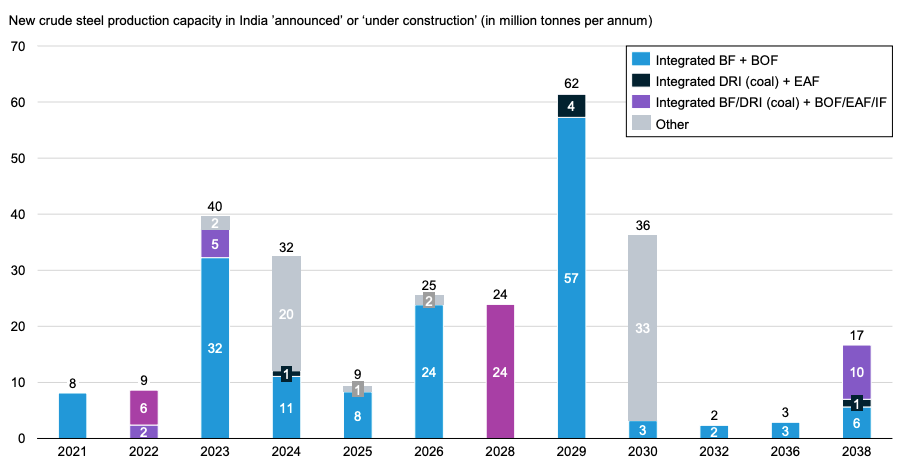
India's new crude steel production capacity (2021 - 2038E)

India is one of the fastest growing steel producers, and set to continue use of blast furnaces to meet rapid demand

CBS Photo Image

Observations:

  • India is now the world’s second largest producer of crude steel, and it has typically been a net exporter post FY2016-17, apart from economic downturns
  • Because of continued investment, India’s steel making capacity is expected to hit 300 mm tonnes per annum by 2030-31
    • To meet demand, India is set to build at least 200 MTPA of new fossil-fuel based, emission-intensive steel production capacity over the next 15 years
    • 68% of this capacity is expected to be blast furnaces
    • Remaining 32% expected to be from other processes like integrated BF + BOF

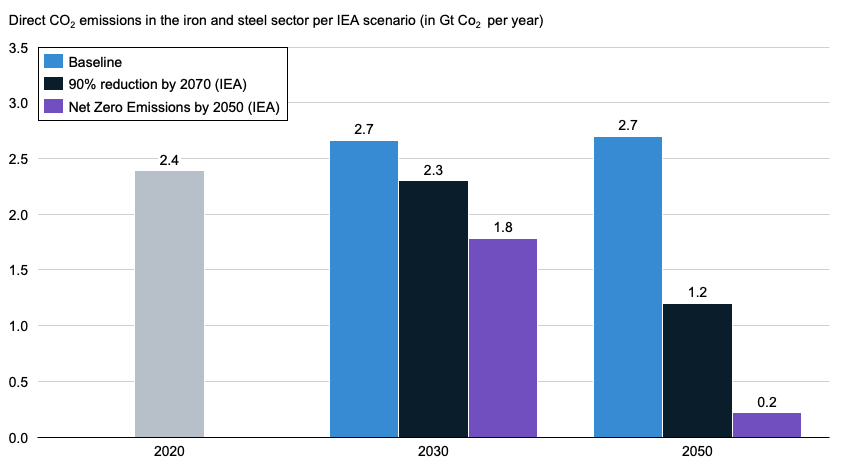
Global iron and steel emissions expected to rise without intervention; future reduction scenarios will require drastic cuts

CBS Photo Image


Notes: Baseline scenario reflects the policies and implementing measures that have been adopted as of September 2022 NZE = Net Zero Emissions. Source: IEA (2020), IEA Net Zero by 2050 (2021),
IEA
Iron and Steel Technology Roadmap (2020), McKinsey (2023). Credit: Mimi Khawsam-ang, Max de Boer, Grace Frascati & Gernot Wagner (18 December 2023); share/adapt with attribution.
Contact:
gwagner@columbia.edu

Observations:

  • If no action is taken, global emissions from the iron and steel sector are expected to peak at 2.7 gigatonnes per year in 2050
    • Increase in emissions attributable to growing steel demand from emerging economies
    • Over time, gradual shift in demand is expected from China to India, Southeast Asia and Africa
  • The International Energy Agency (IEA) has developed several possible pathways for the steel industry:
    • In the 90% reduction by 2070 pathway, emissions would still need to drop by 50% by 2050
    • In the net-zero emissions by 2050 pathway, emissions would already need to drop by 25% by 2030, and drop to close to zero by 2050

Crude Steel Methods that emit C02:

Blast Furnace-Basic Oxygen Furnace (BF-BOF)

Iron ore, coke, and limestone produce pure iron in a blast furnace, which is turned into steel in an oxygen furnace

Iron ore, cooking coal

73% of Global Steel Production

2.32 tonnes

24.42 GJ

$390

Scrap metal is melted in an electric arc furnace using electrical energy

Scrap steel, electricity

22% of Global Steel Production

0.67 tonnes

10.04 GJ

$415

Iron ore is turned into iron using natural gas, which is then melted in an electric arc furnace to produce steel

Iron ore, Natural Gas

5% of Global Steel Production

1.65 tonnes

25.29 GJ

$455

Blast Furnace-Basic Oxygen Furnace (BF-BOF) Process

BF-BOF is the cheapest, most popular, and most polluting process which relies heavily on coal

CBS Photo Image

Process Description:

  • In the first step, coking coal and limestone is mixed with iron ore in a Blast Furnace (BF) to perform iron reduction and obtain molten crude iron
  • At this stage, up to 30% scrap steel can be added

Observations:

  • BF-BOF accounts for 73% of global steel production
  • China, the world’s #1 steel producer, accounts for >50% world output and uses BF-BOF for 90% of steel production
  • Both steps in the BF-BOF process produce CO2 as a byproduct. On average, BF-BOF emits 2.32 tonnes of CO2 per ton of crude steel – the highest amount of the three conventional steel routes
  • BF-BOF remains cheapest means of steelmaking, with average production cost of $390/tonne

Scrap EAF Process

Scrap EAF is a cleaner steel making method that uses an Electric Arc Furnace to recycle scrap steel

Blast Furnace-Basic Oxygen Furnace (BF-BOF)

CBS Photo Image
Source: MIDREX (2021), ArcelorMittal (2021), World Steel Association (2021), IEEFA (2022), IEA Iron and Steel Technology Roadmap (2020), Columbia Center on Global Energy Policy (2021).
Credit: Mimi Khawsam-ang, Max de Boer, Grace Frascati &
Gernot Wagner (18 December 2023); share/adapt with attribution. Contact: gwagner@columbia.edu

Process Description:

  • Scrap EAF takes collected scrap steel as input
  • An Electric Arc Furnace (EAF) converts electricity into heat which is used to melt scrap steel into crude steel

Observations:

  • Scrap EAF accounts for 22% of global steel production, but use of technology is limited by the scarcity of scrap material
  • Cleanest conventional route, emitting 0.67 tonnes of CO2 per ton of steel (71% less than BF-BOF)
  • EU and US lead in scrap EAF production, accounting for ~40% of their steel production
  • Scrap EAF average cost of production of $415/ton – but cost fluctuates based on scrap and electricity prices

Natural Gas-Based Direct Reduced Iron – Electric Arc Furnace (NG DRI-EAF) Process

DRI-EAF is less common and uses natural gas to reduce iron ore to pure iron, which then enters into an EAF to make crude steel

CBS Photo Image
Source: MIDREX (2021), ArcelorMittal (2021), World Steel Association (2021), IEEFA (2022), IEA Iron and Steel Technology Roadmap (2020).
Credit: Mimi Khawsam-ang, Max de Boer, Grace Frascati &
Gernot Wagner (18 December 2023); share/adapt with attribution. Contact: gwagner@columbia.edu

Process Description:

  • Iron ore is mixed with natural gas in a Direct Reduced Iron (DRI) shaft to perform iron reduction and obtain pure iron
  • The iron is then fed into an Electric Arc Furnace (EAF) where it is converted into crude steel

Observations:

  • DRI-EAF accounts for remaining 5% of global steel production and is most dominant in the Middle East and Africa, where gas is cheap and abundant
  • Natural gas is a cleaner reduction agent than coal. DRI-EAF on average emits 1.65 tons of CO2 per tonne of crude steel, 29% less than BF-BOF
  • DRI-EAF is the most expensive conventional production route at $455/ton

BF-BOF Production Methods

BF-BOF is the cheapest production method, but regional cost differences impact margins across production methods

Regional cost differences cause all steel making methods to be competitive


CBS Photo Image

(*) Average steel price based on Hot Rolled Coil Steel Futures Continuous Contract (HRN00), average of 2019 monthly prices. Source: MarketWatch (2019) McKinsey,IEA Iron and Steel Technology, Roadmap (2020), European Commission Joint Research Centre Science for Policy Report (2016). Credit: Mimi Khawsam-ang, Max de Boer, Grace Frascati & Gernot Wagner (18 December 2023); share/adapt with attribution. Contact: gwagner@columbia.edu 

Observations:

  • Profit margins across the industry are slim – the average EBITDA margin of steel producers over the past 10 years was 8-10%
  • Raw material and fuel prices can cause strong fluctuations in margins, given that these typically make up between 60-80% of total production costs
  • While some of these markets are global (iron ore), others are more regional (e.g. electricity, scrap steel) which can drive regional cost differences
  • Labor costs, feeding into fixed OPEX, are typically higher in advanced economies than in emerging economies
  • CAPEX for production equipment is usually consistent across regions. However, engineering, procurement and construction costs can vary significantly

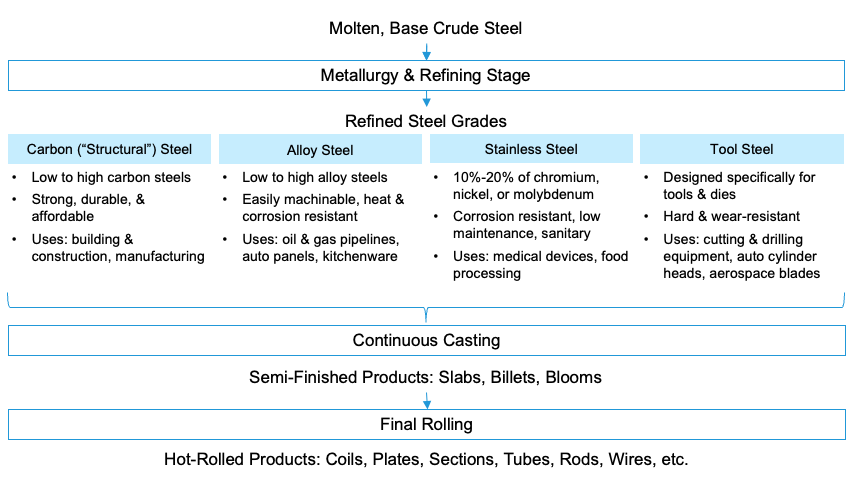
Downstream Steelmaking Process

Downstream activities post-crude steelmaking use process heat and represent <20% of total steel production emissions 

CBS Photo Image
Source: World Steel Association, Association for Iron & Steel Technology, Eziil, Industrial Metal Supply, Steel Manufacturer’s Association Steelmaking Emissions Report (2022). Credit: Mimi Khawsam-ang, Max de Boer, Grace Frascati & Gernot Wagner (18 December 2023); share/adapt with attribution. Contact: gwagner@columbia.edu

Observations:

  • On average, <20% of steelmaking CO2 emissions come from downstream processes
  • Metallurgy involves adding alloys in hot ladle to convert base crude steel into different types of refined steel (carbon, alloy, stainless, or tool)
  • Common alloys: manganese, chromium, cobalt, nickel, tungsten, molybdenum, vanadium
  • Refining step traps and removes impurities through processes like stirring molten steel with gas like argon
  • Continuous casting molds liquid steel into semi-finished products, usually slabs, billets, or blooms
  • Finally, the steel goes through a number of different finishing processes (e.g. hot or cold rolling, galvanizing) depending on the intended end use of the steel

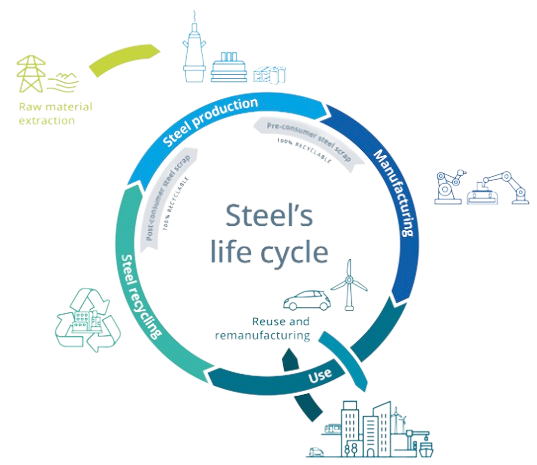
Steel 100% recyclable material; increased use of scrap in primary and secondary routes expected to help decarbonize sector

CBS Photo Image
Source: World Steel Association (2020), World Steel Association Scrap use in the steel industry (2021), World Steel Association Fact sheet: Raw materials in the steel industry (2023), Net Zero Steel (2021), Mission Possible Partnership Net Zero Steel Sector Transition Strategy (2021), IEEFA (2021), World Economic Forum (2023).
Credit: Mimi Khawsam-ang, Max de Boer, Grace Frascati &
Gernot Wagner (18 December 2023); share/adapt with attribution. Contact: gwagner@columbia.edu

Observations:

  • Steel is 100% recyclable and can be infinitely reused. Its magnetic properties allow easy separation from waste streams
  • Scrap EAF lowest-CO2 is the least emitting and least energy intensive conventional route and is also cost competitive;
  • As a share of steelmaking, Scrap EAF expected to grow from 22% today to almost 50% by 2050 in Net Zero scenario
  • Use of scrap as additional metallic inputs in conventional BF-BOF and DRI-EAF possible and proven: EAFs can use up to 100% of steel scrap, and BOFs up to 30%
  • Scrap separated into two categories: pre-consumer scrap (scrap from downstream steel manufacturing) and post-consumer scrap (~50/50 split)
  • Recycling pre-consumer scrap takes <1 year, but post-consumer scrap takes >1 year
  • Over 85% of steel is recycled today, world’s most recycled material. Scrap steel supply only grows as steel products become obsolete
  • The scrap steel market is already well-functioning, and expectations are that as scrap becomes more expensive there will be more incentives to recover steel from difficult applications such as foundations

Among major steel producing countries and regions, Asian economies lag in scrap steel consumption

Scrap steel consumption varies regionally but lags places like India and China


CBS Photo Image
Source: Bureau of International Recycling World Steel Recycling in Figures 2017-2021 (2021), IEA Iron and Steel Technology Roadmap (2020), World Steel Association Scrap use in the steel 
industry
(2021), World Steel Association World Steel in Figures 2023 (2023), IEEFA New From Old: The Global Potential for More Scrap Steel Recycling (2021).
Credit: Mimi Khawsam-ang, Max de Boer, Grace Frascati &
Gernot Wagner (18 December 2023); share/adapt with attribution. Contact: gwagner@columbia.edu

Observations

  • Average lifespan of a steel product is ~40 years, but with a wide range. Steel packaging (such as tin-coated steel cans) lasts only a few weeks on average, while steel used for buildings may last 100 or more years
  • This long life-span means that scrap steel is still scarce in emerging economies, as these countries industrialized later
  • Usually, local scrap steel recycling markets feed the domestic steel industry. But there is some international trade taking place:
    • Turkey, the world’s 7th largest steel producer, imported over 90% of their scrap steel inputs
    • The EU and the US are both large exporters of scrap steel

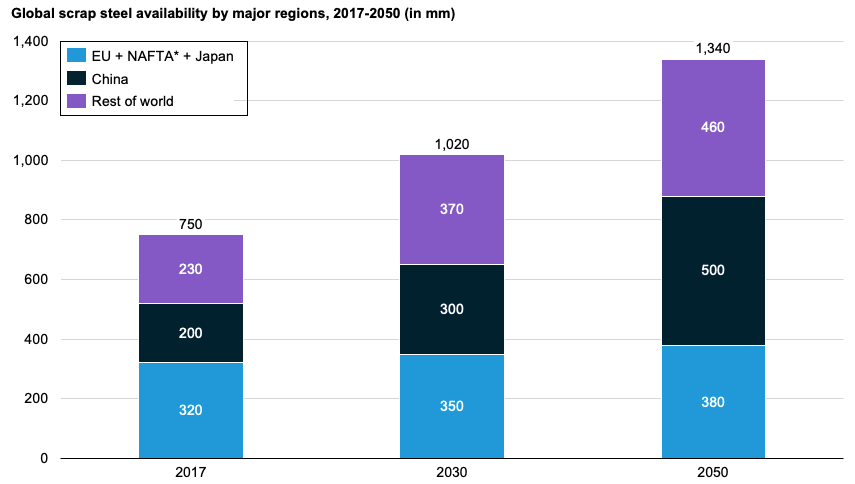
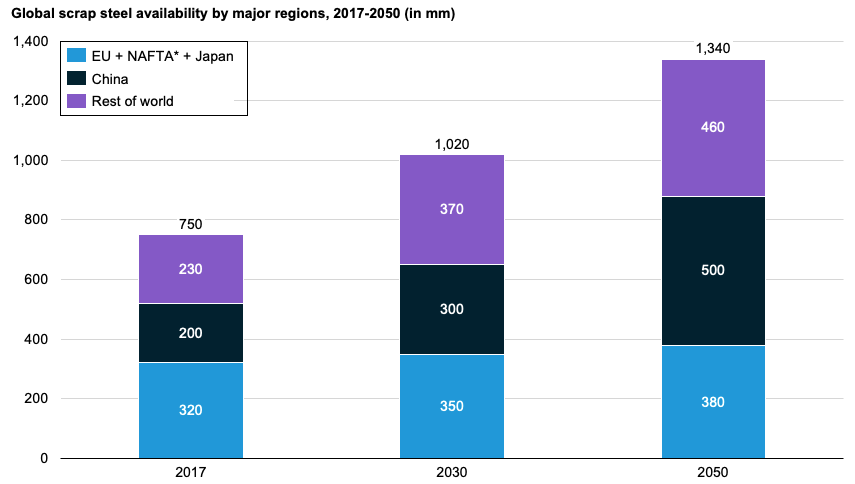
Scrap Steel Stock

Scrap steel stock is expected to continue growing globally, allowing for more markets to increase scrap steel recycling

Growing amount of scrap steel to alleviate demand in emerging economies like China


CBS Photo Image
(*) Canada, Mexico and USA. Source: World Steel Association (2018), World Steel Association Scrap use in the steel industry (2021), IEEFA New From Old: The Global Potential for More Scrap, Steel Recycling (2021). Credit: Mimi Khawsam-ang, Max de Boer, Grace Frascati & Gernot Wagner (18 December 2023); share/adapt with attribution. Contact: gwagner@columbia.edu

Observations

  • Domestic scrap availability to increase significantly in emerging economies over the coming years
  • As China matures, it is expected to fuel much of global scrap steel supply through 2050
  • Today, steel stock in OECD nations has reached 12-13 tonnes per capita, while in India and Africa this is only 1 tonne per capita – meaning less scrap steel is likely to become available in India and Africa over time
  • As scrap availability improves, adoption of Scrap EAF and a growing share of scrap steal in total steel production become more feasible
CBS Photo Image

Steel Decarbonization Technologies

Several emerging deep decarbonization steelmaking technologies now exist: Green hydrogen DRI-EAF, Iron ore electrolysis and Carbon Capture, Utilization and Storage (CCUS).

  • Read More
CBS Photo Image

Steel Sector Trends

IEA expects technology transition to take off after 2030, and CCUS to play the biggest role in 2050 of all green steel technologies.

  • Read More
Climate and Solutions, Energy Transition, Steel
Date
November 22, 2023
Steelworker near a blast furnace with sparks
Climate and Solutions, Energy Transition, Steel

What Steel Decarbonization Needs

It is both technically possible and economically feasible to eliminate almost all the carbon dioxide from iron and steel production by mid-century, thus cleaning up an industry that accounts for 10 percent of global emissions. But progress will not happen without a concerted policy push.
  • Read more about What Steel Decarbonization Needs about What Steel Decarbonization Needs
BAUBusiness as usualH2OWater
BF-BOFBlast Furnace-Basic Oxygen FurnaceIEAInternational Energy Agency
CAPEXCapital expenditure(s)HRCHot Rolled Coil (type of finished steel product)
CCUSCarbon capture, utilization & storageMPPMission Possible Partnership – industry decarbonization coalition
COCarbon monoxideMOEMolten oxide electrolysis
CO2Carbon dioxideNGNatural gas
CO2eCO2 equivalent, using global warming potential as conversion factorNAFTANorth American Free-Trade Agreement
DACDirect Air CaptureNGNatural gas
DRI-EAFDirect Reduced Iron-Electric Arc Furnace production processNG DRI-EAFDRI-EAF production process using natural gas
EAFElectric Arc FurnaceNZENet Zero Emissions
EBITDAEarnings before interest, taxes, depreciation, and amortizationO2Oxygen
EW-EAFElectrowinning-Electric Arc FurnaceOECDThe Organization for Economic Cooperation and Development
GtGigatonne, equal to 1 billion metric tonnesOPEXOperational expenditure(s)
H2HydrogenSR-BOFSmelting Reduction-Basic Oxygen Furnace


External CSS

Homepage Breadcrumb Block

CKI - Decarbonizing Steel

Columbia Business Insights

Official Logo of Columbia Business School

Columbia University in the City of New York
665 West 130th Street, New York, NY 10027
Tel. 212-854-1100

Maps and Directions
    • Centers & Programs
    • Current Students
    • Corporate
    • Directory
    • Support Us
    • Recruiters & Partners
    • Faculty & Staff
    • Newsroom
    • Careers
    • Contact Us
    • Accessibility
    • Privacy & Policy Statements
Back to Top Upward arrow
TOP

© Columbia University

  • X
  • Instagram
  • Facebook
  • YouTube
  • LinkedIn
Back to top

Accessibility Tools

English French German Italian Spanish Japanese Russian Chinese (Simplified) Chinese (Traditional) Arabic Bengali