The picture of a rapid and ready clean-energy transition may seem like a far-off fantasy for many in the U.S. — but it is the current reality in India. And no single renewable energy company is doing more to drive this transition than ReNew, which is not only among the largest renewable energy developers in India but also boasts one of the largest clean energy portfolios in the world. In 2021, ReNew became the first Indian renewable energy company to be listed on NASDAQ.
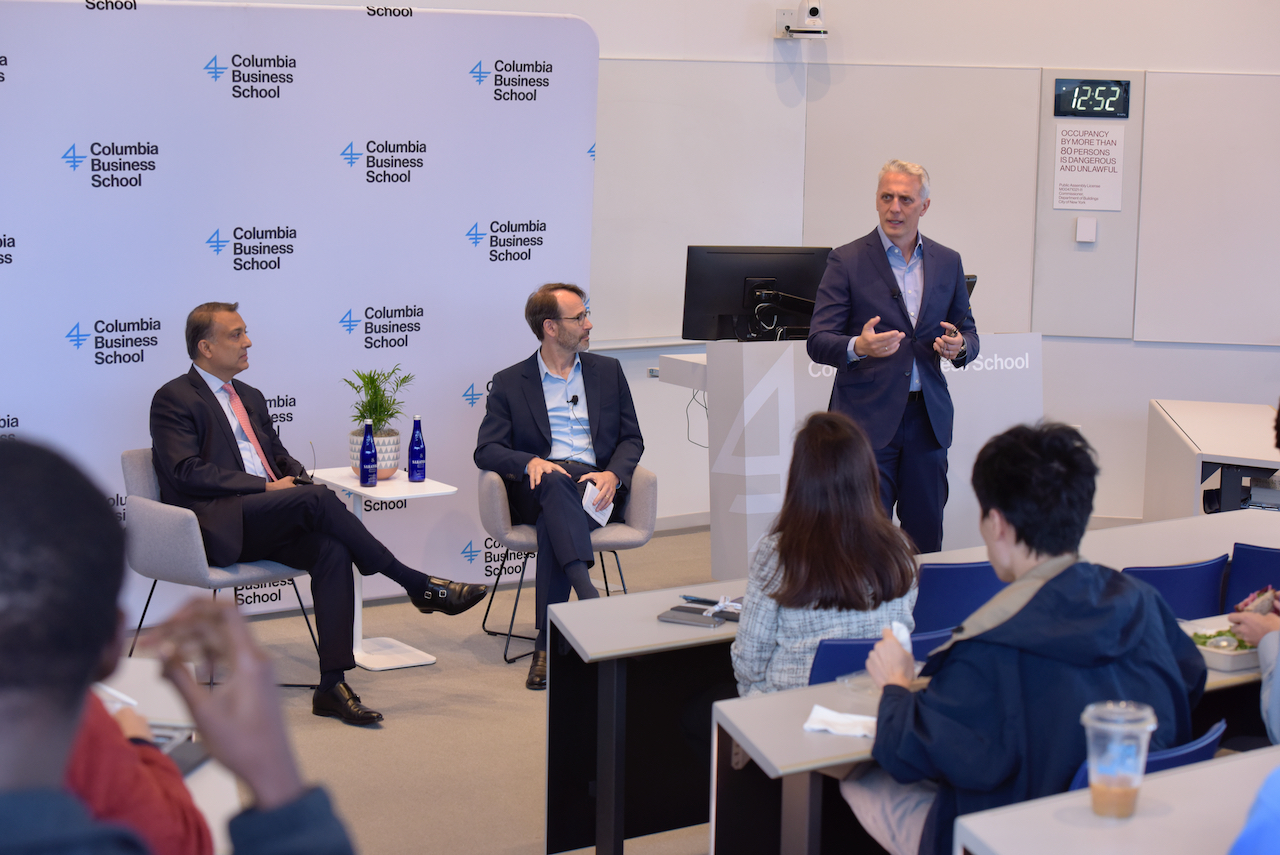
Sumant Sinha, Chairman and CEO, ReNew, visited CBS during Climate Week for a conversation with Columbia Business School Professor Bruce Usher, the Elizabeth B. Strickler ‘86 and Mark T. Gallogly ‘86 Faculty Co-Director of the Tamer Institute for Social Enterprise and Climate Change. Sinha, an alumnus of Columbia’s School of International and Public Affairs and the author of the book “Fossil Free: Reimagining Clean Energy in a Carbon-Constrained World,” spoke frankly about India’s uniquely favorable conditions for developing renewable energy projects — and also about the confounding practical problems that continue to hinder necessary progress in India and elsewhere in the world.
In his introductory remarks, Costis Maglaras, the Columbia Business School Dean and David and Lyn Silfen Professor of Business, highlighted the opportunities to be found in helping to find solutions to these most pressing problems.
“If you think fifty years in the future, what are the things that are going to change the world and change our lives?” asked Maglaras. “Climate change is going to be one. It’s going to disrupt the way we live, it’s going to create incredible opportunities.”
This is why, he added, CBS is investing deeply in new climate curricula and courses, building new synergies with the Engineering and Climate schools and others at Columbia, and together with partner institutions, has launched the Open Climate Curriculum to share free teaching resources.
For climate solutions to take hold, he emphasized, the world needs new types of business models and new approaches to financing – and ReNew is one example of a successful company demonstrating what these can look like.
The discussion yielded three key points:
1. India has offered up a case study in how rapidly ramping up renewables development can work.
In welcoming attendees to the event with Sinha, and acknowledging their setting — New York City’s Climate Week — Usher noted: “The reality is, a lot of the action in climate isn’t happening in New York, and it isn’t happening in the U.S.; it’s happening in countries like India — where, in many ways, there’s a much more favorable environment for the energy transition.”
Sinha agreed, and broke down some of the factors behind that favorability.
Perhaps the headline point, he explained, is that India’s power market is already massive (the world’s third largest) — and it is growing at an unparalleled speed (by roughly 7 to 8 percent per year, while most other parts of the world see little to no demand growth).
Powering that growth primarily with fossil fuels would be devastating for India’s climate — and for the world’s. Already, India accounts for about 8 percent of the world’s carbon emissions — about half of the U.S.’s share. The world can’t afford for India’s emissions to expand in line with its growing power demand.
While India added almost as much new coal as solar generation capacity last year, things are changing fast. “India has realized that we can’t follow the same normal path of development that all other countries have followed,” Sinha said. “Therefore, we have to grow through renewables. That means the clean energy transition is really fundamentally important in India, so that we go down a different path.”
Fortunately, economic logic has aligned with climate logic in this case. Renewable sources of energy are now cheaper than fossil fuel-based power supplies in India — by almost half.
National security interests in India point in the same direction, Sinha noted. Unlike the U.S., India doesn’t have any of its own oil or gas, and imports roughly $200 billion in fossil fuels every year. “It’s a real Achilles heel of India’s economy,” Sinha said.
He adds that the Indian government has clearly taken note of the many advantages renewables present: their role in fighting climate change; their assistance in decreasing energy costs; and their ability to help the country decrease dependence on imports.
As a result, the government has helped to usher the renewables industry along. One particularly smart move the government has made over the past several decades, Sinha explained, is establishing a single National Grid, which has made distributing energy from renewable projects across the country a seamless process.
“Policy has been quite enlightened on renewables,” Sinha said, “and that’s what’s allowed us to add so much capacity, frankly.”
2. Some of the trickiest challenges to confront in rapidly expanding renewable energy continue to be some of the most practical ones.
Sinha laid out some staggering projections: Given India’s 8 percent annual demand growth and its large customer base, between 70,000 and 80,000 MW of new renewable capacity will need to be added per year if the new demand is to be satisfied primarily by renewables.
“Project this out to 2030, and India will have to invest almost half a trillion dollars in generation, transmission, and storage just to meet power and demand growth,” Sinha said.
The financial constraints are important, but they may not even be the challenge that worries Sinha the most. One of his other main concerns? Land.
India is 12 times more population dense than the U.S. The simple fact is that not much free land remains undeveloped or un-farmed.
He explained that most of ReNew’s solar projects have sprung up in Western India, where desert landscapes and natural radiation make for just the right setting for such technology. The problem that has presented, though, is building transmission lines to connect these desert-bound projects to the rest of the country.
Wind power projects have proven more difficult.
“The problem is acquiring land,” Sinha said. “Every turbine becomes a battle for access.”
Even when farmers are willing to sell their land, project developers then often need to build large, broad roads across greater swaths of land to transport the turbines (each larger than the Eiffel Tower), their blades, and other equipment to the remote sites.
“These practical problems actually create the biggest issues for us,” Sinha said. “Ultimately, we have to solve these very real-life, practical, ground-level issues, or the whole climate change effort is not going to take off.”
3. Making climate action economically viable is the only way to move the needle.
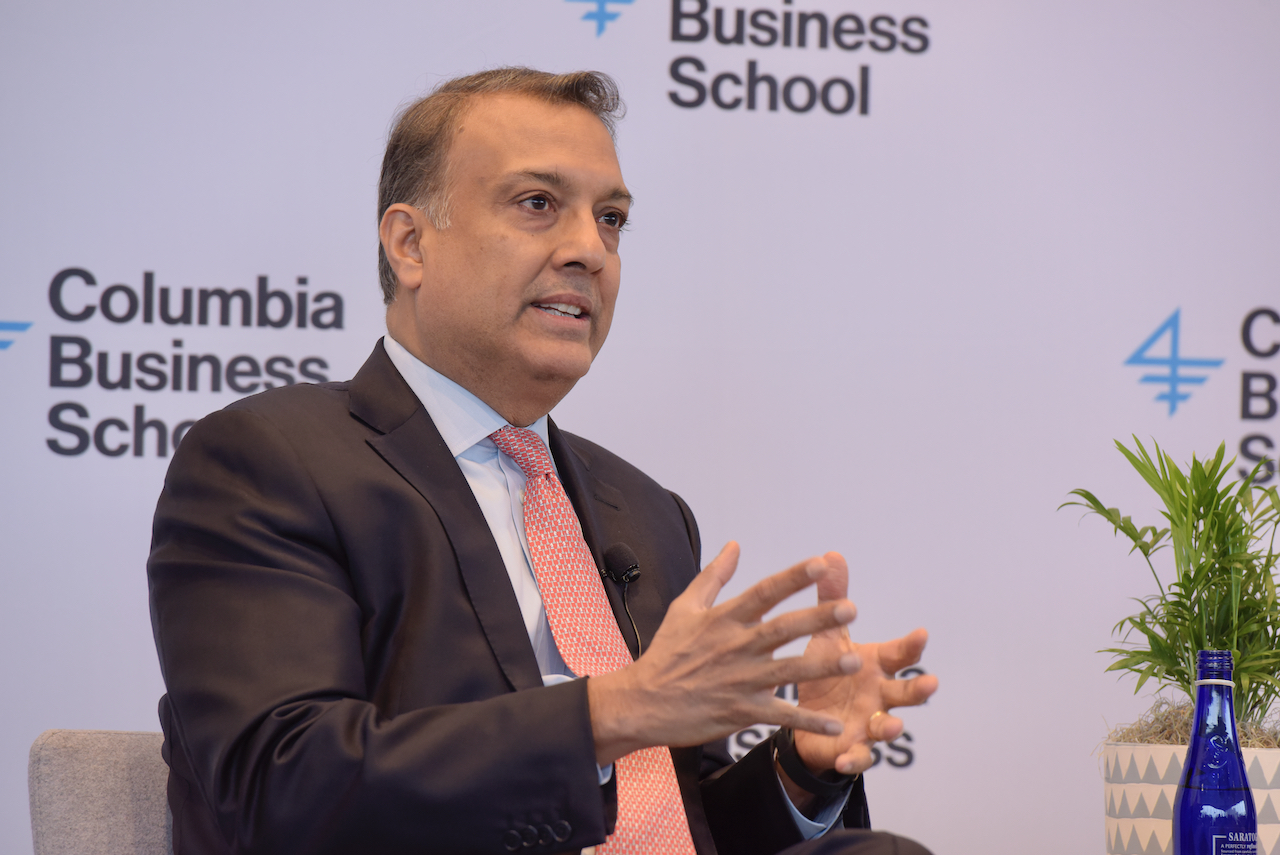
“I have the firm conviction that people will deal with climate change only if it’s commercially sensible to do so,” Sinha said. “Otherwise, nobody is willingly going to pay for it. That’s my experience.”
It’s clear, he added, that the amount of capital required to address the climate crisis is too overwhelming to be satisfied by government spending or even multilateral financing. He believes the capital required will only be available in private markets — and it will require a promise of financial returns.
There’s good news embedded there: since most of the world now acknowledges that addressing climate change is an existential mandate, there are emerging economic opportunities to be found in solving climate problems.
“We all now passed an inflection point where we know that climate change is a real issue,” Sinha said. “And we haven’t even started dealing with it yet; it’s going to take us the next three to four decades to get on top of this problem.”
Examples of emerging opportunities, he said, include putting up new renewable energy capacity (like ReNew is doing), developing and improving batteries, establishing new waste recycling processes, and creating digital tools that allow for better forecasting and modeling.
Of course, challenges present constraints around possible growth for businesses in the climate space. “Instead of 100 percent growth per year, a business might be looking at 20 to 25 percent growth per year,” Sinha said – noting what a clear success such numbers would be for any business. “From a climate standpoint, we do need these businesses to grow at 100 percent a year. So we may not meet the climate targets – but we will meet anyone’s business targets.”
Read more: EU’s Wopke Hoekstra on Climate Action: We Need a Unified Global Response

