
Adapted from “Automating the B2B Salesperson Pricing Decisions: A Human-Machine Hybrid Approach,” by Yael Karlinsky-Shichor of Northeastern University and Oded Netzer of Columbia Business School.
Key Takeaways:
- In business-to-business dynamics, a hybrid human-automated model has the potential to increase profits by more than 10 percent.
- Automation works best for mundane and more common orders from repeat customers, but complex orders and orders from new customers benefit from human involvement, showing the value of a hybrid model vs. full automation.
- Automation can not only automate the task itself but also automate the decision of whether the customer should interact with a machine or a human.
- This type of automation could help preserve institutional knowledge during employees’ parental leave or other transitions.
Automation has become central to most consumer experiences, whether we’re ordering something on Amazon, watching YouTube videos, or purchasing a plane ticket. “If we want something, we go online, find a product, see the price, and buy it,” says Oded Netzer, the Arthur J. Samburg Professor of Business at Columbia Business School. “We realized that the world of business-to-business is very far from that. It's very archaic. It centers around salespeople and high human touch, and it's all about fostering relationships with clients.”
But there are benefits to integrating automation into business-to-business interactions, Netzer says.
“As humans, we are very good at synthesizing information and coming up with frameworks for how to do things like pricing, but we are not very good at repeating things in a consistent way,” he explains. “Machines are better than us at repeating things over and over again, so the question we asked was, ‘Can we actually bring this new emerging technology to this somewhat archaic and relationship-based world of B2B?’”
How it was done: A company that sells metal products agreed to work with Netzer’s team to test possible automation in its day-to-day services, a commitment Netzer was grateful for: “Companies are not always willing to play with academics on these crazy ideas,” he says.
The company’s sales staff was responding to orders and making pricing decisions over and over again, “so we built a statistical model that mimics the employee,” Netzer says. “It takes the historical decisions, and everything I know about the customer and the order, and essentially creates a robot of each salesperson.”
Then, over the course of eight days, the researchers randomly allocated the orders as either treatment or control. The control orders did not use any automation. But the treatment orders added a new step to the sales process: After the salesperson entered the order information and assigned their own price to the order, the automation analyzed the order against the salesperson’s previous pricing decisions and made its own pricing suggestion based on that pricing history. The salesperson then chose whether to go with their own estimate or accept the AI version.
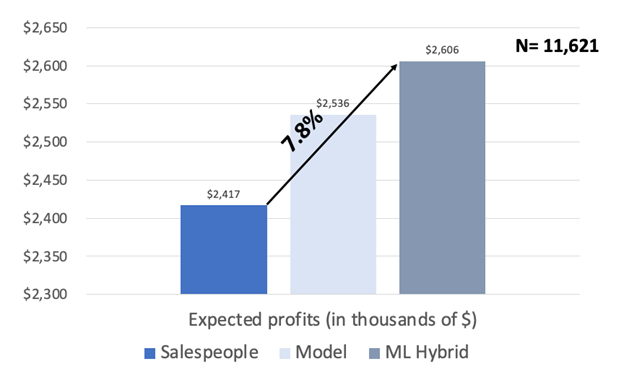
What the researchers found: The research showed that when salespeople were augmented with a robot of themselves, they did better, indicating hybrid automation worked. “By giving people the opportunity to look at what an AI version of themselves would do, we found they consistently converted more sales opportunities and actually increased profitability by over 10 percent,” Netzer says — an improvement that could increase the company’s earnings by $1.4 million annually.
However, the researchers also found that for more complex, nuanced orders, the human salespeople still did a better job of pricing than their AI cohorts. As such, rather than switching to a completely automated system, they recommend a hybrid approach, where salespeople are aided by a robot version of themselves. “We found that we want to automate for situations that are more mundane, but for the complex ones, we still want the human in the picture,” Netzer says.
In addition, the research showed that the AI can learn when it shouldn’t handle a sale itself but rather include a salesperson. “The machine automates not only the pricing but whether it should replace the human in the first place for each order,” Netzer explains.
Why it matters: This research can be applied to many service providers, from metal sales to legal services. A “robot” version of a salesperson will not replace the employee but serve as a valuable assistant. “With hybrid automation, AI can provide a bridge during staffing changes or when an employee wishes to or needs to take some time off,” Netzer says. “It’s a way to preserve institutional knowledge.”
