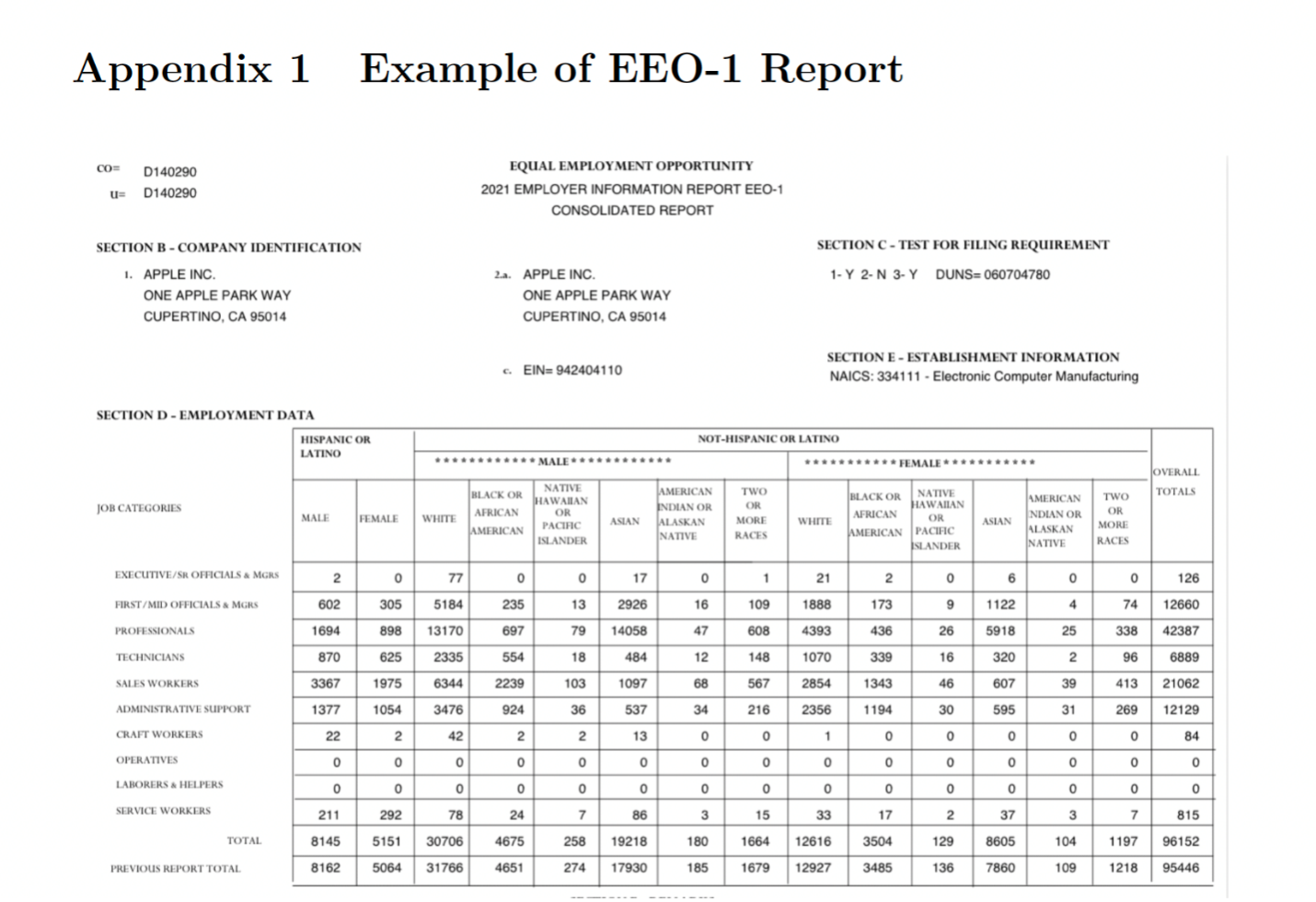
The paper “Behind the EEO Curtain” examines diversity at U.S. firms and how granular data reflects an ongoing lack of diversity at America’s largest public companies and most companies’ resistance to voluntary release of unflattering diversity information.
Comprehensively efforts to analyze workforce diversity at U.S. firms remains complicated given that Equal Employment Opportunity (EEO-1) data is not automatically shared by the government agency. Researchers found that most public firms do not share Equal Employment Opportunity (EEO-1) voluntarily.
Many organizations that share diversity, equity, and inclusion (DEI) data outside of government mandates may do so strategically, with a firm’s likeliness to voluntarily share DEI information with stakeholders often correlating with data that appears to reflect progress towards greater workforce inclusivity with respect to race. Employees implement what they see executives modeling, so “walking the talk” of the company’s stated values is critical.
Even among these more positive reflections of diversity, nuances in the context of reporting reveal continued high levels of racial and gender inequality in positions that tend to lead to a more diverse upper management workforce. These findings underscore a potentially bleaker portrait of diversity trends among a future upper management workforce due to a lack of inclusion in key first and middle management positions.
Adapted from “Behind the EEO Curtain,” by Thomas Bourveau of Columbia Business School, Accounting, Business Law & Taxation, Rachel W. Flam of London Business School, and Anthony Le of Columbia Business School.
Research
Today, even with the possibility of future SEC regulation around DEI reporting present, low levels of voluntary EEO-1 data sharing persist. New research from Columbia Business School, analyzing April 2023 EEO-1 data and 2016–2020 historical data obtained by FOIA litigation on the largest 2,500 U.S. public firms reveals significant deficits in racial and gender diversity in managerial roles among 800 large federal contractors.
White employees held 71 percent of the first- and middle-level manager positions, despite making up only 63 percent of the total workforce.
Researchers found that women held only 35 percent of the first- and middle-level managerial positions, despite making up 39 percent of the workforce.
Asian individuals held 8 percent of the first- and middle-level positions while accounting for 9 percent of the workforce. His- panic and Black employees held just 6 percent and 4 percent of the first- and middle-level manager positions while holding 10 percent and 8 percent of the total workforce in the sample.
Black employees experience the lowest levels of aggregate representation at managerial and executive levels, with nearly 70 percent of firms employing fewer than 5 percent of Black managers and over 85 percent of firms employing fewer than 5 percent Black executives.
“We also observe significant heterogeneity in the distribution of minority employees across firms: while 17 percent of the firms in our sample employ fewer than 10 percent minority managers, half of them employ less than 20 percent minority managers.” According to the researchers, their findings confirm longstanding results in sociological studies (Dobbin and Kalev, 2022) that firm-initiated diversity training has not led to a balanced representation of minorities in managerial roles.
Despite the significant rise in the number of firms disclosing EEO data between 2016 and 2020 in the researchers’ sample (from 0.8 percent in 2016 to 15 percent in 2020), just seven percent of the EEO-1 reports in the sample were voluntarily disclosed by the firms. Organizations were more likely to disclose EEO data if they had above-median proportions of racially diverse managers relative to greater diversity among non-managerial employees. Because corporate investors and other stakeholders now tend to view a lack of workforce diversity and inclusion as an element of risk for public companies, investors’ calls for the SEC to legally mandate disclosure of comprehensive DEI data have increased (Augustine et al., 2021; Mennie, 2021).
Key Takeaways
First and middle manager diversity impacts the effectiveness of long-term diversity strategies—as firms tend to promote from within. Yet if large public companies do not offer insight into the true state of their DEI hiring and promotion results, investors and other stakeholders may have an inaccurate view of these companies’ success at promoting inclusivity. Higher overall numbers of normally underrepresented groups at a firm might indicate some workforce diversity, but it does not necessarily indicate an upward career trajectory for diverse employee groups within an organization. Racial minorities continue to be underrepresented at the management levels, even at more diverse firms, as are women.
Organizations typically require a legal mandate to disclose comprehensive granular insights on diversity and inclusion practices and results. This research found that over a span of several years, most large public companies failed to share key diversity and inclusion statistics with the public and did so only after a successful lawsuit by independent researchers. Investors and other stakeholders may be unable to gain extensive visibility over hiring, promotion, and career trajectory information without a government legislation compelling company to disclose information.
Access to this data is key to developing DEI policies that may be more effective in the future. Researchers were able to discover a significant lack of racial diversity at first and middle manager levels only because of non- voluntary diversity data sharing.
As gender and racial disparities persist in both high-level and lower-level managerial appointments, businesses and stakeholders must look at long- term data patterns in how inclusivity policies are achieving or missing benchmarks over time and their relationship to the roles underrepresented groups hold at the beginning and middle of their careers.
Mandatory disclosure may be a key step in making information more transparent and readily available, helping investors, employees, and partners have a better understanding of diversity at all levels of the company.