
Very rarely do people wake up in the morning and think, “I’m going to be unethical today,” but the fact is, our ethics are often challenged daily, either consciously or not. As humans, we are less ethical than we like to think we are, but why is that? And how can we be better about it in our professional and personal lives?
These were some questions I grappled with as part of the 2024 Fellowships at Auschwitz for the Study of Professional Ethics (FASPE) business cohort. FASPE is a highly selective fellowship program that uses the Holocaust as a historical backdrop to teach applicable industry ethics to people of all backgrounds. I was humbled to be selected as one of three alumni from Columbia Business School who joined a cohort of 40 diverse, passionate, intelligent, and, perhaps most importantly, interesting fellows. All of our collective, unique experiences were expertly curated to bring varying perspectives to the table. This is a core element of the FASPE curriculum, which both honors the experiences of Holocaust victims and shows how easy it is for people from all walks of life to become perpetrators, cooperators, and bystanders.
In preparation for the trip, we were required to read Primo Levi’s Survival in Auschwitz, a memoir recounting his time at the concentration camp. Like other firsthand recollections from survivors, Levi details the abhorrent conditions prisoners endured. What’s unique about his perspective, however, is his emphasis on power struggles, inequality, and betrayal amongst prisoners at Auschwitz. At one point, he explains, “[Man’s] capacity for hatred, unfulfilled in the direction of the oppressors, will double back, beyond all reason, on the oppressed; and he will only be satisfied when he has unloaded on to his underlings the injury received from above.” Suffering forces people to abandon their values out of desperation and fear. While the typical person’s experiences cannot compare to that of prisoners in concentration camps, it’s reasonable to assume that everyone has experienced some degree of suffering (or immense stress) where the consideration of ethics and personal values became subconsciously dismissed.
A personally impactful moment during the trip occurred at the end of our visit to Auschwitz, when FASPE’s Executive Director for Strategy and Academics (who also served as our expert historian) pointed out that it’s normal to grapple with complex emotions during these site visits. In particular, regarding the ongoing conflict in Gaza, he mentioned that some of us may better understand why the IDF (Israel Defense Forces) exists, while others may just be realizing why liberation for all people is an important human right. Maybe the “other side” in all conflicts is doing what they believe is moral and just. Very rarely do people choose to be knowingly unethical in their beliefs and actions.
While I learned so much from the course material, lectures, site visits, and classroom-style discussions, what I appreciated most goes back to the interesting people I spent time with during those two weeks. It turns out, an interest in ethics does not skew toward one side or another based on socio-economic status, career path, political affiliation, cultural background, or past traumas. These factors don’t necessarily impact one’s desire to be an ethical person.
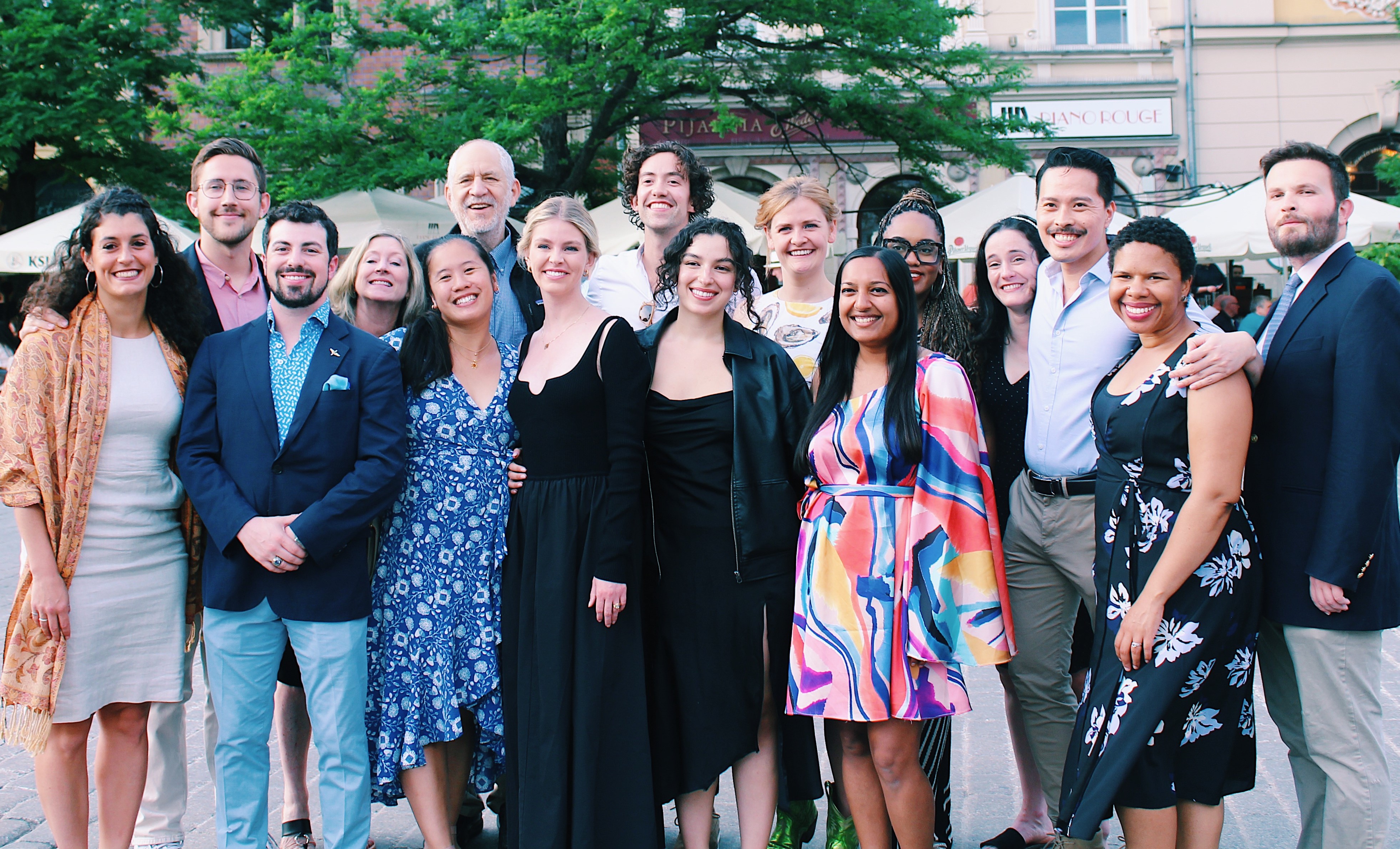
Living in today’s highly polarized society can be confusing, and this realization changed me. While I tend to naturally avoid conflict with others, I realize that disengagement from “the other side” for my own comfort traps me in a self-serving echo chamber. Running away from dissenting opinions only stifles my learning and capacity for humanity and understanding. At the very least, ignorance is a disservice to the self.
Very rarely do people choose to be knowingly unethical in their beliefs and actions.
As the school year starts for business school students, many young professionals find themselves stepping into what seems like sensitive territory. The disagreements that occurred over the past year may seem irreparable; some may feel silenced, others afraid to speak up. The Columbia community especially may feel battered—I can feel it even as an alumna living on the other side of the world.
Business School is a time to return to learning, not only in the classroom, but from others. I have been in my professional career for nine years, and there will likely never be another opportunity for me to learn, engage, and discuss in the same capacity I did while at Columbia Business School and through FASPE. Learning comes from difficult conversations and uncomfortable questions. Most of all, it comes from listening to perspectives different from our own. Today, echo chambers are bigger and louder than ever, and people avoid tough conversations that lead to true learning.
It's important to realize learning doesn’t have to equate to agreement. We must be comfortable with unfinished conversations because meaningful dialogues are complex and ever-evolving. Ethics and morality can be one person’s truth and another’s falsity. There is no way to change this facet of humanity.
What we can change is the ability to engage in productive discussions, and above all, lead with empathy. What’s been lost in today’s highly polarizing times is the ability to acknowledge each other’s needs and understand that at the rudimentary level, we are all driven by the desire for care, fairness, loyalty, authority, sanctity, and freedom (Moral Foundations Theory).
When speaking, approach discussions with the intention of teaching, not convincing. When listening, practice empathy and receive with an open mind rather than preparing rebuttals. This will relieve the stress of difficult conversations and serve as a reminder of our humanity, making it possible to learn from one another in times of intense conflict. My experience with FASPE taught me to embrace disagreements rather than avoid them, and it’s made me more well-rounded in my thinking and more empathetic. I challenge everyone to attempt this mindset shift. You’ll be surprised at how it shapes your ethics, influences how you see the world, and motivates you to take purposeful action.
Marissa Guiang received her dual-degree MBA and MS in Journalism from Columbia Business School and Columbia University Graduate School of Journalism in 2022. She served as the Student Leadership and Ethics Board Co-Chair during the 2021-2022 academic year. Marissa currently resides in Hong Kong and works at BlackRock.