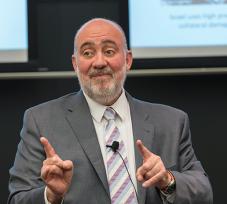
 When you think of the hallmarks of innovation, you think adaptability. Ingenuity. And the ability to get inside a consumer’s — or a competitor’s head.
All these traits have come to the fore over the past half-century as Israel has tackled what is perhaps its most vital challenge: national security. In the most recent installment of the Ira L. Rennert Speaker Series, Ron Prosor, former U.N. Ambassador for Israel, revealed how this up-and-coming economy has changed how it battles terrorism.
Prosor has spent more than two decades with the Ministry of Foreign Affairs for Israel, a state that has fought terrorism throughout its 28-year history. Now chair of International Diplomacy at the Interdisciplinary Center Herzliya, he oversaw Israel’s 2005 disengagement from Gaza (among other accomplishments). More recently, Prosor has served as the country’s representative to the United Nations and operated in diplomatic roles in Washington, London and Bonn.
Twenty-first century terrorism, including the 9/11 and European attacks, may take on a modern patina, he said, but the underlying causes and weapons of the Taliban and ISIS are not that different from those that Israel has faced for a generation.
The history of terrorism has traveled a frustrating but inevitable evolution as counterterrorists learn to frustrate attacks and terrorists move on to new tactics.
Stage 1: Hijackings
Prosor traced modern terrorism from the 1969 hijacking of a flight from Rome to Tel Aviv, where all passengers and crew members were eventually released. The experience, he said, gave Israel — and the world — the security protocol now common in airports around the globe.
Israel learned to set up travel security as a series of circles, each of which communicates but is independent from the others, “so the chance of all failing are remote,” Prosor explained.
The outer perimeter of the security circle consists of intelligence gathering, meaning authorities collect and share information on known and suspected terrorists. The next ring meticulously scans vehicles entering the airport zone. Within the airport, civilian and uniformed police search for suspicious behavior patterns and check baggage.
The next ring employs personalized interrogation methods meant to help identify even unlikely or naive collaborators. For example, in 1986, after a profiler interrogated Anne-Marie Murphy and found her “clueless,” or easily duped, authorities discovered a bomb that the pregnant young Irish Catholic woman’s fiancé had snuck into her luggage.
Since the 1970s, an armed air marshal has flown on every El Al flight, a final precaution that Prosor said has deterred further hijackings but isn’t accepted procedure in many countries.
Prosor wondered if 9/11 might have had a different outcome if the United States had followed some of these precautions — or even if American agencies had shared intelligence, the first circle designed to flag any terrorist reservations. “It’s not that the authorities were lacking suspicions on the subjects,” he said, “but the agencies didn’t communicate.” Especially in today’s era of big data, “it takes a network to defeat terrorism.”
Stage 2: Suicide bombings
Once air travel security foiled a number of hijackings, terrorists began changing their approach, observed Prosor. Over the past 20 years, “they began to use their body as a weapon” either through bombs strapped to their torsos or in vehicles that would detonate with them in it. Since 2000, 140 suicide attacks have killed 542 Israelis. It is no longer enough to simply keep the weapons out of the target area and seal off routes of escape. Now authorities face individuals eager to die for their cause.
The solution here is to step up surveillance in public places. Israel has adapted some of the same security circles that worked well in air travel to buses, malls, cafes, etc., and supplemented them with metal detectors, separation barriers and armed police at every public gathering. The effort is massive, but has reduced the number of suicide vehicle attacks by 95 percent, Prosor said.
Stage 3: Digital Lone Wolves
Thanks to the proliferation of social media, recruitment is now occurring on a much more massive scale from that of a previous generation. “Radicalization takes place in chat rooms and forums,” said Prosor. “The Internet is perfect as it has no gatekeepers, is interactive and protects identities.”
But “shutting down Facebook is not an answer,” Prosor said. Social media routinely provides the best leads to terrorist organizations. Since the Internet is open, authorities can use chats and posts to identify terrorists. Prosor added that neither Israel nor any other country has yet to find a solution to the social media advancement of terrorism, although he suggested private media sponsors bear some responsibility for monitoring sites that promote incitement. He praised Twitter’s suspension of 125,000 ISIS accounts, indicating that ISIS Twitter traffic has plunged by 45 percent since mid-2015.
He also suggested states partner with social media companies to pursue prosecution and class lawsuits against terrorists where possible.
The Next Stage: Future Terrorism
Prosor expects terrorism to continue evolving. He summarized terrorism as a simple formula:
Terrorism = motivation x capability.
All counterterrorists need to do is to disrupt either element.
To change motivation, the best tools are long-term education and increased opportunities. To decrease capability, counterterrorists need to put all those security circles in place and be on constant alert for new ways terrorists are evolving, all without disrupting the elements of democracy.
One way authorities have done that is through profiling, a controversial practice. Still, in a country with limited resources, some targeting of demographic groups likely to engage in terrorism is needed, he noted.
Yet profiling’s effectiveness is waning. Although early suicide terrorism was largely carried out by individuals without high-level careers or families, that distinction is disappearing. Some 17 percent of suicide terrorists worldwide today are women, including many mothers, he said.
One truism, according to Prosor, is that a large chunk of today’s homegrown terrorists are young, second-generation immigrants. Examples include Syed Rizwan Farook, a second-generation Pakistani-American who carried out a terrorist attack in San Bernardino, Calif., with his wife last year. And nine of the 10 attackers involved in the November 2015 series of coordinated attacks in Paris, were second-generation immigrants.
The most effective tool to counter terrorism is a substitute narrative to that provided by terrorists. “Radical Islam offers an alternative value system,” Prosor said. “It’s not enough for states to show what’s bad. They have to provide a counter-narrative to show what’s good, to make all citizens feel a part of something. Countries need to invest in their children’s education” to tell their side of the story.
And all this needs to occur while protecting the freedoms of democratic societies. “Look, it can be done,” said Prosor. “Free, open societies have to find the right calibration between freedom and protection. We have to maintain our freedoms of speech and movement while putting pressure on terrorist who use and abuse the democratic process.”
Israel and its “vibrant, democratic society,” believes Prosor, has found such a balance.