

Over the past decade, literally hundreds of start-up companies and established tech leaders have built free streaming and subscription services for music. With good reason, since in 2015 alone over one trillion songs have been streamed. Google and Amazon joined the fray a few years ago, but the big mainstream splash occurred this summer with the launch of Apple Music. Even casual music fans are now aware they have options to sign up not just for free internet radio, but also for paid subscription music services.
Although it almost seems silly to wonder whether today’s streaming music business models will last, I felt for years that their financial stability was not necessarily secure. So, I feel the question is worth asking.
First of all, it is not a good sign that musicians are aggravated about how they are being compensated. Artists have been making headlines by rebuffing the tiny royalty payments they receive from such services. The biggest news was Taylor Swift pulling out of Spotify, and a range of star-studded performers, led by Jay-Z, are re-launching their own subscription platform, Tidal, with the promise that a greater share of revenue would go to recording companies and artists.
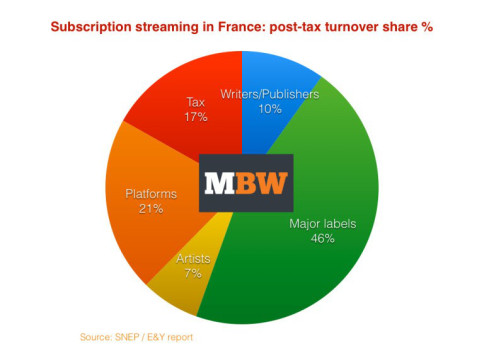
There is a need to take a deeper look at the financials behind these services. Let us say that the word “obtuse” is a generous way of defining the transparency of these deals. When I sent a musician friend of mine this Ernst & Young analysis of how Spotify in France splits its revenue, he remarked, “Meet the new boss, same as the old boss.” The music labels, as before, take in the majority of post-tax revenue.
Where is the money in music?
Most artists receive fractions of a penny on every track played, but almost none of the streaming music services are yet making any profit. Plus, there are lawsuits and regulatory changes (here and here) that could make the financials even more challenging. The deals Apple Music made with the labels are actually under investigation, because of the possibility that some provisions could be anti competitive.
Despite all of this, a big-picture look at U.S. music revenues (2014 RIAA Music Industry Shipment and Revenue Statistics) makes it clear why this model is here to stay. The growth rate of streaming services has been extremely rapid, nearly tripling between 2011 and 2014. Next year, streaming services will likely provide a larger percentage of music revenue than physical music sales. If these “disruptive” services are now the second-largest source of revenue for the music industry, they are not likely to disappear anytime soon.
As streaming use has grown, physical and digital download sales have shrunk, and the overall revenue for the music industry has plummeted. This decline has less to do with these new forms of legally purchasing, or listening to music, than with the opportunities to easily “share” music via the Internet. Not to mention numerous years of an economic downturn and the simultaneous growth of other forms of digital entertainment that grab people’s eyes, ears, and cash.
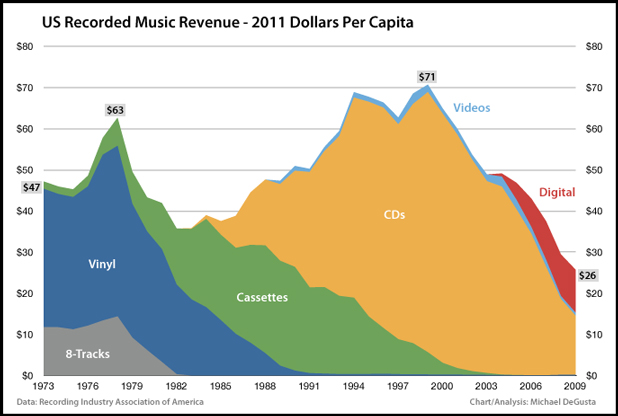
Since 1973, the peak of the industry in the United States occurred during 1994 through 2000, with the average American spending $60 to $70 per year on music. At present, that number is down to close to $20.
Consumers adopt paid entertainment services
In the midst of this, I believe that the subscription model actually offers hope for the industry. Marketers seeking to understand the potential future behavior of the music audience can see signs of the future in other entertainment media.
A majority of the U.S. public is now accustomed to paying for cable TV, Internet service, and mobile phone service, with streaming video services about to hit mass market adoption as well. Subscription service competition is rampant, so there is a real possibility that a majority of households in the country will set up a subscription streaming music service as part of their annual entertainment spend.
To grow users, the services will need to add pricing tiers at the lower and higher ends. This could start, for example, at $4.99/month with some restrictions (and/or some ads). Higher prices could be charged for added services (e.g., Tidal offers a $19.99/mo. option for lossless quality audio).
The ad-supported streaming music model of the future may not look quite like it does today, depending on regulatory decisions, lawsuits, and future licensing negotiations, but with Pandora now generating $1 billion in annual revenue and building a loyal brand following, it is hard to believe that the model will disappear either.
After years of thinking that this unlimited access to music was too good to last, I’m now wiping my brow and smiling. But I have knocked on wood, as well, just to be safe.
What can marketers outside the music world glean from this industry and apply to their own? The music streaming sector has evolved greatly over the last decade, and industry leaders now offer an increasingly personalized experience. Spotify offers their subscribers “Discover Weekly” which is an ultimate personalized playlist based on recommendations from analyzing listening history. With such advanced capabilities for marketers to collect data about their customers, they are able to offer truly personalized and customized experiences like never before.
Examine your business to see if you can encourage customers to move past the ownership model to a “renting” or subscribing one. The rise of the sharing economy shows us that this model has become more prominent. How might a similar disruptive innovation change your industry?