Whether it’s your first time going or whether it’s just another year at CES, the event never ceases to feel overwhelming. Over half a dozen hotels are involved, the actual ‘trade show’ is filled with so many booths that it is split into multiple venues covering over 2.5 million square feet, and for a full week there is basically non-stop keynote and conference content.
There is a lot of noise at CES, and pulling out different signals within it can sometimes be difficult. Press coverage is rampant – and inevitably a bit snarky at times – and you can get top takeaways from dozens of different outlets. For example:
- AdAge highlighted things that got buzz
- Phys.org focused on listing new tech
- The New York Times explored how experiential even a deal making room can be, and
- Znet highlighted the weirdest and worst gadgets
It was just my second year at CES and so I’m not expert on a historical perspective of the event, but a few themes clearly emerged from my experience.
Rebranding the event itself
For a time, the latest TV advances seemed to dominate the buzz, both good and bad, at the Consumer Electronic Show. Over the past several years, though, as the world became more interconnected and technical components became cheaper and cheaper, the tone and breadth of the event changed significantly.
Recognizing these changes, in 2015 the producing organizing rebranded itself as the Consumer Technology Association (from Consumer Electronics Association) and dropped the full name of the trade show to just CES. As CTA President Gary Shapiro noted, “Our name change is an evolution. Just as the tech sector itself has evolved and now crosses multiple industry sectors, we’ve broadened our membership to include new technologies and intersecting industries – software, app development, crowdsourcing technology, robotics, content creation, and the personalized health care and services sectors.”
In this case, the name changes follow an already established shift in the mission of the organization and the set-up of its flagship event, so it didn’t draw much attention or create any real impact. Still, it does formalize the fact that CES is now highlighting how technology will drive broad social and business changes, rather than just showing off the latest update to a gadget in your home.
Autonomous vehicles
The auto industry has become a large part of CES over the past few years. Gary Shapiro even joined in at the Volkswagen Keynote that I attended on January 5. Most of the focus was on electric vehicles, physical displays and interconnectivity. CEO Herbert Diess opined, “The car will be the most important device on the Internet.”
What didn’t get nearly as much attention via the microphones was the future of the automated/self-driving car. This was unfortunate, as one moment on the showroom floor showed me that this is what people are most fascinated by when thinking about the future of transportation.
The benefit of attending CES in person is that you can see people’s reaction to the tech in front of them. When walking the automotive area, the Nvidia booth immediately stuck out as an anomaly. Isn’t Nvidia a graphics card company? And why is this booth swarming with people? What’s going on?
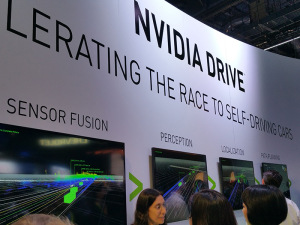
It turns out that Nvidia has become a strong player in the automotive area by developing Nvidia Driveto create automated systems to “enable cars to see, think, and learn.” Employees at the booth were surrounded by folks interested in understanding the technical set-up for gathering information on the road as well as the neural networks and machine learning that are being develop to create automated driving experiences.
While looking at futuristic car designs draws one’s eye, people’s minds are sharply attuned to how their car may help them drive in the future.
Partnerships rule
Just introducing the new cool gadget isn’t going to cut it anymore. Every keynote and press conference wasn’t complete without other companies, entertainers, or politicians gracing the stage to talk about projects and partnerships that would shape the future of society.
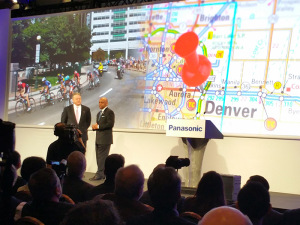
At the Panasonic press conference, I got to see the mayor of Denver, Michael Hancock, take the stage with Panasonic N.A. Chairman and CEO Joe Taylor to talk about their smart city initiative. Ford announced its efforts with Amazon to integrate the Echo system into future smart vehicles. Google appeared on stage at the LG press conference to highlight their partnership to develop more secure smart things. And Samsung had Microsoft’s Bryan Roper demonstrate natural language queries on Windows 10 that will drive their smart devices.
Finally, there was no bigger experience than Intel’s keynote. From knowns like A.R. Rahman, Oakley, X Games, and Lady Gaga, to smaller start-ups like Daqri, there was a constant steam of people demonstrating what can be made possible by Intel’s latest line of chips.
While competition still abounds in the tech sector, the future growth of smart things, augmented/virtual reality, drones, and robots, will be contingent on various kinds of shared systems. The potential of interconnectivity for both commercial growth and societal benefits will only come about if the devices and systems that hold promise in this area can find ways to work together via partnerships, APIs, and universal standards.
Some closing observances
Samsung Gear has been available, but with Oculus Rift taking pre-orders at CES, virtual reality fully put its stake in the marketplace this year. I’ve tried the headset a few times and within minutes gotten “VR sickness.” I await future reports on the return rate of these devices.
There are car manufacturers a plenty now at CES, but sadly they have no idea how to staff the show floor. Turn left or right at any other booth and you can find a staff person to talk to – sometimes even at a leadership level – but from Volvo to Ford to Toyota, it was nearly impossible to find anyone to talk to about their latest efforts.
The smallest things can create the biggest emotional reaction. Panasonic showed off its transparent TV screen in a natural looking living room setting and people crowded around to watch it with expressions of joy and wonder plastered across their face.
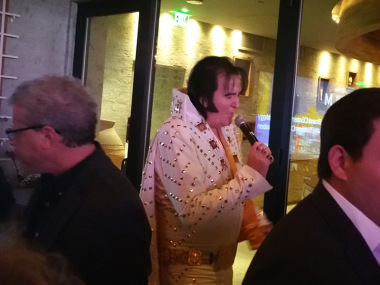
And finally, no Las Vegas experience would be complete without an Elvis moment…