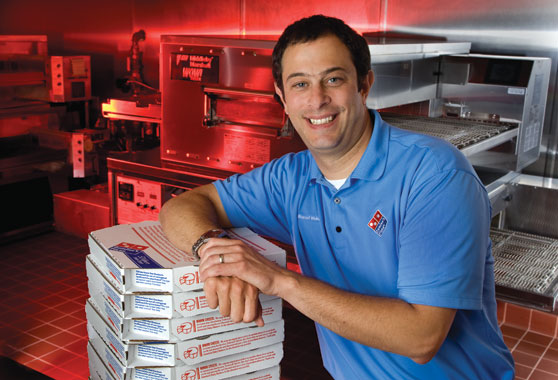
In September 2008, Russell Weiner began his tenure as CMO of Domino’s Pizza at a tough time—its sales were stagnant and the economy was bottoming out. But, the company was also planning a bold risk-reward initiative that involved the very core of the Domino’s brand: the taste of its pizza.
As Weiner recently told QSR Magazine, “We knew that certainly we were known for our strength of delivery and service but that our pizza could be improved,” he says. “I knew that when I was interviewed. You didn’t have to do the research.” Over a two-year period, Weiner and the company took a holistic approach—conducting multiple taste tests and, most importantly, collecting opinions from all its stakeholders: customers, headquarters employees, and franchisees.
Encouraged by an internal commitment to change its 50-year-old recipe, Weiner then built and launched a marketing strategy in December 2009: the Pizza Turnaround campaign. Video ads showed actual criticisms from consumers (“the crust…is like cardboard”) and the authentic commitment of Domino’s employees to make a better pie. An integrated campaign followed with a PR push, promotions, and an extended use of social media, including a Facebook contest in which customers gained points by getting their friends to commit to try the new recipe.
The effect? A 14.3% increase in Q1 2010 same-store sales over Q1 2009, and a boost that continued throughout last year with sales in Q3 2010 up 11.2% over Q3 2009.
“If you’ve ever read The Art of War, they say the best way to win a war, if the war is fought on an island, is to blow up the bridge,” Weiner told QSR Magazine. “Everyone’s fighting for the death, because there’s no retreat. When we knew the product was so much better than our old one and the competition’s, we felt like we could go for it. So we blew up the bridge.”
Russell Weiner spoke at our BRITE ’11 Conference (March 2-3, 2011, NYC).