
I had a great time running an executive program last week for Aalto University (formerly Helsinki School of Economics).
One of our liveliest discussions was on the subject of open vs. closed models of innovation. We examined the contrasting approaches of Google vs. Apple.
Google (“don’t be evil”) represented an open innovation culture, with its flat organizational structure, employee autonomy, fairly transparent communications, iterative approach to products (“beta, beta, beta”), and embrace of open platforms like Chrome and Android.
Apple (“be a little evil, and they’ll love you for it”) represented a contrast to that Silicon Valley conventional wisdom, with its hierarchical organization, charismatic hands-on leader, radical secrecy, disavowal of customer input, and embrace of proprietary platforms like iTunes and the iPhone App Store.
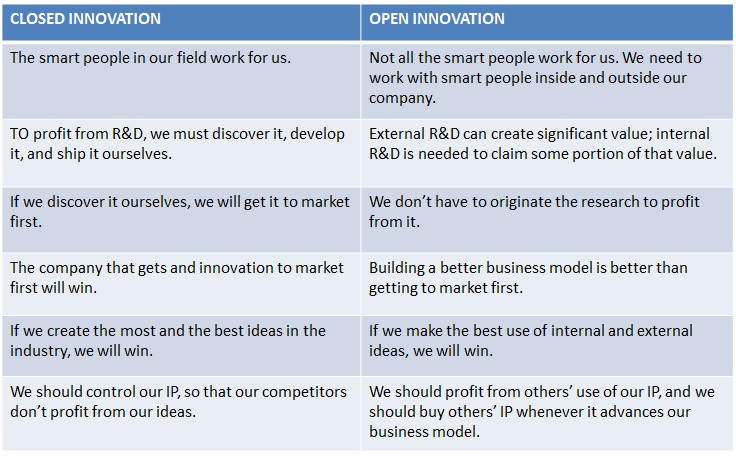
While partisans often take a strong position on “open” vs. “closed,” both companies have shown the potential benefits of their own approach to innovation. Google has grown thanks to the platform of the open Web, and proven incredibly innovative with a freewheeling, iterative, and decentralized approach (including its famous “20% time” for employees to initiate their own projects). Yet, Apple has likewise thrived under Steve Jobs, proving the power of vertically integrated innovation—linking web apps, installed software, and hardware—to create a transformative product like the iPhone.
With the recent news that Android phone sales have overtaken the iPhone in the U.S., Google’s open approach may be emerging as a winner in the smartphone space. After all, the Android operating system has managed to duplicate much of the magic of the iPhone, while allowing for more customization, greater product variety, availability on every network (not just AT&T), as well as an app store that doesn’t block submissions on sometimes mystifying grounds.
Of course, “open” and “closed” are really just extremes on a spectrum. The whole success of the iPhone came when Apple shifted, in its second model, from a fully closed system to a much more open platform for independent app developers. And, as a recent post by Nik Bhattacharya indicates, Android is not as purely open source as we may assume.
In an age of tight margins and competitive markets, open approaches to innovation are being adopted not just by Silicon Valley companies, but by governments, nonprofits, and traditional corporations like Procter & Gamble. The possibilities for reduced cost and broader sourcing of ideas often outweigh the risks to competitive surprise and exclusivity. It may be that the more traditional “closed” innovation is becoming a luxury that only a high-margin market leader like Apple will be able to afford in the future.
This post originally posted by David on the DavidRogers.biz blog at: http://www.davidrogers.biz