
The cracks are starting to show in the proverbial glass ceiling. There are more women in senior management, on corporate boards, and at the top echelons of government than ever before. Objectively, though, how far have we really come? While women make up 47% of the U.S. labor force, they hold less than 40% of all management positions and make up only 4% of the S&P 500's CEOs, according to the latest numbers from the Department of Labor.[1] And women in management still earn only 77 cents for every dollar earned by their male counterparts. Globally, those numbers remain fairly consistent.
To identify the challenges that still remain and learn from companies and individuals who are rising above them, the Richard Paul Richman Center for Business, Law, and Public Policy invited a panel of women who have broken through the glass ceiling to share their experiences. The event, co-sponsored by Columbia University Center on Japanese Economy and Business and Columbia Business School, offered fresh insight and new ideas on how individually and collectively business leaders can help close the gender gap while creating more opportunity for everyone.
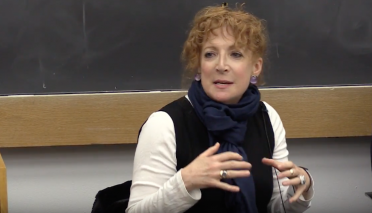
The panel included Jean Afterman, Senior Vice President and Assistant General Manager of the New York Yankees; Michelle (Mick) Lee, CEO and Founder of WINiT, a non-profit focused on promoting women in the travel industry; and Mary Harman, Managing Director of Global Payments, Bank of America. Jennifer Hill, former Chief Financial Officer of Global Banking and Global Markets at Bank of America, acted as moderator. Fielding questions from the audience and the moderator, the executives explained the role that everyone can play in expanding diversity in Edge.
Creating Pathways
Building a more diverse workforce isn't just good PR. It's good business, Hill noted. Numerous studies have shown that companies with more women and minorities in senior Leadership & Strategy positions are more profitable that those top heavy with white men. The challenge for even the most progressive companies, though, is finding qualified candidates who are ready to move up the corporate ladder.
Afterman pointed to the so-called “Selig Rule” to illustrate the problem. In 1999 then-baseball commission Bud Selig mandated that every club interview minority candidates for all senior-level positions. While hailed as a leap forward for diversity, under the Selig rule interviewing women became little more than a box that managers could check off because there were no women qualified for the positions, Afterman said. “You can't just get the job just because you're a woman,” she added.
That's why the Yankees started building a diversity pipeline, reaching out to women and other minorities to fill entry-level jobs that will provide the experience necessary to move up through the organization. “That's how we're trying to increase diversity in my industry,” Afterman said. “And not just for women, but for minorities or anyone you don't see represented in front offices.”
Another unintended consequence of the drive for diversity is that often women and other minorities are hired or promoted over more qualified candidates. “I would never want to be the person who was better qualified but wasn't selected because of some long-term corporate strategy that I can't impact or change,” Lee said.
Instead, identify the best-qualified women in the candidate pool who didn't make the cut and help her get the experience she needs to get the next job, Lee suggested. “She doesn't get the job until she deserves the job, but it helps her get what she needs to move forward,” she added
Leveling the Playing Field
Even as more women earn their MBAs, they are promoted less than men, and they are paid less than men when they do get promoted. “You can't disguise the fact that women vice presidents, on average, are paid less,” Harman noted. Of course, there are numerous factors affecting that pay differential that are totally legitimate, she added. But there are plenty that aren't. “Associates are all pretty much paid the same,” Harman said. “It's when you hit the VP and director level that the band starts to expand.”
That's about the time when women are starting families and will need maternity leave, and there's still a well-entrenched corporate culture that views having children as a negative, Harman says. Often women will simply opt out of the corporate world rather than swim against that tide. In fact, stepping away from careers to have children is regularly cited as a leading factor in the wage gap between men and women.
Among younger generations, though, prioritizing family over work isn't just a women's issue. Increasingly, men are eager to take a more active role in childrearing. To level the playing field in the office and at home more companies are offering some amount of paternity or family leave for men, too. For example, in March of 2016 Bank of America boosted its fully paid maternity, paternity and adoption leave to 16 weeks, up from 12 weeks.
Being an Advocate
No matter where you are in your career, you can take a Leadership & Strategy role in promoting diversity and respect throughout any organization, Lee said. It could be as simple as speaking up for yourself or for someone else in a meeting, whether it's a man or a woman struggling to be heard. “It's not about being for or against one gender,” Lee said. “It's about being a leader in everything you do every day.”
Lee urged the audience to identify just one or two things they could do every day to continue moving the ball forward. “If everyone has that approach to their day then, organizationally, things are going to change,” Lee said.