Official Logo of Columbia Business School
Academics
  • Visit Academics
  • Degree Programs
  • Admissions
  • Tuition & Financial Aid
  • Campus Life
  • Career Management
Faculty & Research
  • Visit Faculty & Research
  • Academic Divisions
  • Search the Directory
  • Research
  • Faculty Resources
  • Teaching Excellence
Executive Education
  • Visit Executive Education
  • For Organizations
  • For Individuals
  • Program Finder
  • Online Programs
  • Certificates
About Us
  • Visit About Us
  • CBS Directory
  • Events Calendar
  • Leadership
  • Our History
  • The CBS Experience
  • Newsroom
Alumni
  • Visit Alumni
  • Update Your Information
  • Lifetime Network
  • Alumni Benefits
  • Alumni Career Management
  • Women's Circle
  • Alumni Clubs
Insights
  • Visit Insights
  • Digital Future
  • Climate
  • Business & Society
  • Entrepreneurship
  • 21st Century Finance
  • Magazine
Insights
  • Digital Future
  • Climate
  • Business & Society
  • Entrepreneurship
  • 21st Century Finance
  • Magazine
  • More 

Tax Reform Fundamentals

Leading tax experts Mihir Desai, Michael Graetz, and Alex Raskolnikov discuss tax reform in the United States.

Published
December 19, 2017
Publication
Business & Society
Jump to main content
Richman Center Image
News Type(s)
Richman Center News
Topic(s)
Capital Markets and Investments, Tax Policy

0%

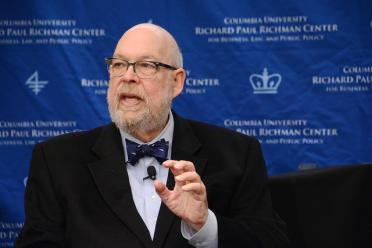
 Michael Graetz

With U.S. tax reform looming on the horizon, the Richman Center gathered a panel of subject matter experts to explain major policy issues, challenges, and opportunities. Hear what panelists Mihir Desai (Mizuho Financial Group Professor of Finance, Harvard Business School), Michael Graetz (Columbia Alumni Professor of Tax Law, Columbia Law School), and Alex Raskolnikov (Wilbur H. Friedman Professor of Tax Law, Columbia Law School) have to say.

Common Ground

The panelists noted that an American tax overhaul could actually be one of the few bipartisan issues of our day. According to Graetz, “We're seeing uniform consensus that the United States needs to lower the corporate tax rate.” Raskolnikov agreed, noting that “there are two big questions—revenue and distribution.”

The combination of a business-friendly president, a Republican Congress, and progressive reform features to placate Democrats could give tax reform a better chance than it has had in decades.

Background: 1986 Tax Reform

The last major U.S. tax policy reform was in 1986. This tax overhaul put the United States in a more competitive position with other countries, even giving it a leading role in corporate tax policy at the time. However, as other countries have continued to make progress with their handling of corporate taxes, the American tax system has fallen behind. With corporate tax rates stagnant since 1986, politicians and legislatures have called for a tax overhaul.

What is the Border Adjustment Tax?

In addition to lowering the corporate tax rate to 20 percent, the Destination-Based Cash-Flow Tax (DBCFT), also known as the House Blueprint, taxes goods and services in the jurisdiction where they are consumed—a major departure from the current system that bases taxes on where the goods and services are produced or where the company is headquartered. This so-called “border-adjustment feature” taxes imports and exempts exports.

The DBCFT effectively replaces the corporate income tax with a levy on consumers, but with major loopholes. In an effort to spur employment and development, companies can use the cost of wages as well as capital investments (rather than depreciating them over years) as tax deductions. However, interest costs would no longer be deductible. These features makes the DBCFT what Graetz calls “a cousin to a value-added tax (VAT),” making it progressive relative to a VAT, and suggesting that even some Democrats could embrace such a tax system.

The DBCFT has substantial support—and opposition as well. With its new lower tax rate and incentives for growth, “there's no longer any reason for companies to transfer out of the United States,” explained Mihir Desai. “The US could become a tax haven.”

You Might Like

Business and Society, Diversity, Ethics and Leadership, Globalization, Leadership, Leadership and Strategy, Management, Social Impact
Date
February 04, 2025
A protestor holding a placard
Business and Society, Diversity, Ethics and Leadership, Globalization, Leadership, Leadership and Strategy, Management, Social Impact

When Should Companies Take a Stand? The Risks and Rewards of Corporate Activism

New CBS research explores the factors driving inconsistent corporate stances on global sociopolitical issues and the risks that come with them.
  • Read more about When Should Companies Take a Stand? The Risks and Rewards of Corporate Activism about When Should Companies Take a Stand? The Risks and Rewards of Corporate Activism
Business and Society, Leadership
Type
Business & Society
Date
January 23, 2025
Business and Society, Leadership

The Wall and the Bridge with Glenn Hubbard

Taking Adam Smith’s logic to Youngstown, Ohio, as a case study in economic disruption, Hubbard discusses the benefits of an open economy and creating bridges to support people in turbulent times so that they remain engaged and prepared to participate in, and reap the rewards of, a new economic landscape.
  • Read more about The Wall and the Bridge with Glenn Hubbard about The Wall and the Bridge with Glenn Hubbard
Elections, Marketing, Politics
Type
Business & Society
Date
October 10, 2024
Elections, Marketing, Politics

The Rise of Meddle Ads in Political Campaigns—and Why They’re Backfiring

Watch Professor Mohamed Hussein describe this new approach to political campaigning and explain why it might not always have the desired impact.
  • Read more about The Rise of Meddle Ads in Political Campaigns—and Why They’re Backfiring about The Rise of Meddle Ads in Political Campaigns—and Why They’re Backfiring
Business and Society, Labor, Leadership
Date
September 05, 2024
CBS Photo Image
Business and Society, Labor, Leadership

The Power of New Hires: How Fresh Talent Shapes Company Culture

A company's culture can significantly impact its financial performance, employee retention, and the overall well-being of its employees, according to new research from Professor Wei Cai.
  • Read more about The Power of New Hires: How Fresh Talent Shapes Company Culture about The Power of New Hires: How Fresh Talent Shapes Company Culture
Save Article

Download PDF

More to Explore
Share
  • Share on Facebook
  • Share on Threads
  • Share on LinkedIn

External CSS

Homepage Breadcrumb Block

Official Logo of Columbia Business School

Columbia University in the City of New York
665 West 130th Street, New York, NY 10027
Tel. 212-854-1100

Maps and Directions
    • Centers & Programs
    • Current Students
    • Corporate
    • Directory
    • Support Us
    • Recruiters & Partners
    • Faculty & Staff
    • Newsroom
    • Careers
    • Contact Us
    • Accessibility
    • Privacy & Policy Statements
Back to Top Upward arrow
TOP

© Columbia University

  • X
  • Instagram
  • Facebook
  • YouTube
  • LinkedIn