

More than ever, innovation and change are the twin engines of growth, competitive advantage, and success in global business. Nevertheless, companies and organizations continue to struggle, often failing to inspire their people to embrace change or to help them develop innovative ideas.
The path to transforming innovation from an aspirational concept to the driving force of your company begins with understanding the root causes of our resistance to change.
With this understanding in place, we can explore the different people, processes, and creative tools to make innovation actionable.
Three Reasons Why Change Is Hard
Psychology and neuroscience offer us the three core reasons change is hard:
- Our brains are wired for laziness.
- Our brains' capacity is limited.
- Our brains don't like change.
Our brains are wired for laziness because they take in countless pieces of data at any given point, and they desperately try to make sense of this information by engaging in shortcuts such as pattern recognition that are not always accurate.
Our brains' capacity is limited because we have a limited amount of decision-making power in a given day before we just come to a stop. A famous National Academy of Sciences study of more than 1,000 parole board hearings demonstrated the limits of our brains' capacity. According to this study, at the beginning of the day and right after lunch, a judge would grant parole in 65 percent of the cases. By the end of the morning, and at the end of the day, favorable decisions in parole board hearings steadily decreased to nearly zero percent.
Our brains don't like change, because that's the way they are wired. Thanks to fMRI technology, we know that when you try to convince people to overcome their confirmation bias, to show that a fact does not confirm their bias, their brains react as if they were in pain.
To encourage and enable innovation, organizations must overcome these mental shortcuts, decision-making limits, and physiological resistance to change that undermine the creative thinking of their people.
Helping People Embrace Change
One way to overcome the mental shortcuts and limits of our brains is to incorporate different perspectives into your company's decision-making and creative-thinking processes. You can do this, for example, by kicking off meetings requesting contributions from team members via anonymous methods, such as submitting index cards or using a smartphone-based polling system. These methods give those who are less comfortable speaking up an equal opportunity to contribute ideas.
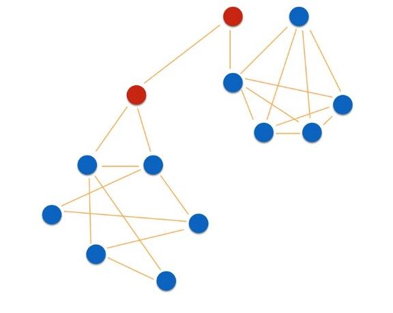
Another way is to deliberately develop weak ties in your organization, an approach related to network theory. Weak ties are connections to people with whom you have very little in common (the red dots in the below illustration). Data shows that organizations that are able to connect weak ties are more innovative. You can do this by making sure you have weak ties represented in your next meeting, or by purposefully holding brainstorming meetings across business units, geography, or products.
A third people-focused approach to enable innovation is to transform conflict into creative thinking, for example, by seeing an argument as two people coming at the same issue from different perspectives. Imagine two people looking at the image below. Rather than arguing over whether there are three bars or four, they could ask, “Why is it that you see three bars?” By changing the language from a sense of conflict, we can instead work to understand why people have differing opinions.

Divergence, Convergence, and Lazy Testing
Innovation is also built on creative processes. Among the most effective processes are divergence, convergence, and lazy testing.
Many organizations mistakenly conflate the divergence process—casting the widest net possible to generate the greatest number of ideas—with the convergence process—narrowing down the ideas to a select few to be pursued.
When you're in an organization engaged in change and innovation, you have to be purposeful about when you're in a diverging stage versus a converging one.
A number of different brainstorming tools are available for the divergence stage. A tried-and-true tool is SCAMPER, which stands for Substitute, Combine, Adapt, Modify, Put to another use, Eliminate, and Reverse. If your company wants to develop the next generation of a product or service, for example, your creative team might think about how to substitute the product or combine it with another, find another use for it, and so forth.
As with divergence, the process of convergence can be guided with different tools and methodologies in which the mass of ideas collected in the divergence phase are narrowed down through team consensus until there remain just a few viable ideas to test.
Once you've generated ideas and chosen a few to move forward with, the next step is to test them “lazily.” The laziness in lazy testing lies in the timing. Instead of expending significant resources to perfect and build a new product or service, lazy testing allows you to test them first preemptively. Procter & Gamble, for example, has built a virtual reality supermarket, in which customers pretend they are walking through the aisles. This allows them to test new products before moving onto subsequent stages of product-to-market fit testing.
Another way to test a product or service concept lazily is to build a prelaunch virtual test environment to gauge consumer interest in it. Before you manufacture a single product unit, you can create multiple web pages, or landing pages (see example below), that describe different versions of the potential offering and ask consumers to 'express their interest' in some way. You may ask them to share their email address, for example, to receive more information about the product, or to receive a special offer. The version of the offering that receives the highest engagement rate is the one that you would then launch. Imagine how much more likely your product's success rate will be after following this process!
To be an innovative company in the 21st century, then, requires a concerted effort to bring the right people together and to teach them effective creative thinking skills and decision-making processes.
