
The electric vehicle industry has disrupted more than a century of automobile innovation in under a decade. Not since the transition away from horse and buggy has there been more opportunities for car manufacturers and customers.
With more opportunities, however, come more challenges. EV companies must contend with formidable competition, lower profit margins, and the need to manage relationships with regulators, among other factors. These challenges are clearly being met, however, both domestically and abroad: EV sales in the United States grew nearly 52 percent in 2023, crossing the 1-million-unit mark for the first time in history, according to S&P Global.
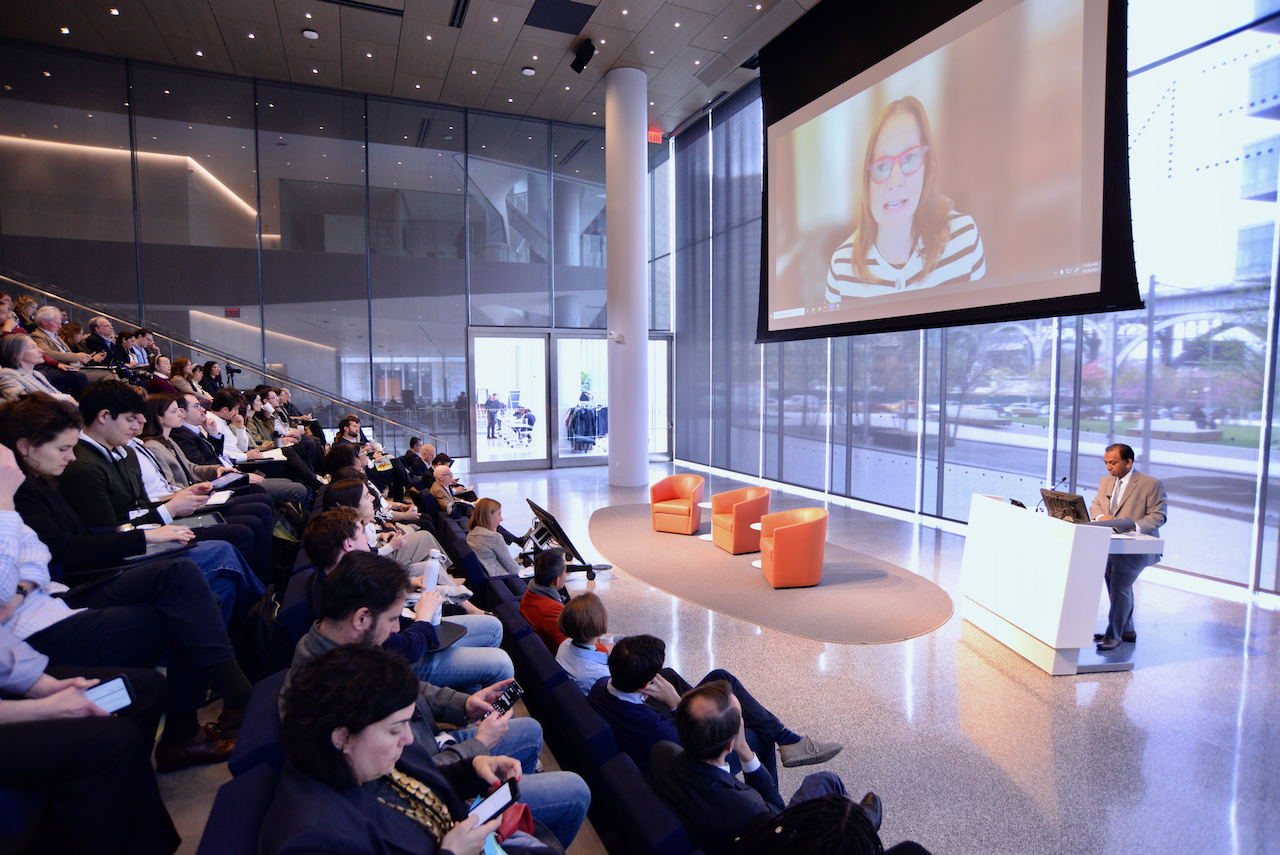
During a conversation with The Economist's Vijay Vaitheeswaran at Columbia Business School, General Motors CEO Mary Barra shared how one of the country's Big Three automakers is tackling the EV revolution. The discussion was part of the 2024 Climate Business & Investment Conference, hosted by the School's Tamer Institute for Social Enterprise and Climate Change, Columbia Technology Ventures, and Columbia Climate School.
Barra, who has served as GM's CEO for more than a decade, spoke candidly about GM's strategy of transitioning to a new industrial structure and shed light on EV adoption in global markets. She also addressed recent CBS research on China's EV subsidies. Below are key highlights from the conversation.
Winning Over Consumers Begins with Choice
Barra sees the advent of EVs as commencing one of the most transformative periods in GM's 115-year history, comparable to the transition from horse and buggy to motorized vehicles. EVs are objectively faster, cleaner, and for some, more fun to drive than their internal combustion engine (ICE) counterparts. Additionally, Barra said GM's EV portfolio can also address some of the more negative externalities of motor vehicles.
“I really see it as our responsibility to solve some of the issues around crashes and emissions and congestion. And to do that, we're building a portfolio of electric vehicles that will really give people choice — we think that's going to be critically important to drive EV adoption,” she said.
According to Barra, choice is key. The average purchase price for an EV at the end of 2022 was north of $61,000, according to Kelley Blue Book, mostly driven by the cost of battery manufacturing. While net-effective prices have fallen a bit, due in part to US tax incentives, new EVs still command significantly higher prices than ICE vehicles, leading the majority of consumers to choose the latter. During the conversation at CBS, Barra touted GM's Chevrolet brand as a means of penetrating the lower-cost EV market. One upcoming model, the Equinox EV, will likely fall into the $30,000 to $40,000 price range after tax incentives.
She added that new driver assistance technology, like GM's Super Cruise, will contribute to a world with fewer vehicle crashes and congestion.
“Being able to have a platform that spans that multitude of products is vitally important to getting that scale reach, making sure the customer has choices that they're comfortable making,” Barra said.
Tariffs on the Horizon
In early April, US Treasury Secretary Janet Yellen visited China amid concerns that Chinese subsidies to producers of EVs will take a massive bite out of US car manufacturers' sales if Chinese manufacturers are able to penetrate the market. As a result, US legislators have called for tariffs on China's clean energy exports, a move Yellen is strongly considering.
However, a recent article from CBS's Gernot Wagner, a senior lecturer and faculty director of the Tamer Institute's Climate Knowledge Initiative, and Shang-Jin Wei, the N T Wang Professor of Chinese Business and Economy, argues that tariffs are the wrong road to take. Western car manufacturers' suffering is largely “self-inflicted,” they write, arguing in favor of domestic subsidies instead.
“A punitive tariff that raises the prices of EVs and reduces competition is counterproductive. A subsidy race, together with stronger efforts at pricing carbon dioxide emissions, is vastly superior to a tariff war. The world will be both richer and cleaner for it,” the authors said.
During the conversation, Barra also highlighted the quality of GM's products, and while she stopped short of agreeing with Wagner and Wei, she added that “there's a role for governments to play to ensure there's a level playing field.” Thinking ahead to the 2024 US presidential election, she noted that a potential administration change would likely have little impact on the industry, pointing to the bipartisan nature of the Infrastructure Investment and Jobs Act as an example.
'What's Good for GM …'
Looking toward the future, Barra called for regulators to invest more in US electric infrastructure, praising the contributions made by the Infrastructure Reduction Act. Investing in the development of raw battery materials, the most critical component of EV manufacturing, was also top of mind.
When asked about problems GM's self-driving taxi subsidiary Cruise has faced, Barra noted the importance of working and communicating with regulators at all levels of government, including local. Cruise came under scrutiny in 2023, after a human-operated vehicle struck a pedestrian in the opposite lane, pushing her into the self-driving vehicle's path. The Cruise vehicle, believing there was a side-impact crash, attempted to pull over, dragging the pedestrian and causing injuries. As a result, GM paused Cruise operations pending an investigation.
But Cruise's shortcomings doesn't mean the United States should turn away from AI-driven vehicles, according to Barra. She pointed out that with AI-driven vehicles and AI more broadly, “human beings have more tolerance for human mistakes than they do for technology mistakes.” She added that Cruise's autonomous driving technology, like that of other manufacturers, was assessed to be at a higher level of driving ability than average human drivers.
In her closing thoughts, Barra noted that creating a seamless charging experience for consumers, investments in battery technology, and GM's continued vertical integration will be the key to an “all-electric future.” While EV market challenges will be omnipresent, she said, so will growth opportunities.
“My role is to make sure we're running a very efficient business that is satisfying, surprising, and delighting the customer,” Barra said. “We continue to grow and exist, and that's what I focus on every day.”