
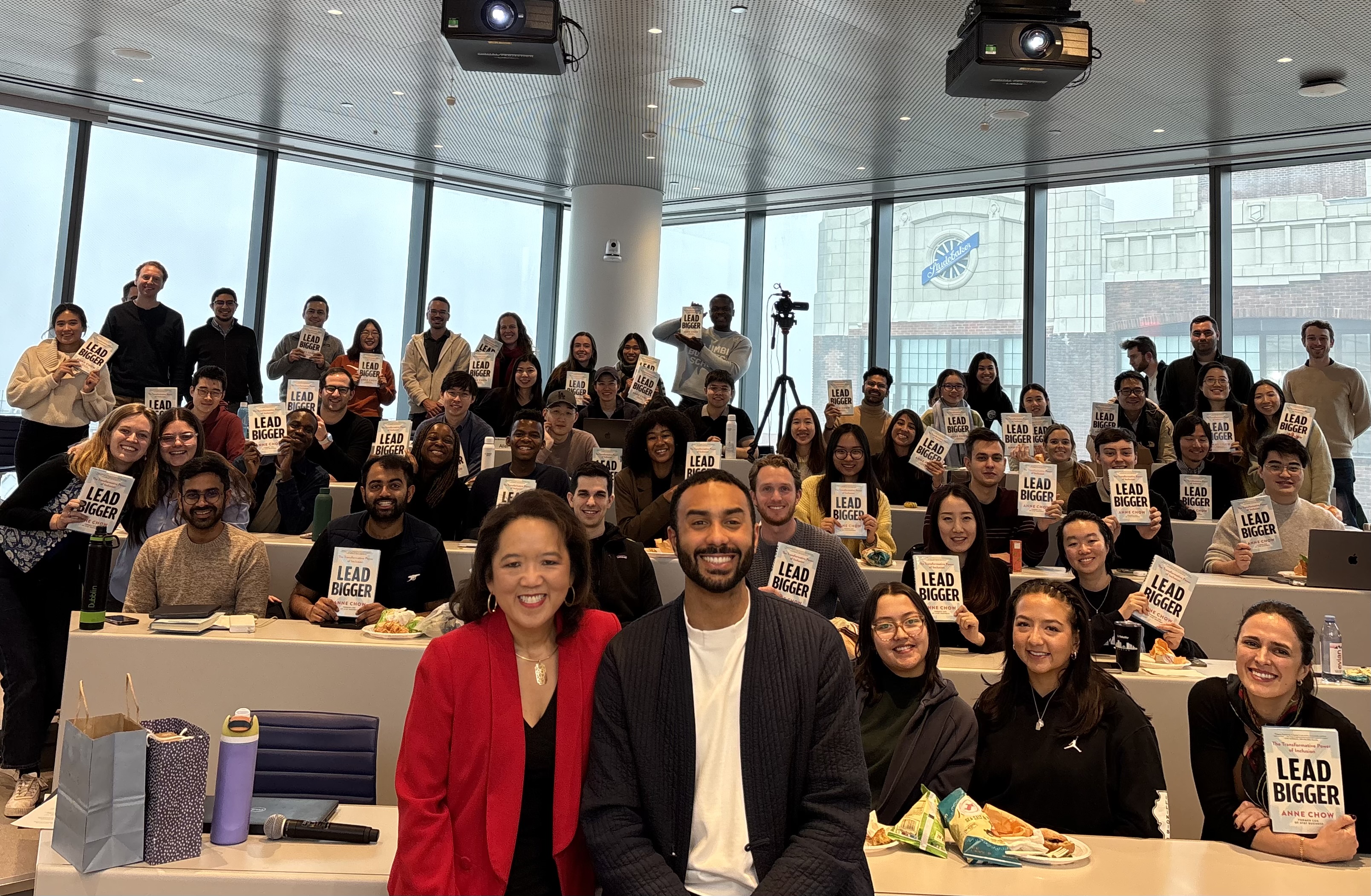
As the former CEO of AT&T Business and the first woman of color CEO in the company’s 140-year history, Anne Chow understands the impact that inclusive leadership can have on an organization. While leading a $35 billion global operating unit and 35,000 people, she cultivated a culture that served as a catalyst for greater innovation and performance.
Chow’s philosophy of leading bigger, which is also the name of her new book, is grounded in purpose, inclusion, and intentional action. In the book, she challenges leaders to widen their perspectives and embrace the transformative power of human-centric organizations. For those looking to elevate their leadership impact, Chow’s advice is clear: Align with your purpose, lead with authenticity, and never lose sight of the fact that every business is, at its heart, a people business.
In a recent conversation with Columbia Business School Professor Derek Brown, hosted by the Reuben Mark Initiative for Organizational Character and Leadership, Chow drew from her principles – and from three decades of experience – to share lessons for business leaders seeking to navigate uncertain times, inspire their teams, and create sustained success.
Leading Bigger for Greater Impact
Chow emphasized that creating an inclusive culture requires proactive effort, from seeking diverse hires to encouraging open and constructive dialogue. Her philosophy of leading bigger is synonymous with inclusive leadership. At its core, this means widening perspectives to achieve greater performance and impact. She challenges leaders to intentionally seek out diverse viewpoints, engage with differing data sources, and learn all parts of their business in order to unlock new ideas and drive competitive advantage.
“When I started working at AT&T, I knew that I wanted to move into places of power and influence where people like me were not well represented, which in business were areas like strategy or product management,” Chow said. “[These are places] where you're running businesses [and] where you're making decisions about capital allocation and the strategy around where the companies are going.”
According to Chow, this approach isn’t just about representation—it’s about fostering connections that drive innovation and performance.
Every Business Is a People Business
Regardless of industry, technology, or market focus, a business’ long-term success ultimately hinges on people, according to Chow. She encouraged leaders to create spaces where diverse perspectives can thrive, highlighting that innovation often springs from varied experiences and backgrounds.
“It's not business that drives people. It's people who drive every single business. And the sooner you recognize that in your professional journey, the more successful and impactful you'll be,” Chow said.
She added that to create these sorts of workplaces where innovation can occur, leaders should recognize and celebrate individual contributions to strengthen team cohesion and engagement.
Align Personal Values With Your Organization’s Purpose
Chow argues that having clear purpose and values are non-negotiable for any leader aiming to inspire and drive meaningful change. She emphasized that every professional journey is deeply connected to personal experiences and values.
For Chow, those experiences come from being the daughter of Taiwanese immigrants. Her parents instilled within her foundational values of education, integrity, and lifelong learning—principles that shaped her leadership style.
"It is our job as leaders to help our people and ourselves find and see and embrace meaning in our work,” Chow said.
Leaders, she argued, must be clear about their own values and ensure alignment with their company's mission. This alignment not only fosters authenticity but also cultivates an environment where employees feel motivated and connected to their work.
In order to further ensure this alignment, leaders should periodically reflect on their most important values and assess whether their organization’s mission aligns with these principles. A disconnect can erode authenticity and hinder leadership effectiveness.
Rethink the Meaning of DEI in Leadership
Chow offered a nuanced perspective on diversity, equity, and inclusion initiatives, emphasizing that while the terminology can be polarizing, the underlying principles remain essential for a business’ success.
Diversity, she argued, reflects the reality of today’s interconnected world; equity ensures fairness and access; and inclusion demands intentional actions to create environments where all voices are heard.
“Inclusion requires that you think differently, that you act differently, that you behave differently. To choose to do something inclusively means that you're widening your perspective to have greater performance and impact,” Chow said.
Rather than getting lost in acronyms, Chow encouraged leaders to focus on the core business imperative: fostering environments where diverse talent can thrive, leading to stronger performance and innovation.