
Leadership Implications
- Improving board diversity can only occur as a result of board expansion or member turnover. Only the latter is sustainable.
- Since the 2008 financial crisis, the percentage of women joining boards has increased. But gains have been partly offset by attrition.
- The long tenures of board directors slow the transition to more diverse boards.
- Proxy contests to board elections dramatically increase the rate of board turnover.
In "Diversity Through Turnover: How to Overcome the Galacial Pace Toward Board Diversity?"" Bernstein Faculty Leader Wei Jiang identifies the long tenures of directors as the bottleneck slowing diversification of corporate boards. While other research has examined the diversity of leadership positions within boards, this paper is the first to assess the impact of board turnover.
Investigating the Slow Pace of Change
Jiang analyzed the makeup of corporate boards in the U.S. finding that about 30 percent of board members appointed since the 2008 financial crisis were women. Many of these gains resulted from one-time expansions of corporate boards to include more seats—a practice that isn’t sustainable in the long term. Jiang also found that a proportionate number of women left boards through normal attrition, further slowing the uptick in the overall rate of female membership.
Jiang also scrutinized the records of proxy contests to board elections resulting from shareholder activism. She found the contests increased board turnover rates by 50 percent. Previous research found that nominees put forward by shareholder activists especially in early years were less likely to be women. Even so, Jiang’s calculations revealed a net positive effect for diversity, due to the much higher rate of turnover caused by the external pressure.
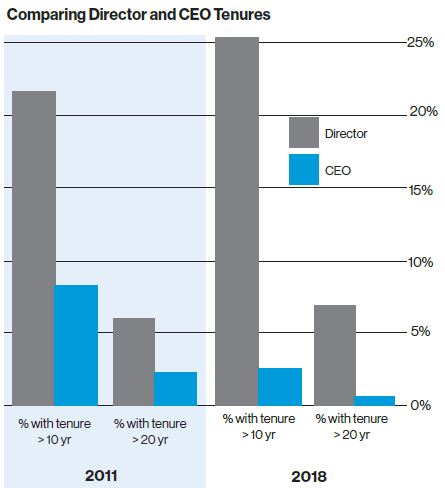
Without external pressure, there was little motivation for board members to voluntarily leave their posts. Jiang found the average annual turnover rate to be just 8.9 percent. About one-quarter of the directors had been in their seats for 10 years or more, while 8.5 percent held their seats for 20 years. By comparison, Jiang noted the average annual turnover rate of corporate CEOs is 12.5 percent, and the percentages of CEOs holding their positions after 10 and 20 years were 3 percent and 1 percent, respectively. A board that relies on natural turnover will take a very long time to diversify even if it does a terrific job in diversifying the new recruits.
Conclusions
Gender diversity was the focus of this study, however the insights regarding board turnover are just as relevant for increasing racial diversity. Similarly, while the study examined the recent developments in gender diversity on U.S. corporate boards, the lessons are likely to be applicable in other countries of the developed world where the progress of diversification has largely mirrored the U.S.
A board that relies on natural turnover will take a very long time to diversify even if it does a terrific job in diversifying the new recruits.
Improvements in gender diversity have been driven primarily by two factors: expanding the number of board seats and nominating more women. The former is a one-time boost that obscures the persistence and importance of the underlying situation, and the latter may be restrictive given a corporation’s other strategic needs.
A better option for increasing board diversity would be to focus on director turnover. By setting soft caps on tenures and neutralizing any stigma associated with short board terms, corporations can avoid diversity fatigue and ensure enough room for candidates with a range of contemporary skills and knowledge. Higher turnover would quickly refresh corporate boards from today’s inherently more diverse talent pool, closing the gender gap while also meeting the need for up-to-date skill sets.
Explore more Bernstein-sponsored research that highlights real-world applications for leaders.