
Leadership Implications
- Improving gender equity in the labor market can significantly increase output and efficiency of businesses and the macroeconomy.
- According to a revealed-preference measure, men and women attach different weights to pay versus non-pay job attributes (e.g., schedule flexibility, generous parental leave, etc.).
- Gender-targeted recruitment policies play an important part in explaining why men and women end up in different jobs.
In "The Gender Pay Gap: Micro Sources and Macro Consequences," Bernstein Faculty Leader Christian Moser and co-author Iacopo Morchio from the University of Bristol overcome this challenge by studying employment records of millions of workers collected by the Brazilian government between 2007 and 2014. The authors find a 9 percent gender pay gap in the Brazilian labor market. At the same time, their study allows for the possibility that there are important differences in how women and men perceive the value of non-pay job attributes. Consistent with this hypothesis, they find that women are significantly more likely to leave a high-paying job for a new job with lower pay but better amenities.
While gender preferences in job attributes are important, the study also highlights the importance of gender-specific obstacles in the labor market, such as gender bias in firms’ recruiting behaviors and unequal treatment on the job. Overall, these gender differences in the Brazilian economy account for up to 3.5 percent in output losses due to the fact that women currently face barriers that keep them out of some of the most productive jobs. This means that improving gender equity can simultaneously boost economic efficiency—a lesson that is likely applicable to labor markets around the world.
Understanding Gender Preferences in Job Value
Moser first generated employer ranks based on a revealed-preference argument that uses a variant of the PageRank algorithm developed by Google founders Larry Page and Sergey Brin. Google’s version of this algorithm has been used to rank websites according to their popularity as measured by the pattern of between-website referrals. Moser’s modified version of the PageRank algorithm can be used to rank employers in the labor market based on the pattern of between-firm worker flows. In essence, the researchers deduce that a firm has a high amenity value if its employer rank is high relative to its pay rank. By creating this ranking separately for men and women, Moser is able to compare the relative importance of pay versus non-pay job attributes across genders.

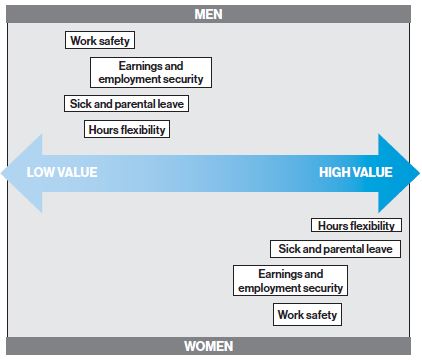
The research concludes that approximately one-fifth (or around 2 percentage points) of Brazil’s gender pay gap can be attributed to gender-specific valuations of job amenities. Specifically, women are more willing than men to give up pay in favor of better workplace amenities. The remaining four-fifths of the pay gap was due to labor market barriers that may include different forms of discrimination, both in hiring and treatment on the job.
Conclusions
The study points toward two complementary approaches for closing the pay gap and improving overall gender equality. The first is for policymakers to level the playing field for men and women along the lines of equal pay and amenities provision on the job. The second approach is to help women get into the right jobs, where they find their preferred mix of pay and amenities.
Women are significantly more likely to leave a high-paying job for a new job with lower pay but better amenities.
Some popular gender-equality proposals fall short of achieving their stated goal. For example, equal-pay mandates address only the first of these two approaches, while equal-hiring policies address only the second. Moser’s research suggests that such one-dimensional approaches are not effective at closing the gender gap. In fact, they could exacerbate gender differences by inducing some employers to offset regulations. For example, an equal-pay mandate may make it less likely for some firms to hire women, while an equal-hiring policy may increase the gender pay gap within firms.
Instead, a multi-pronged approach is needed. Equal treatment on the job and equal opportunities to find the right job go hand-in-hand, and policies aiming to close the gender gap must address both dimensions at the same time.
Explore more Bernstein-sponsored research that highlights real-world applications for leaders.