Leadership Implications
- Similar brand preferences increase people’s willingness to discuss divisive social issues.
- With brand preference serving as a common denominator, brand communities offer a positive safe space for dialogue by deescalating demographic differences and increasing an appreciation for a difference in opinions.
- Brands could be a vehicle to help reduce social polarization if they foster difficult conversations among loyal consumers.
In “The Power of Brands: Similarity in Brand Preferences Increases Willingness to Discuss Controversial Issues,” CBS PhD candidate and Bernstein Research Grant recipient Sonia Kim investigates people’s willingness to discuss controversial topics with others who share their brand preferences. She and her collaborator, CBS professor Gita Johar, find that when people believe potential conversation partners share their brand preferences, they are more willing to engage in a dialogue and that those discussions are more impactful.
Testing Conversational Attitudes
The researchers conducted a series of eight studies to test the effects of brand preference similarity on people’s willingness to discuss controversial issues. The first study confirmed the theory that people assume others who share their same brand preferences also share similar personal values, such as an interest in healthy living or environmentalism — even when the brands involved were not inherently activist or political. Then, because previous research showed that anticipated disagreement is one of the biggest barriers to initiating controversial conversations, the researchers tested whether people were more willing to discuss a divisive topic (in this instance, raising the minimum wage) when they were informed that the discussion partner shared the preference for a favorite car brand. The results showed they were significantly more willing.
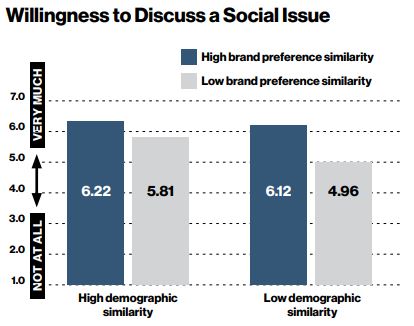
Brand preference is a stronger driver than demographics when it comes to creating a willingness to discuss controversial issues.
Importantly, the researchers found that liking the same brand is particularly effective in fostering conversations among people from dissimilar demographic backgrounds. While people are generally willing to discuss even sensitive topics with others from similar demographic backgrounds, they avoid initiating conversations with people from different demographic groups altogether. In one study, the researchers revealed that people can overcome this reluctance if they learn that the potential conversation partners prefer the same brands as them. (See graph).
Next, the researchers investigated whether brand preferences could help overcome differences in opinion. They showed that even when people learned their potential discussion partners held different positions than their own on a topic, they were still more willing to talk about it with people who shared their brand preferences. Plus, once people participated in the conversations, they were much more willing to find common ground. Surveying participants before and after discussions showed that even very short conversations decreased opinion differences (in this case, about phasing out gasoline-powered cars) and opinions converged even more when participants believed their discussion partners shared brand preferences.
In a final study, the researchers analyzed brand and non-brand communities on Reddit. They found that brand-associated forums have a generally more positive and receptive conversational tone, expressing more positive emotions and less negative emotions, anxiety, and anger.
Conclusions
Statistics suggest that people from different demographic backgrounds tend to have opposing opinions on social issues. Previous research also shows this disagreement worsens when people choose to interact only within their demographic bubble. This new research finds that brand preference is a stronger driver than demographics when it comes to creating a willingness to discuss controversial issues.
Society needs solutions that create opportunities for people from distinctive backgrounds to interact, and this research suggests brands are uniquely positioned to help create positive and welcoming spaces for dialogue. By convening healthy conversations and debates among their fans, brands could help reduce the increasing polarization in society today and foster a shared appreciation of how similarities and differences of opinion can co-exist in communities.
Explore more Bernstein-sponsored research that highlights real-world applications for leaders.
