
Somewhere in a nondescript American suburb, a tale of two morning commutes is unfolding: A woman donning an Under Armour backpack steps onto her front porch, where a Trump flag flaps in the wind overhead. At the same time, her neighbor strolls past an “In This House, We Believe…” sign staked into the grass, a Starbucks cup in hand. The pair walk briskly to their respective cars: a Tesla for the first neighbor, a Toyota for the second.
These days, it’s not just overt lawn displays or candidate T-shirts that signal someone’s political leanings — increasingly, the products we buy, brands we affiliate with, sports teams we root for, and nonprofit organizations we support allude to our political preferences.
“During the Trump-Clinton election in 2016, we started seeing political polarization in a magnitude we had never seen before,” says Oded Netzer, the Arthur J. Samberg Professor of Business in the Marketing Division at Columbia Business School. “As researchers, we asked ourselves: How deep does this division go? Does it spread to non-political behaviors like brand preferences and purchases?”
While there are some straightforward barometers of political allegiance — if someone follows Breitbart vs. The New York Times, or if they donate to the National Rifle Association (NRA) vs. Planned Parenthood — Netzer wanted to know if those patterns extended to a preference for brands like Pepsi or Coke. To find the answer, he and a team of researchers embarked on a research initiative analyzing how consumers’ political preferences are reflected in their brand affiliations and product selections.
Key Takeaways:
- Political polarization in the United States extends beyond obvious political indicators; increasingly, it spills over to other aspects of our lives, like our brand preferences and purchases.
- Social media can provide insights into the “political color” of brands and their customers.
- The rise in brand-preference polarization is often exhibited by the political group that has suffered a loss (e.g., Democrats after the 2016 election).
- This pattern is consistent with the psychological theory of compensatory consumption. When faced with an identity threat, consumers compensate by more strongly supporting brands that purport their political identity.
Social Media Provides a Window into Consumer Preferences
To investigate this topic, the researchers identified users’ political affiliations based on whether they followed official Democratic or Republican Twitter (now known as X) accounts. They examined the brands and organizations that these Twitter users followed and determined each account’s political leaning based on the apparent political affiliation of its followers.
The researchers then compared the social media data to external measures, including stated brand preferences from consumer surveys and purchase data from the Nielsen Homescan Consumer Panel. Ultimately, the results of the Twitter analysis were consistent with the other, more established data sets, indicating that social media followership can be a reliable bellwether of brand preference polarization.
“It turns out that social media is not just a catalyst for polarization but also a window into it,” says Netzer. “We can look at the followers of a brand, determine their political affiliation, and then analyze what percentage of the followership is red or blue.”
‘Color Coding’ Brands via Social Listening
With this data in hand, the researchers created the Social Listening application programming interface (API), which allows users to look up the political affiliations of various brands based on their Twitter followerships.
“We’re able to take any brand you want and color it — meaning, show what proportion of the brand followers belong to each side of the political map,” explains Netzer. “What we found is that polarization goes deep. It extends to the products we buy, the airlines we fly, the cars we have, and the drinks we drink.”
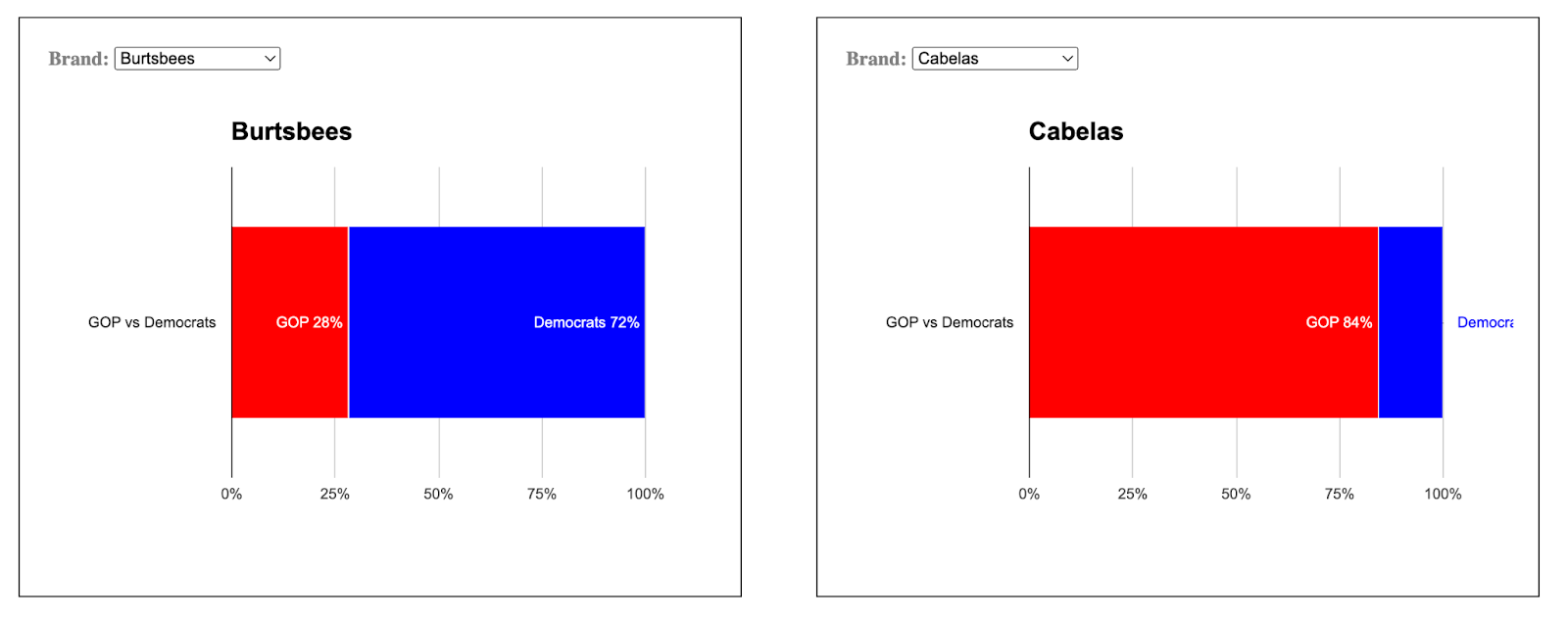
The majority of consumer brands fall within the 60 to 40 range on the Social Listening API, but some brands lean more strongly in one direction or another — Burt’s Bees, for instance, skews 72% blue, and Cabela’s Retail is 84% red on the scale.
Compensatory Consumption: The Psychology of Consumer Preferences
The postelection landscape saw dramatic shifts in where brands fell on the Social Listening scale — largely reflecting Democrats’ flight to brands they perceived as reflecting liberal values. At the time of the research, after the 2016 election, the data suggested an outsized polarization effect for Democrats versus Republicans, indicating that the 2016 election outcome had a stronger impact on liberals’ consumer behavior than on conservatives’.
This phenomenon aligns with a psychological theory called compensatory consumption, explains Netzer. “This occurs when someone’s identity is being threatened,” he says. “One of the mechanisms by which they try to take back control is through consumption.” He gives an example: “If my identity as someone who is environmentally conscious is being threatened, I’m more likely to make purchases that make it clear I support sustainability.”
Notably, as time went on and political winds shifted, Netzer watched this trend reverse, further solidifying the compensatory consumption theory: “After Biden was elected, we started seeing a reversal of this — Republicans suddenly started to buy more of their ‘type’ of products.”
Brands, Echo Chambers, and the Power of ‘Knowing Your Color’
The study also examined the impact of companies taking political stances. Brands that took active stances against President Trump or his policies — like Nordstrom discontinuing Ivanka Trump’s product line — saw significant shifts in their customer base’s political affiliation. Notably, more liberal-leaning accounts flocked to the brand online than conservative-leaning accounts abandoned it.
Netzer notes that this finding has implications for brands, including how they tackle messaging and marketing. While there’s some risk of alienating customers, there may be opportunities to strengthen loyalty with others. “I think it’s important for brands to understand their color — is it consistent with whatever they’re selling?” he says. “Brands that take a stand can also shift their mix of customers; it’s something they can take ownership over.”
For consumers, this research also highlights how political identities can shape what they’re drawn to on store shelves or online. To further investigate the implications of this, Netzer is now conducting subsequent research on the impact of echo chambers on consumer decision-making and market dynamics — an initiative he hopes will provide insights into breaking dangerous polarization cycles.
“At the heart of these polarizations is the fact that we don’t surround ourselves with different preferences or opinions,” says Netzer, noting that there are valuable learning opportunities and empathy-building benefits associated with escaping echo chambers. “Whether it’s politics or brands, if you actively seek more diversity of opinions from other people around you, you might learn something, even if you disagree with it.”
Adapted from “Frontiers: Polarized America: From Political Polarization to Preference Polarization” by Oded Netzer of Columbia Business School, Verena Schoenmueller of ESADE University, and Florian Stahl of the University of Mannheim, Germany.
