Official Logo of Columbia Business School
Academics
  • Visit Academics
  • Degree Programs
  • Admissions
  • Tuition & Financial Aid
  • Campus Life
  • Career Management
Faculty & Research
  • Visit Faculty & Research
  • Academic Divisions
  • Search the Directory
  • Research
  • Faculty Resources
  • Teaching Excellence
Executive Education
  • Visit Executive Education
  • For Organizations
  • For Individuals
  • Program Finder
  • Online Programs
  • Certificates
About Us
  • Visit About Us
  • CBS Directory
  • Events Calendar
  • Leadership
  • Our History
  • The CBS Experience
  • Newsroom
Alumni
  • Visit Alumni
  • Update Your Information
  • Lifetime Network
  • Alumni Benefits
  • Alumni Career Management
  • Women's Circle
  • Alumni Clubs
Insights
  • Visit Insights
  • Digital Future
  • Climate
  • Business & Society
  • Entrepreneurship
  • 21st Century Finance
  • Magazine

The Carbon Knowledge Gap: Why Most Consumers Struggle to Make Effective Eco Choices

A new Columbia Business School study reveals a troubling knowledge gap: most consumers can’t accurately estimate carbon emissions from industries, companies, or behaviors, undermining their ability to make impactful eco-friendly decisions.

Based on Research by
Eric Johnson, Eli Sugerman, Vicki Morwitz, Gita Johar, Michael Morris
Published
January 14, 2025
Publication
Research In Brief
Focus On
Climate, Consumer Behavior, Social Impact
Jump to main content
Air travel
Category
Thought Leadership
Topic(s)
Business and Society, Climate and Consumer Behavior, Data/Big Data, Tamer Institute for Social Enterprise and Climate Change

About the Researcher(s)

Eric Johnson

Eric Johnson

Norman Eig Professor of Business
Marketing Division
Director
Center for the Decision Sciences
Fellow
Association for Psychological Science
Vicki Morwitz

Vicki Morwitz

Bruce Greenwald Professor of Business
Marketing Division
Gita Johar

Gita Johar

Meyer Feldberg Professor of Business
Marketing Division
Michael Morris

Michael Morris

Chavkin-Chang Professor of Leadership
Management Division
Eli Sugerman

Eli Sugerman

PhD Candidate
Marketing Division

View the Research

Widespread misestimates of greenhouse gas emissions suggest low carbon competence

0%

When Columbia Business School Professor Eric Johnson was planning to travel to a speaking engagement in Washington, D.C., he asked an engineering postdoctoral fellow how much worse it was — in terms of carbon output — to take a plane than a train from New York to Washington. He did not expect it to take her days to figure it out. 

“She told me she spent 20 hours doing the calculation,” he says. It was a complicated comparison, involving variables like how full the train was and whether a flight would take off as scheduled or face delays. In the end, she estimated the plane trip would emit nine times as much carbon as the same journey taken by train — a massive difference, and not one that was readily calculated. “It's not like she could just look that up,” Johnson says. The interaction emphasized to him how hard it can be for the average person to understand the relative scale of carbon emissions.

Johnson recognized that while many individuals try to make more sustainable choices, just like he did, it’s impossible to make the right choice without knowing which behaviors matter more than others and which firms — and, on a broader scale, which industries — emit more greenhouse gasses. Thus began his investigation into just how carbon savvy consumers really are. 

Key Takeaways From the Research

  • Across five studies, the researchers showed that laypeople could not accurately estimate relative carbon emissions by industry, company, or behavior. This knowledge gap persisted regardless of their political affiliation or level of concern about climate change.
  • The research demonstrated that people used attribute substitution, whereby they substituted easier-to-assess attributes — like the perceived healthfulness of a company’s product — when estimating carbon emissions, leading to errors. 
  • This knowledge gap highlights the challenge consumers face in aligning their sustainability intentions with impactful actions. Making objective information about carbon emissions more available and accessible could help.

How Little We Know

Johnson, the Norman Eig Professor of Business in the Marketing Division at CBS, and his team of CBS co-authors examined how much laypeople know about the relative carbon emissions of various behaviors, firms, and industries. “The answer, I thought, would be, not a lot,” he says, but it was worse than that. “The answer is zero.”

The researchers devised a series of quizzes that participants could complete on their phones, ranking behaviors, firms, and industries by carbon emissions. They then administered it to 2,000 people across various groups, from social media users to climate conference attendees to readers of Columbia Business, the School’s magazine. The results were overwhelmingly bad: The average correlation between participants’ estimates and the actual emissions was close to zero, indicating a near-complete lack of knowledge.

Aside from correctly placing airlines at the top of the industry rankings of carbon emitters, study participants were unable to rank industries like apparel and footwear (they overestimated its emissions) or beverages (underestimated). Among companies, participants ranked Chipotle far below McDonald’s in terms of carbon emissions, but the two companies are actually close to equal in their output. Participants also failed to identify the carbon effects of behaviors, overestimating the impact of reducing garbage while vastly underestimating the importance of avoiding long-distance flights, objectively the most effective emissions-reducing behavior of the available choices. 

The research showed one contributing factor in the poor results is the cognitive process known as attribute substitution, where participants, not knowing the answer to one question (in this case, which company, industry, or behavior contributes most to carbon emissions), will answer an easier, related though less relevant question. In this series of studies, participants more highly ranked the effectiveness of behaviors they may have heard about frequently, like reducing garbage through recycling, Johnson says. Even though not taking long-distance flights is more impactful, people may hear that suggestion less often than they are urged to recycle. Likewise, participants ranked Chipotle as having a smaller carbon footprint than McDonalds, which may be due to Chipotle’s “advertising emphasis on health, which the consumer may associate with sustainability,” the study states. “In reality, health perceptions may or may not correlate with emissions.”

The results remained consistent even when the researchers factored in political ideology, environmental concern, and a person’s self-reported knowledge, or how much they thought they knew. Only experts working in conservation estimated carbon emissions rankings more accurately than the general population, although accuracy was still limited. “​​It took people who are really in the business to do this,” Johnson says.

Learning to Build a Greener Future

The problem with such widespread ignorance, according to Johnson, is that it prevents well-intentioned people from making effective decisions. “Imagine there were food labels that didn't have any ingredients on them; your choices would be worse,” he says. “And I think that's exactly what happens here.” In this case, lack of information hinders people’s ability to help mitigate the climate crisis.

Retailers can help bridge the information gap, Johnson says. He points to Google Flights as an example: If you search for air travel options on Google, it offers an option to sort ticket options by carbon emissions. Furthermore, he adds, while some firms may be motivated to conceal high emissions, businesses that have worked to lower their carbon footprint should make efforts to advertise that fact. 

“If I'm a firm that  has low emissions, I shouldn't assume that people know that and will choose my product,” he says. “I have to do some education — maybe compare myself to other products.” 

Behavior and Industry-Level Accuracy
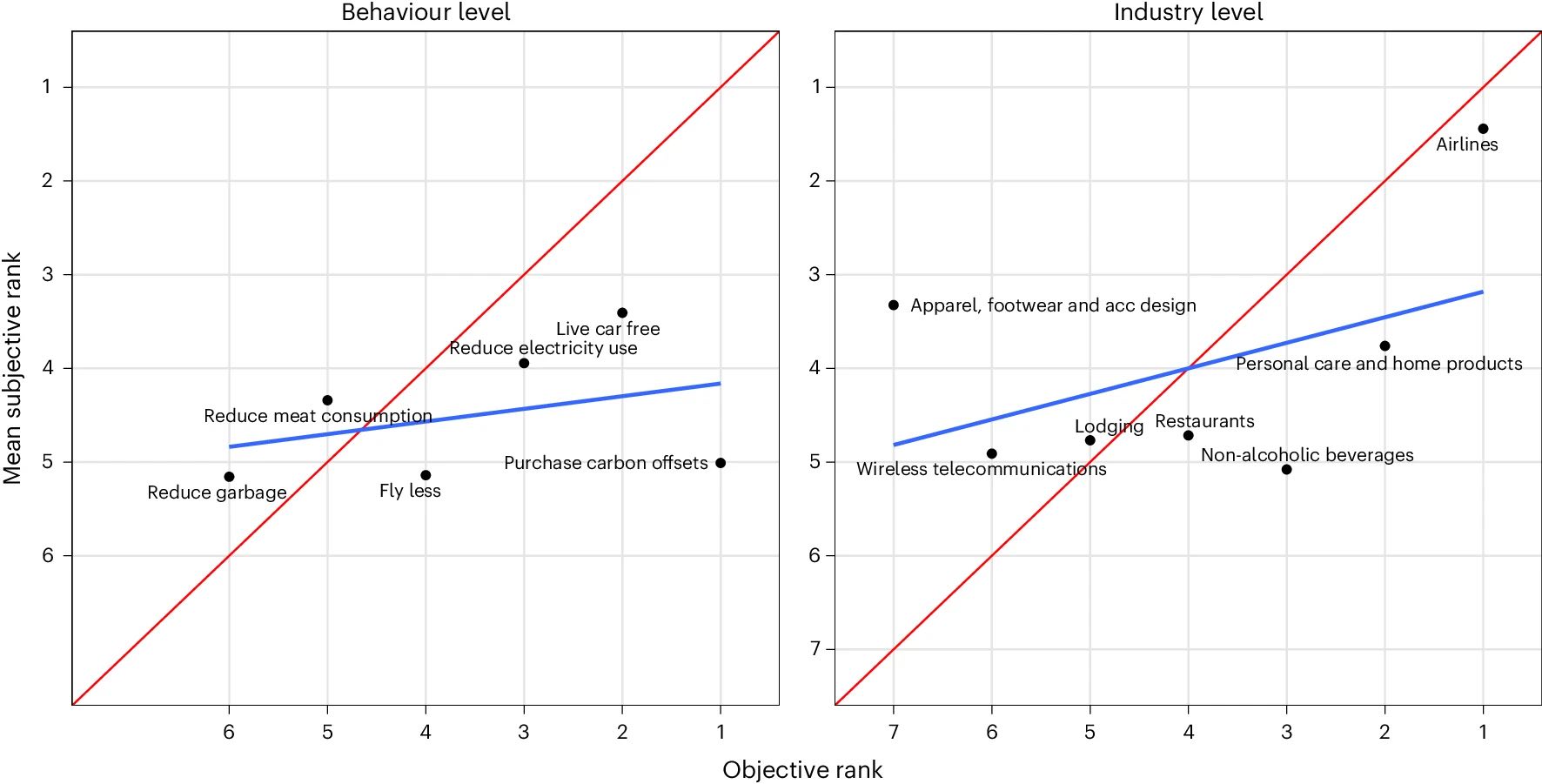
Behavior and industry-level accuracy.
Behaviour-level plot (left, study 3) and industry-level plot (right, study 4) comparing participants’ mean subjective rankings (y axis) with objective ranks (x axis), pooled across conditions. If participants were perfectly accurate, all behaviours (left) and industries (right) would fall on the red 45° line. The items above the red 45° line are overestimated, while those below are underestimated. The linear line of best fit is plotted in blue. On both the x and y axes, the values closer to the origin represent lower emission-reduction potential (left) and lower emissions (right).


Adapted from “Widespread misestimates of greenhouse gas emissions suggest low carbon competence,” by Eric J. Johnson, Eli Rosen Sugerman, Vicki G. Morwitz, Gita V. Johar, and Michael W. Morris from Columbia Business School.

About the Researcher(s)

Eric Johnson

Eric Johnson

Norman Eig Professor of Business
Marketing Division
Director
Center for the Decision Sciences
Fellow
Association for Psychological Science
Vicki Morwitz

Vicki Morwitz

Bruce Greenwald Professor of Business
Marketing Division
Gita Johar

Gita Johar

Meyer Feldberg Professor of Business
Marketing Division
Michael Morris

Michael Morris

Chavkin-Chang Professor of Leadership
Management Division
Eli Sugerman

Eli Sugerman

PhD Candidate
Marketing Division

View the Research

Widespread misestimates of greenhouse gas emissions suggest low carbon competence

You Might Like

Data/Big Data, AI and Transformative Tech, Marketplace
Date
April 21, 2025
Online real estate listings
Data/Big Data, AI and Transformative Tech, Marketplace

Uncovering the Costly Bias in Marketplace Testing

Statistical bias could be misleading your product and feature testing, according to research from Columbia Business School Professor Hannah Li, but solutions might be easier than you think.
  • Read more about Uncovering the Costly Bias in Marketplace Testing about Uncovering the Costly Bias in Marketplace Testing
Algorithms, Analytics, Artificial Intelligence, Business and Society, Business Economics and Public Policy, Data and Business Analytics, AI and Transformative Tech, Digital IQ, Finance, Marketing, Marketplace
Date
April 17, 2025
Close-up computer monitor with trading software
Algorithms, Analytics, Artificial Intelligence, Business and Society, Business Economics and Public Policy, Data and Business Analytics, AI and Transformative Tech, Digital IQ, Finance, Marketing, Marketplace

Designing Smarter Economic Systems: A New Approach to Mechanism Design

Award-winning research from Professor Laura Doval tackles the “limited commitment” problem in economics, offering a model that helps governments and firms adjust rules and strategies based on new information over time.
  • Read more about Designing Smarter Economic Systems: A New Approach to Mechanism Design about Designing Smarter Economic Systems: A New Approach to Mechanism Design
Data and Business Analytics, Data/Big Data, AI and Transformative Tech, Digital IQ, Marketing, Media and Technology
Date
April 04, 2025
Shopping for travel online
Data and Business Analytics, Data/Big Data, AI and Transformative Tech, Digital IQ, Marketing, Media and Technology

How Real-Time Click Data Drives Smarter Personalization

New Columbia Business School research reveals how analyzing real-time customer journey data — from search queries to filtering behavior — can predict preferences with remarkable accuracy, even without historical data.
  • Read more about How Real-Time Click Data Drives Smarter Personalization about How Real-Time Click Data Drives Smarter Personalization
Business and Society, Economics and Policy, Globalization, Management, Social Impact
Date
March 27, 2025
Depressed woman in business
Business and Society, Economics and Policy, Globalization, Management, Social Impact

When Economic Struggles Foster Self-Interest, Not Universal Compassion

A Columbia Business School study shows that experiencing a recession in young adulthood leads to lasting support for wealth redistribution—but mostly for one’s own group.
  • Read more about When Economic Struggles Foster Self-Interest, Not Universal Compassion about When Economic Struggles Foster Self-Interest, Not Universal Compassion
Save Article

Download PDF

More to Explore
Share
  • Share on Facebook
  • Share on Threads
  • Share on LinkedIn

External CSS

Official Logo of Columbia Business School

Columbia University in the City of New York
665 West 130th Street, New York, NY 10027
Tel. 212-854-1100

Maps and Directions
    • Centers & Programs
    • Current Students
    • Corporate
    • Directory
    • Support Us
    • Recruiters & Partners
    • Faculty & Staff
    • Newsroom
    • Careers
    • Contact Us
    • Accessibility
    • Privacy & Policy Statements
Back to Top Upward arrow
TOP

© Columbia University

  • X
  • Instagram
  • Facebook
  • YouTube
  • LinkedIn