Official Logo of Columbia Business School
Academics
  • Visit Academics
  • Degree Programs
  • Admissions
  • Tuition & Financial Aid
  • Campus Life
  • Career Management
Faculty & Research
  • Visit Faculty & Research
  • Academic Divisions
  • Search the Directory
  • Research
  • Faculty Resources
  • Teaching Excellence
Executive Education
  • Visit Executive Education
  • For Organizations
  • For Individuals
  • Program Finder
  • Online Programs
  • Certificates
About Us
  • Visit About Us
  • CBS Directory
  • Events Calendar
  • Leadership
  • Our History
  • The CBS Experience
  • Newsroom
Alumni
  • Visit Alumni
  • Update Your Information
  • Lifetime Network
  • Alumni Benefits
  • Alumni Career Management
  • Women's Circle
  • Alumni Clubs
Insights
  • Visit Insights
  • Digital Future
  • Climate
  • Business & Society
  • Entrepreneurship
  • 21st Century Finance
  • Magazine

The $282 Billion Toll: Quantifying the Economic Impact of Mental Illness

New research from Professor Boaz Abramson pioneers a method for assessing the impact that mental illness has on GDP, making the case that expanding the availability of treatment services and improving treatment of mental illness, especially in late adolescence, could positively impact the economy.

Published
October 18, 2024
Publication
Research In Brief
Focus On
Business & Society
Jump to main content
Depiction of mental health
Category
Thought Leadership
Topic(s)
Economics and Policy, Healthcare

About the Researcher(s)

Boaz Abramson

Boaz Abramson

Assistant Professor of Business
Finance Division

0%

Professor Boaz Abramson of Columbia Business School knows that mental health isn’t something you typically expect a group of macroeconomists to research. 

“You might wonder initially, ‘What does mental health have to do with the macroeconomy?’” he says. “The answer is that more than 20 percent of the population experiences some level of mental illness, and more than 5 percent of the population lives with what's classified by psychologists as severe mental illness, meaning that it interferes with daily life. So, once you have that in mind, then it becomes obvious that it's a macroeconomic issue. If we have something that negatively impacts 20 percent of the population, then it must have negative macroeconomic implications.”

Abramson and his co-authors identified a dearth of research on mental health from a macroeconomic perspective. “There's a ton of work in macroeconomics on the impact of physical health — on savings behavior, on labor market outcomes, all kinds of things — but little work on mental health.”

Key Takeaways:

  • Mental illness costs the US economy $282 billion annually — equivalent to 1.7 percent of GDP or the cost of an average economic recession.
  • This estimate is about 30 percent larger than previous estimates because it accounts for a host of overlooked adverse socioeconomic outcomes  associated with mental illness, including the fact that people with mental illness consume less, invest less in the stock market and in housing, and choose lower paying jobs.
  • Expanding the availability of mental health treatment, especially among adolescents, could substantially improve mental health and welfare, thereby lessening the economic cost of mental illness. 

How the research was done: The study required an immense amount of background research just to begin asking the right questions. “As macroeconomists, we had to ask: What are the most prominent features of mental illness?” Abramson says. Drawing on theories of mental illness in fields from psychiatry and psychology to neurobiology and computer science, Abramson and his colleagues worked to develop an economic model of mental illness that was both consistent with the state-of-the-art psychiatric understanding of mental illness and manageable from a computational perspective. 

In the end, they narrowed their framework to three main features of mental illness: 

  • Negative thinking about oneself and the future 
  • Rumination, or preoccupation with one’s negative thoughts
  • Self-perpetuation of mental illness by not taking actions that could improve one’s mental health 

“On the empirical side, we asked ourselves, ‘How do people with mental illness make different economic choices?’” Abramson says. Using data from the Panel Study for Income Dynamics and the National Institute for Mental Health, the researchers documented that people with mental illness tend to work less, consume less, and invest less in assets that have high return, like housing and stocks. 

“Essentially, what we're doing is, we're combining psychiatric theories with economic data into one model, which is an integrated model of macroeconomics and mental illness,” Abramson says. “The model allows us to estimate the massive economic costs associated with mental illness and to evaluate public policies that might alleviate these costs.”

What the researchers found: The researchers were able to quantify the impact that mental illness has on GDP. “If we eliminate mental illness, we get a lot more economic activity, more labor supply, more investment, more consumption,” Abramson says. “We found that if we eliminated mental illness, then the US economy would grow by 1.7 percent of GDP, or $282 billion. To put this in context, this is the size of a typical recession.”

Why it matters: Abramson believes this research could be extremely useful for policymakers. “Investing in improving mental health can actually be cost effective and save money for taxpayers by spurring economic activity. And by putting a number to these savings, it may make it easier to push policy that helps people with mental illness,” he says. “If treating mental illness is equivalent to a 1.7 percent growth in the US economy, that could make a difference.”
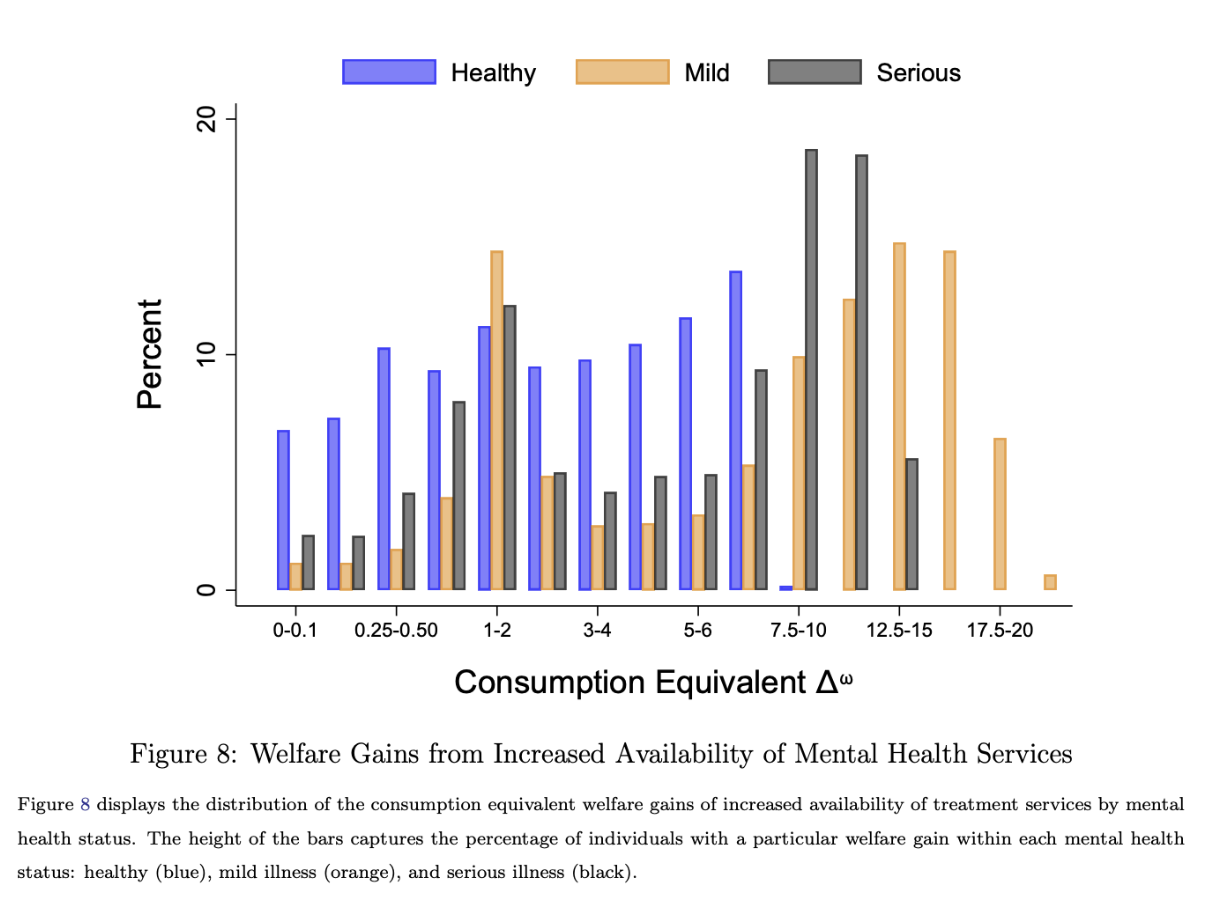
 

Mental health graphic


The chart above illustrates the welfare gains from full access to mental health treatment based on individuals' mental health status. These gains increase with the anticipated use of treatment services among those currently lacking access.


Adapted from “Macroeconomics of Mental Health,” by Boaz Abramson of Columbia Business School, Job Boerma of the University of Wisconsin-Madison, and Aleh Tsyvinski of Yale University.

About the Researcher(s)

Boaz Abramson

Boaz Abramson

Assistant Professor of Business
Finance Division

You Might Like

Data/Big Data, AI and Transformative Tech, Marketplace
Date
April 21, 2025
Online real estate listings
Data/Big Data, AI and Transformative Tech, Marketplace

Uncovering the Costly Bias in Marketplace Testing

Statistical bias could be misleading your product and feature testing, according to research from Columbia Business School Professor Hannah Li, but solutions might be easier than you think.
  • Read more about Uncovering the Costly Bias in Marketplace Testing about Uncovering the Costly Bias in Marketplace Testing
Algorithms, Analytics, Artificial Intelligence, Business and Society, Business Economics and Public Policy, Data and Business Analytics, AI and Transformative Tech, Digital IQ, Finance, Marketing, Marketplace
Date
April 17, 2025
Close-up computer monitor with trading software
Algorithms, Analytics, Artificial Intelligence, Business and Society, Business Economics and Public Policy, Data and Business Analytics, AI and Transformative Tech, Digital IQ, Finance, Marketing, Marketplace

Designing Smarter Economic Systems: A New Approach to Mechanism Design

Award-winning research from Professor Laura Doval tackles the “limited commitment” problem in economics, offering a model that helps governments and firms adjust rules and strategies based on new information over time.
  • Read more about Designing Smarter Economic Systems: A New Approach to Mechanism Design about Designing Smarter Economic Systems: A New Approach to Mechanism Design
Data and Business Analytics, Data/Big Data, AI and Transformative Tech, Digital IQ, Marketing, Media and Technology
Date
April 04, 2025
Shopping for travel online
Data and Business Analytics, Data/Big Data, AI and Transformative Tech, Digital IQ, Marketing, Media and Technology

How Real-Time Click Data Drives Smarter Personalization

New Columbia Business School research reveals how analyzing real-time customer journey data — from search queries to filtering behavior — can predict preferences with remarkable accuracy, even without historical data.
  • Read more about How Real-Time Click Data Drives Smarter Personalization about How Real-Time Click Data Drives Smarter Personalization
Business and Society, Economics and Policy, Globalization, Management, Social Impact
Date
March 27, 2025
Depressed woman in business
Business and Society, Economics and Policy, Globalization, Management, Social Impact

When Economic Struggles Foster Self-Interest, Not Universal Compassion

A Columbia Business School study shows that experiencing a recession in young adulthood leads to lasting support for wealth redistribution—but mostly for one’s own group.
  • Read more about When Economic Struggles Foster Self-Interest, Not Universal Compassion about When Economic Struggles Foster Self-Interest, Not Universal Compassion
Save Article

Download PDF

More to Explore
Share
  • Share on Facebook
  • Share on Threads
  • Share on LinkedIn

External CSS

Official Logo of Columbia Business School

Columbia University in the City of New York
665 West 130th Street, New York, NY 10027
Tel. 212-854-1100

Maps and Directions
    • Centers & Programs
    • Current Students
    • Corporate
    • Directory
    • Support Us
    • Recruiters & Partners
    • Faculty & Staff
    • Newsroom
    • Careers
    • Contact Us
    • Accessibility
    • Privacy & Policy Statements
Back to Top Upward arrow
TOP

© Columbia University

  • X
  • Instagram
  • Facebook
  • YouTube
  • LinkedIn