Official Logo of Columbia Business School
Academics
  • Visit Academics
  • Degree Programs
  • Admissions
  • Tuition & Financial Aid
  • Campus Life
  • Career Management
Faculty & Research
  • Visit Faculty & Research
  • Academic Divisions
  • Search the Directory
  • Research
  • Faculty Resources
  • Teaching Excellence
Executive Education
  • Visit Executive Education
  • For Organizations
  • For Individuals
  • Program Finder
  • Online Programs
  • Certificates
About Us
  • Visit About Us
  • CBS Directory
  • Events Calendar
  • Leadership
  • Our History
  • The CBS Experience
  • Newsroom
Alumni
  • Visit Alumni
  • Update Your Information
  • Lifetime Network
  • Alumni Benefits
  • Alumni Career Management
  • Women's Circle
  • Alumni Clubs
Insights
  • Visit Insights
  • Digital Future
  • Climate
  • Business & Society
  • Entrepreneurship
  • 21st Century Finance
  • Magazine

Why Inflation Could Stay High Despite Central Bank Efforts

Professor Pierre Yared and his co-researchers argue that deglobalization, fiscal expansion, and other global trends will reverse the low inflation rates of recent decades, making the job of central banks more challenging.

Based on Research by
Hassan Afrouzi, Marina Halac, Kenneth Rogoff, Pierre Yared
Published
October 8, 2024
Publication
Research In Brief
Focus On
Economy & Policy, Finance
Jump to main content
Federal Reserve Building, Washington, D.C.

The Federal Reserve building in Washington, D.C. 

Category
Thought Leadership
Topic(s)
Economics and Policy, Financial Policy

About the Researcher(s)

Photo Image of Pierre Yared

Pierre Yared

MUTB Professor of International Business
Economics Division
Co-Director
Richard Paul Richman Center for Business, Law, and Public Policy at Columbia University

View the Research

Changing Central Bank Pressures and Inflation

0%

Up until the past few years, the United States and other advanced economies enjoyed an unusually long period of low and stable inflation. But recent rising inflation has taken a heavy toll on households and businesses, making people’s day-to-day lives more difficult. Understandably, everyone wants to know where inflation is going next. 

One popular view among economists is that inflation will eventually return and stay at lower central bank targets — around 2 percent in advanced economies, somewhat higher in emerging ones. A countervailing argument, however, holds that structural changes in the global economy will keep inflationary pressure high, making the job of central bankers much more challenging than in the past few decades. It’s a debate Columbia Business School’s Pierre Yared and fellow researchers consider in their new study, “Changing Central Bank Pressures and Inflation.”

“We were interested in trying to understand the forces that kept inflation low for the past three decades and look forward to see where inflation is likely going,” explains Yared, the MUTB Professor of International Business at CBS. 

Key takeaways:

  • Worldwide economic dynamics like the reduction of restrictions to trade and foreign direct investment, tighter fiscal policy in emerging markets, and de-unionization in advanced economies have helped central banks keep inflation rates low in recent decades.
  • These dynamics are beginning to reverse course. Deglobalization, expansionary fiscal pressure, and rising long-run real interest rates will make it more difficult for central banks to keep inflation in check.
  • In responding to disruptive economic events, inflation will likely spike more frequently than in the past, leading to higher long-run average inflation. 
  • Heightened central bank independence and a more credible public debt policy may help offset these new inflationary pressures.

How the research was done: Yared and his fellow researchers created a new model to study the relationship between global economic factors and inflation. They started with the New Keynesian model, the most well-known framework for studying monetary policy, and modified it in two important ways: They allowed for the steady state of inflation to be greater than zero, and they recognized that central banks are not always committed to perfect monetary policy, instead having discretion to respond to political economy factors. 

Under the new model, the researchers can predict how different economic factors manifest themselves in long-run inflation and evaluate the impact of phenomena such as deglobalization and supply chain disruptions. It also allows them to quantify how these different economic mechanisms affect inflation, in both the short and long term. 

What the researchers found: Over the past few decades, the job of the central banks to keep inflation low was made easier over the last few decades by several factors: 

  1. Globalization through the reduction and elimination of barriers to trade and foreign direct investment brought about more competition and lower prices.
  2. De-unionization reduced wage pressures in advanced economies. 
  3. The public-debt-to-GDP ratio in emerging markets declined, reducing the incentive for central banks to accommodate fiscal policy with looser monetary policy.

Now, these global forces are reversing course. An international trend toward protectionism, partially fueled by tensions among world superpowers, has led to economic nationalism and the reshoring of production to home countries where costs may be higher. The COVID pandemic exposed weaknesses in critical supply chains that caused governments to double down on reshoring in the name of national security. At the same time, most advanced economies are experiencing expanding fiscal pressure for servicing national debt, spending more on industrial policy, and honoring increasingly expensive entitlement programs for aging populations.

The researchers argue that while inflation is likely to come down from its recent highs, it will remain higher on average in the long run from what were the abnormally low levels over the past three decades. Unfortunately, price hikes are likely to come in the form of sudden surges, like the one seen in 2022, rather than gradual increases. The model showed that inflation rates will tend to spike up in response to disruptive economic events, overcorrecting, before falling to a higher average level. 

Why it matters: The researchers suggest that it’s time central banks begin to take a new set of factors into consideration in keeping inflation under control. “This is a warning to central banks that they can’t take their pre-COVID past successes for granted,” Yared says. “Their jobs are getting much harder. It will be globally much more difficult for all central banks to fight the forces pushing inflation upward.” 
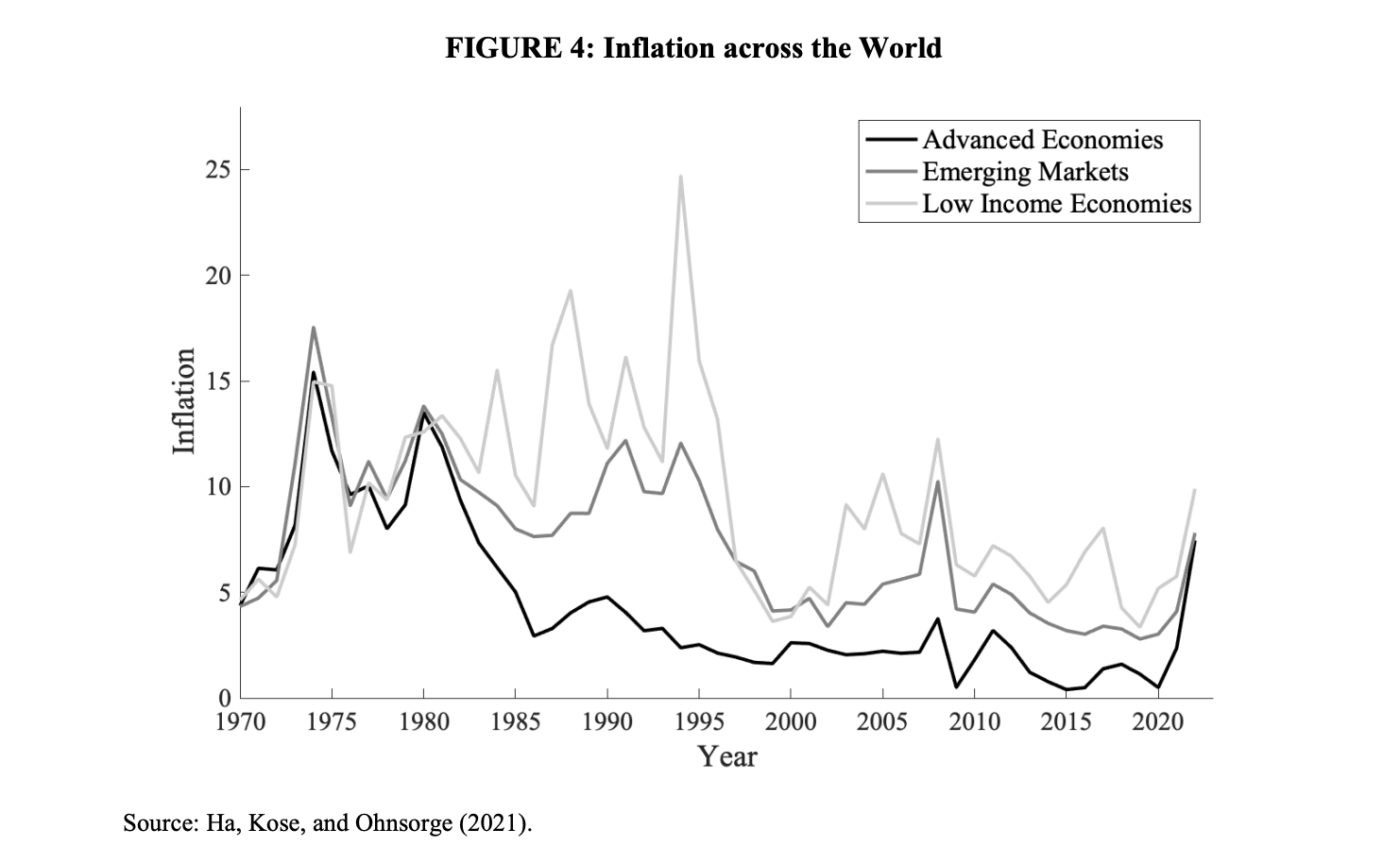
Inflation across the World
The figure above illustrates the global decline in inflation that peaked in advanced economies in the early 1980s, and globally in the early 1990s. The rapid decline in advanced economy inflation during the 1980s, after the high-inflation experience of the 1970s, has been widely studied in the literature (e.g., Sargent, 2001, Primiceri, 2006, Bianchi, 2013).


Adapted from: “Changing Central Bank Pressures and Inflation” by Hassan Afrouzi of Columbia University, Marina Halac of Yale University, Kenneth Rogoff of Harvard University, and Pierre Yared of Columbia Business School.

About the Researcher(s)

Photo Image of Pierre Yared

Pierre Yared

MUTB Professor of International Business
Economics Division
Co-Director
Richard Paul Richman Center for Business, Law, and Public Policy at Columbia University

View the Research

Changing Central Bank Pressures and Inflation

You Might Like

Data/Big Data, AI and Transformative Tech, Marketplace
Date
April 21, 2025
Online real estate listings
Data/Big Data, AI and Transformative Tech, Marketplace

Uncovering the Costly Bias in Marketplace Testing

Statistical bias could be misleading your product and feature testing, according to research from Columbia Business School Professor Hannah Li, but solutions might be easier than you think.
  • Read more about Uncovering the Costly Bias in Marketplace Testing about Uncovering the Costly Bias in Marketplace Testing
Algorithms, Analytics, Artificial Intelligence, Business and Society, Business Economics and Public Policy, Data and Business Analytics, AI and Transformative Tech, Digital IQ, Finance, Marketing, Marketplace
Date
April 17, 2025
Close-up computer monitor with trading software
Algorithms, Analytics, Artificial Intelligence, Business and Society, Business Economics and Public Policy, Data and Business Analytics, AI and Transformative Tech, Digital IQ, Finance, Marketing, Marketplace

Designing Smarter Economic Systems: A New Approach to Mechanism Design

Award-winning research from Professor Laura Doval tackles the “limited commitment” problem in economics, offering a model that helps governments and firms adjust rules and strategies based on new information over time.
  • Read more about Designing Smarter Economic Systems: A New Approach to Mechanism Design about Designing Smarter Economic Systems: A New Approach to Mechanism Design
Data and Business Analytics, Data/Big Data, AI and Transformative Tech, Digital IQ, Marketing, Media and Technology
Date
April 04, 2025
Shopping for travel online
Data and Business Analytics, Data/Big Data, AI and Transformative Tech, Digital IQ, Marketing, Media and Technology

How Real-Time Click Data Drives Smarter Personalization

New Columbia Business School research reveals how analyzing real-time customer journey data — from search queries to filtering behavior — can predict preferences with remarkable accuracy, even without historical data.
  • Read more about How Real-Time Click Data Drives Smarter Personalization about How Real-Time Click Data Drives Smarter Personalization
Business and Society, Economics and Policy, Globalization, Management, Social Impact
Date
March 27, 2025
Depressed woman in business
Business and Society, Economics and Policy, Globalization, Management, Social Impact

When Economic Struggles Foster Self-Interest, Not Universal Compassion

A Columbia Business School study shows that experiencing a recession in young adulthood leads to lasting support for wealth redistribution—but mostly for one’s own group.
  • Read more about When Economic Struggles Foster Self-Interest, Not Universal Compassion about When Economic Struggles Foster Self-Interest, Not Universal Compassion
Save Article

Download PDF

More to Explore
Share
  • Share on Facebook
  • Share on Threads
  • Share on LinkedIn

External CSS

Official Logo of Columbia Business School

Columbia University in the City of New York
665 West 130th Street, New York, NY 10027
Tel. 212-854-1100

Maps and Directions
    • Centers & Programs
    • Current Students
    • Corporate
    • Directory
    • Support Us
    • Recruiters & Partners
    • Faculty & Staff
    • Newsroom
    • Careers
    • Contact Us
    • Accessibility
    • Privacy & Policy Statements
Back to Top Upward arrow
TOP

© Columbia University

  • X
  • Instagram
  • Facebook
  • YouTube
  • LinkedIn