
Key Takeaways:
- Writing about an experience, a proven therapy for victims of trauma, can provide a similar therapeutic effect for consumers who had a bad experience with a business.
- Reviews that are integrated — drawing on both the emotional and the factual aspects of the experience — provide the highest therapeutic effect.
- Consumers who “recover” from their bad experience by writing about it in an integrated manner are more likely to give that business another try.
- To increase customer retention, businesses should encourage customers to write reviews that draw on both the emotional and factual aspects of their experiences.
It’s becoming rare to make a purchase — whether it’s a dinner, a product, a home repair, or the hotels, flights, and activities we book for a vacation — without first reading the online reviews. Negative write-ups are particularly helpful: According to a 2021 PowerReviews report, 96 percent of review readers specifically look for negative reviews.
Although much research has examined the effects of negative reviews on readers, little is known about how these reviews affect review writers. That’s precisely what Alisa Yinghao Wu wanted to explore as a doctoral student at Columbia Business School. Wu worked with Vicki G. Morwitz, the Bruce Greenwald Professor of Business in CBS’s Marketing Division, to study online reviews.
Wu and Morwitz theorized that the way consumers write about a negative consumer experience might facilitate a recovery from that experience, much in the way writing has shown to be a therapeutic tool for victims of trauma. They specifically wanted to test whether recovery depended on the style of the review: Was it primarily rational, emotional, or a combination of the two? Trauma-recovery literature has shown that drawing on both emotion and objective facts yields the best therapeutic results when writing about traumatic experiences. Could the same hold true for writing online reviews?
How the research was done: Wu and Morwitz defined recovery from a negative consumer experience as twofold: affective, meaning the writer felt better, and cognitive, meaning the writer would recommend the business to others or try it again in the future.
The overall study was broken into separate parts. In the first part, which examined field data, Wu and Morwitz used machine learning to classify more than 20,000 extant reviews of airline experiences as emotional, rational, or integrated. They compared the type of review with the cognitive recovery of the writer — namely, would this writer recommend the airline to others?
Wu and Morwitz designed the experimental part of the study to determine causation: Does the way consumers write reviews cause them to feel better? Participants were asked to recall their last bad experience in a restaurant and to write about it in one of three randomly assigned ways: rational, emotional, or integrated. A control group received no guidance on how to write their reviews. Afterward, all participants answered questions about whether they felt better after having written the review and if they would try the restaurant again.
Still another part of the study examined review writers’ responses by using objective data: blood pressure. Trauma-recovery literature demonstrates that integrated writing about a traumatic experience temporarily raises systolic blood pressure, which indicates more complete processing and coming to closure with the negative experience. Again, Wu and Morwitz randomly assigned participants to write about a negative consumer experience in one of the three styles, this time with wrist monitors to measure blood pressure changes.
Morwitz notes the overall study’s multidisciplinary approach as significant and unique. “In my field, we have scholars who do the more quantitative modeling kind of work and other scholars who do work in the lab. This study really combines all of that,” she says. The result is a vigorous study utilizing both field data to show real-world correlation between review writing and recovery, as well as experimental data to demonstrate causation.
What the researchers found: In the field data part of the study, the odds of recommending an airline to others after a bad experience were five to 10 times higher for writers of integrated reviews than for writers of either rational or emotional reviews.
Importantly, the experimental part of the study proved that participants who wrote integrated reviews recovered significantly more than writers of other review types. Further, it was the act of writing the integrated review that actually caused the recovery: Systolic blood pressure rose for integrated review writers, signaling a cathartic response, while no such response was found in the other two groups.
Significant from a business perspective, the study also revealed that readers respond to integrated reviews as positively or more so than they do to emotional or rational reviews.
Although the researchers expected to find some therapeutic aspect to writing a negative review, Morwitz says she was surprised at how closely the study’s findings mirrored those in psychology regarding trauma, especially the blood pressure results. “There’s literature that says writing about trauma can be really helpful, but a bad consumption experience is nothing like actual trauma. Could there really be similar processes in play even for negative consumption experiences? I found it very surprising,” she says.
Why the research matters: Any business, no matter how well run, can fall short of a customer’s expectation on a given day, making it important for firms to find ways to mitigate these experiences. To maximize customer retention, Morwitz and Wu’s study shows that businesses and online review sites should ask reviewers specifically for both the emotional and factual aspects.
“Negative reviews can be very detrimental to firms,” Morwitz says. “They’re much more impactful than positive ones. You remember a bad experience for a long time, and you tell more people about a bad experience than a good one. Obviously, as a business, you want to avoid those negative experiences to begin with, but inevitably they’re going to happen. This is one tool for making consumers feel better.”
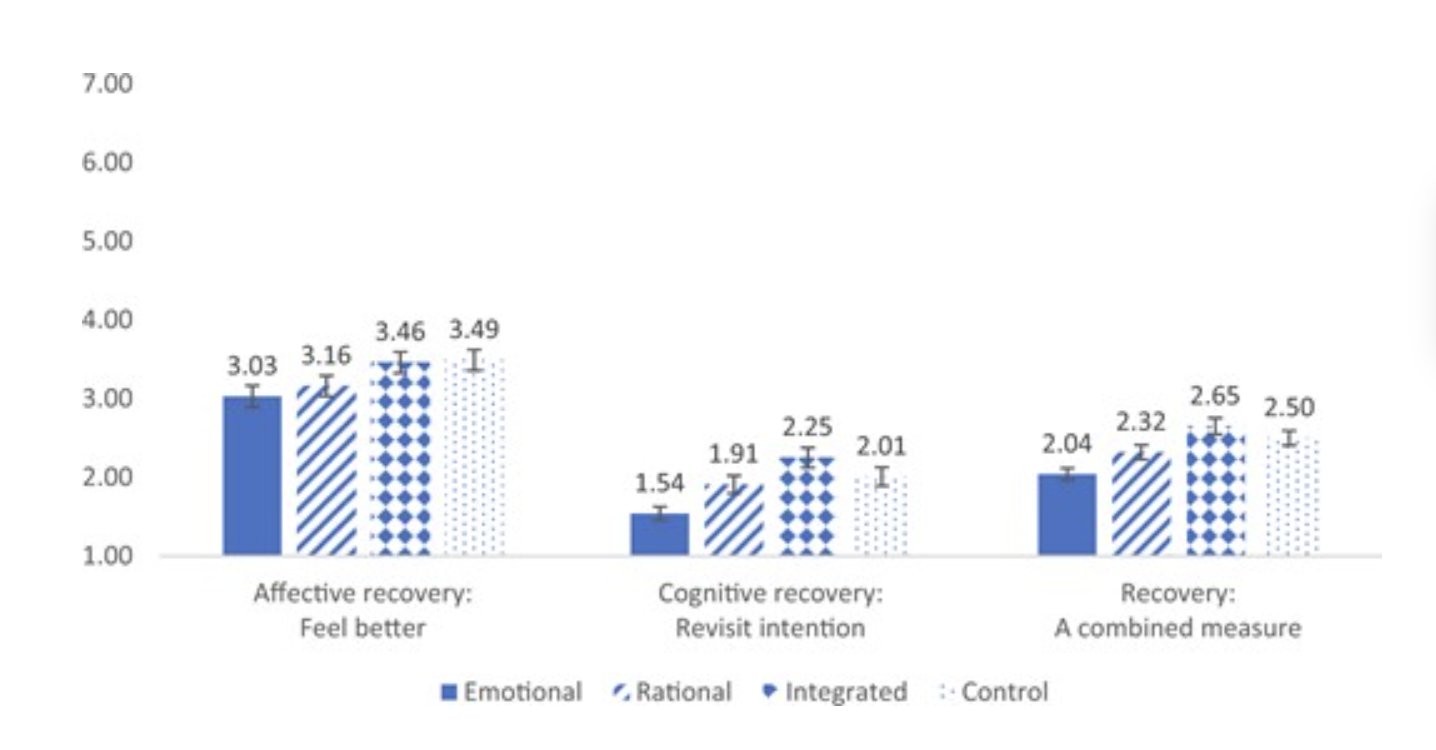
Adapted from “Digital Therapy for Negative Consumption Experiences: The Impact of Emotional and Rational Reviews on Review Writers” by Alisa Yinghao Wu, formerly a doctoral student at Columbia Business School and now the David Eccles School of Business at the University of Utah, and Vicki G. Morwitz of CBS.

