
As online shopping has boomed, the volume of online advertising has naturally followed. One example: Advertising on e-commerce marketplaces, known as retail media, has surged, with Amazon alone bringing in over $47 billion in advertising revenue in 2023.
A significant part of this advertising derives from sponsored listings, where a seller pays to have its product appear at a higher position in a search result than the platform’s algorithm may have accorded it. Such ads are usually denoted with a tag like “sponsored listing” to distinguish them from organically generated results.
With so much revenue riding on these ads, it behooves online marketplace managers to understand their effect on consumer behavior. Are consumers suspicious of products that appear in sponsored listings? Do they click on them less often than they would have clicked on the product the ad displaced? Does the presence of ads turn consumers away from a platform — and how many ads does it take before that happens?
To answer these questions, Kinshuk Jerath, the Arthur F. Burns Professor of Free and Competitive Enterprise at Columbia Business School, and his co-researchers partnered with leading Indian e-marketplace Flipkart to conduct a field experiment in retail media.
Key Takeaways:
- In categories with quantifiable specs, such as electronics, e-market algorithms showing organic results excel at identifying relevant products and sponsored ads are generally less relevant to consumers. These ads perform poorly, but algorithmic listings near the ads produce partially countervailing sales.
- Algorithms showing organic results don’t do as well with categories like clothing, which has few quantifiable features and is subject to flash trends. For such categories, a sponsored ad may be more relevant to consumers than the organic listing that would have appeared in that space based solely on the algorithm. These retail ads improve product sales.
- At least in the short term, ads benefit the marketplace by bringing in revenue and, for some categories, increasing clicks and conversions.
How the research was done: Jerath and his co-researchers partnered with e-commerce marketplace Flipkart for an eight-day experiment. Approximately 1.2 million users of the Flipkart mobile app were randomly divided into three groups. Each group was shown ads at different positions in the search results, and user clicks and conversions for each group were recorded.
The varying positions of ads within the search result hierarchy allowed researchers to compare the results of sponsored ads versus the organic listing that would have appeared in the absence of the ad. For instance, in one group, a sponsored ad appeared in the second position, whereas in another group, an organic listing appeared in that slot.
Users in the three groups were exposed to a different number of ads, with volumes ranging from 16 to 26 percent.
What the researchers found: Jerath and his colleagues discovered that retail media affects consumer behavior in nuanced ways, depending on the product category. In electronics, sponsored ads performed poorly compared to the organic listings they displaced. On the other hand, the organic listings surrounding the ad enjoyed a bump in sales over listings that would have appeared in those slots in the absence of any ads.
In the clothing and shoes categories, they observed the opposite effect. Sponsored ads enjoyed more clicks and conversions than the displaced organic listings. Surrounding listings in this case were unaffected by the presence of ads.
Jerath attributes this dichotomy to the asymmetry of information between the seller and the platform. In the electronics category, the platform’s algorithm excels at capturing the features consumers are interested in, such as a television’s screen size and resolution. Products that best match the consumer’s needs will automatically appear in the top positions in a search result, giving sellers of these products little incentive to advertise. As a result, sellers of products that are of less relevance to consumers place sponsored ads with their featured products.
In the clothing category, a product’s features are less easily described and captured by an algorithm, and a new trend may emerge too quickly for a platform to capture it. If, for example, Taylor Swift is photographed in a dress, sellers of that dress can predict high demand the next day and buy a sponsored listing to make sure it shows up prominently. This asymmetry between what the seller knows and what the algorithm “knows” means a sponsored listing will often outperform the displaced organic one, benefitting the consumers, the advertiser, and the platform.
Why the research matters: The study’s results can help guide platforms as they look to grow their revenue from advertising. Sponsored ads in the aggregate either increased total sales (clothing) or had no effect on total sales (electronics), with any loss of sale revenue from a low-relevance ad compensated by an increase in sales in adjacent organic listings. A marketplace may wish to make more ad space available in categories where sellers have an informational edge over the platform’s algorithms. Also, marketplaces may be able to take advantage of these ads to identify high-relevance products and improve their algorithmic search rankings.
While sponsored listings add to a platform’s bottom line, the upper threshold of consumer tolerance for online ads is an area that should be explored further, the researchers say. But in this short-term study, consumer behavior seemed unaffected by as much as one in four listings being sponsored.
“From the perspective of the marketplace, you can do retail media without hurting the experience of the consumer, and in some cases, you can improve their experience,” Jerath says. “It’s a positive message for retailers.”
The figure below shows additional clicks on an ad compared to the organic result on the y-axis, and product subcategories on the x-axis
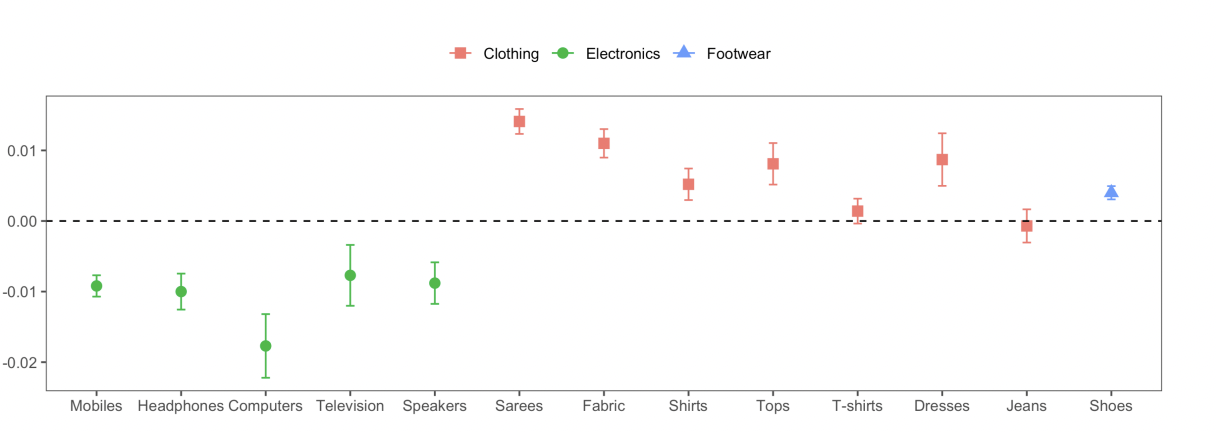
Adapted from “The Impact of ‘Retail Media’ on Online Marketplaces: Insights from a Field Experiment” by Kinshuk Jerath of Columbia Business School, Vibhanshu Abhishek of the Merage School of Business at the University of California, Irvine, and Siddhartha Sharma of the Kelley School of Business at Indiana University.
