Official Logo of Columbia Business School
Academics
  • Visit Academics
  • Degree Programs
  • Admissions
  • Tuition & Financial Aid
  • Campus Life
  • Career Management
Faculty & Research
  • Visit Faculty & Research
  • Academic Divisions
  • Search the Directory
  • Research
  • Faculty Resources
  • Teaching Excellence
Executive Education
  • Visit Executive Education
  • For Organizations
  • For Individuals
  • Program Finder
  • Online Programs
  • Certificates
About Us
  • Visit About Us
  • CBS Directory
  • Events Calendar
  • Leadership
  • Our History
  • The CBS Experience
  • Newsroom
Alumni
  • Visit Alumni
  • Update Your Information
  • Lifetime Network
  • Alumni Benefits
  • Alumni Career Management
  • Women's Circle
  • Alumni Clubs
Insights
  • Visit Insights
  • Digital Future
  • Climate
  • Business & Society
  • Entrepreneurship
  • 21st Century Finance
  • Magazine

Give Us Your Tired, Your Poor … and Your High-Skilled!

New research by Columbia Business School faculty shows how increasing the number of high-skilled immigrants can spur regional entrepreneurship and economic growth without the cost of other economy-boosting strategies.

Published
December 3, 2024
Publication
Research In Brief
Focus On
Business & Society, Economy & Policy, Globalization, Leadership & Organizational Behavior, Macroeconomics, Social Impact
Jump to main content
Article Author(s)

Deb Mead

Affiliated Author
US immigration document
Category
Thought Leadership
Topic(s)
Economics and Policy, Ethics and Leadership, Future of Work, Labor, Management, The Workplace

About the Researcher(s)

Dan Wang

Dan Wang

Lambert Family Professor of Social Enterprise in the Faculty of Business
Management Division
Co-Director of the Tamer Institute for Social Enterprise and Climate Change
Tamer Institute for Social Enterprise and Climate Change
Jorge Guzman

Jorge Guzman

Gantcher Associate Professor of Business
Management Division
Inara Tareque

Inara Tareque

PhD Candidate
Management Division

0%

While it’s well established that high-skilled immigrants are major drivers of entrepreneurship in the United States, immigrant founders are often naturalized citizens or permanent residents. Inara Tareque, a doctoral candidate in the Management Division at Columbia Business School, wondered whether H-1B visa immigrants — i.e., skilled immigrants on work visas — might also contribute to entrepreneurship, beyond their direct labor in joining new companies. After all, regulations governing H-1B visas prohibit visa holders from working outside of the sponsoring company. Was it possible that some of the growth in entrepreneurship seen in regions with H-1B visa populations could be attributed to a knowledge sharing between the newly arrived immigrants and their local community in the region where they settle?

To answer this question, Tareque enlisted the help of CBS faculty members Dan Wang, the Lambert Family Professor of Social Enterprise, and Jorge Guzman, the Gantcher Associate Professor of Business. Focusing their study on high-skilled immigrants, the trio took advantage of newly released data from the US Department of Labor on the geographic destinations of new H-1B visa holders. They also utilized data from the Startup Cartography Project, a publicly accessible data set collected by Guzman and other colleagues. The project assesses not only the number of new regional startups but also their quality, as measured by markers like patent holdings and corporate status.

Key Takeaways from the Research

  • High-skilled immigrants fuel regional entrepreneurship.
  • Evidence points to an indirect effect on regional entrepreneurship when immigrants share valuable knowledge that can benefit the growth of existing startups.
  • When regions experience increases in H-1B visa immigrants, new startups tend to be of higher quality, with more opportunity for growth.
  • Increasing the number of H-1B visa immigrants in a region can drive economic growth as much as other strategies like state tax credits and infrastructure improvement — but without the cost.

The Knowledge Transfer Effect

The study’s findings were dramatic: A doubling of H-1B immigrants to a region was followed by a 6 percent increase in regional entrepreneurship within three years. The researchers are quick to acknowledge that many mechanisms play a role in driving entrepreneurship, such as immigrants choosing to migrate to regions with the right ingredients for entrepreneurship. But even after controlling for those factors, they still saw a significant, unexplained economic effect — one that can be plausibly accounted for by knowledge transfer.

“When high-skilled immigrants move into a region in the United States, they don’t just bring labor. They bring knowledge and ideas, and those ideas become channeled and translated through networks, ties, and social links, which are typically hard to observe,” Wang says. “It leads to expansion of the entrepreneurial ecosystem that these new immigrants don’t directly contribute to as employees but have a profound impact on.” 

What’s more, the magnitude of the new immigrant effect held up across all regions, from areas already densely populated with H-1B immigrants, like the New York metropolitan area, to smaller regions like Kansas City, Missouri. “It really surprised me how robust the findings were, even after removing the big immigration centers,” Tareque says.

The researchers note a few salient aspects of this study. First, the relationship between immigration and entrepreneurship holds only for high-skilled H-1B visa holders. Low-skilled, or H-2B, immigrants, who may well provide other benefits to a community, do not spur regional high-growth entrepreneurship within three years of immigrating. Second, the presence of an existing co-national community for new H-1B visa holders in the region amplifies the entrepreneurial benefits that skilled immigrants bring. Third, the high-skilled immigrants must be newly arrived to spur this growth. 

The study points the way to more research that remains to be done, particularly in affirming the causal relationship that is so strongly suggested. Further studies could explore the exact nature of knowledge transfer — whether it mainly entails industry-specific knowledge or more general entrepreneurial know-how that transcends a specific industry. And although Indian nationals make up 70 percent of all H-1B visa recipients and thus were the focus of this study, expanding this research to other nationalities remains an important area of investigation.

Implications for Government and Business Leaders

Tareque, Guzman, and Wang hope the findings of their research will inform policy decisions in the future. They note that the annual cap of 85,000 H-1B visas has remained unchanged since 1990, despite an economy increasingly driven by technology and reliant on knowledge workers. Opening the doors to more skilled immigrants provides an economic boost comparable to what state tax credits for research and development or infrastructure improvements provide — but without the associated costs. For policymakers, it could be an easy win.

The consistency of the results across geographic regions also suggests an opportunity to stimulate regions outside of the main immigrant hubs. Adding 50 additional H-1B immigrants to the already immigrant-dense New York metro area represents a modest gain of only 0.3 percent. In contrast, those same 50 immigrants added to the workforce in Mobile, Alabama — an increase of almost 200 percent — could be expected to boost startup activity by 12 percent. 

“Based on our results, the simplest and lowest cost action the United States can take to immediately boost its entrepreneurial growth and GDP is to welcome more skilled immigrants,” Wang says. “To see the profound effect it has is really quite remarkable.”
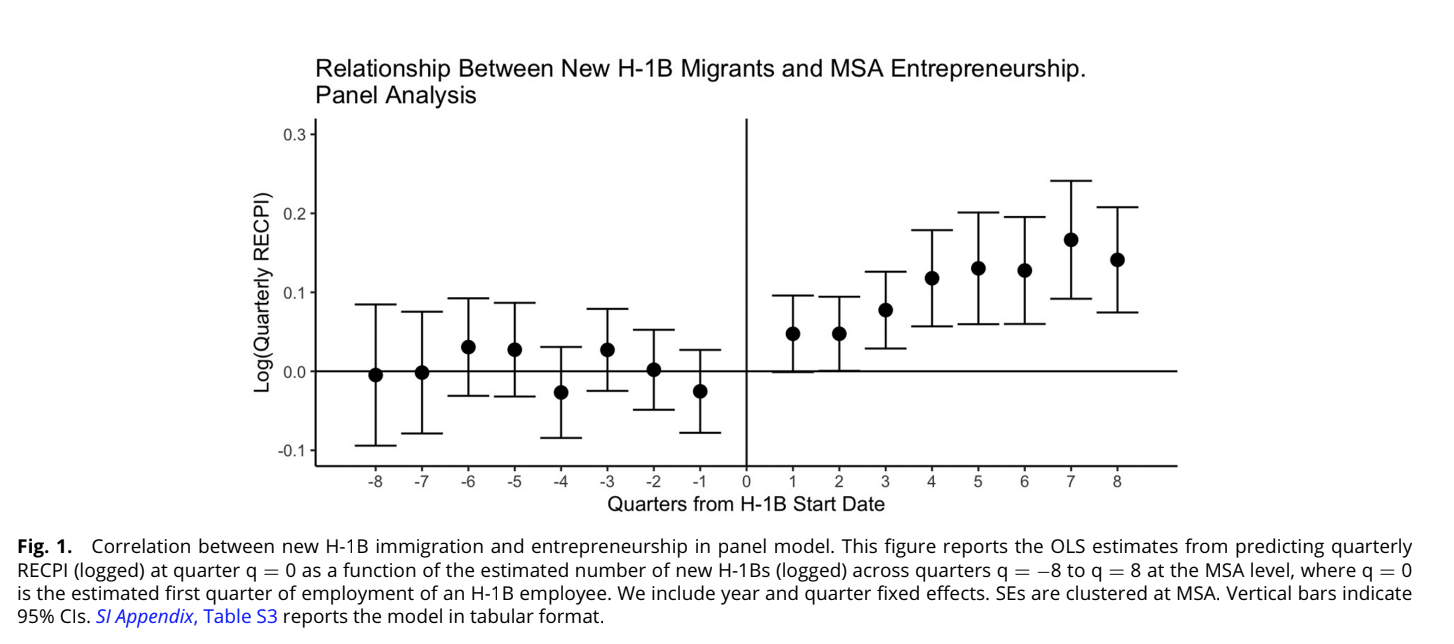
 

Figure 1 in the study shows how the number of quality startups (the y-axis) increases after new H-1B arrivals.


Adapted from “High-Skilled Immigration Enhances Regional Entrepreneurship” by Inara S. Tareque, Jorge Guzman, and Dan Wang of Columbia Business School.

About the Researcher(s)

Dan Wang

Dan Wang

Lambert Family Professor of Social Enterprise in the Faculty of Business
Management Division
Co-Director of the Tamer Institute for Social Enterprise and Climate Change
Tamer Institute for Social Enterprise and Climate Change
Jorge Guzman

Jorge Guzman

Gantcher Associate Professor of Business
Management Division
Inara Tareque

Inara Tareque

PhD Candidate
Management Division

You Might Like

Data/Big Data, AI and Transformative Tech, Marketplace
Date
April 21, 2025
Online real estate listings
Data/Big Data, AI and Transformative Tech, Marketplace

Uncovering the Costly Bias in Marketplace Testing

Statistical bias could be misleading your product and feature testing, according to research from Columbia Business School Professor Hannah Li, but solutions might be easier than you think.
  • Read more about Uncovering the Costly Bias in Marketplace Testing about Uncovering the Costly Bias in Marketplace Testing
Algorithms, Analytics, Artificial Intelligence, Business and Society, Business Economics and Public Policy, Data and Business Analytics, AI and Transformative Tech, Digital IQ, Finance, Marketing, Marketplace
Date
April 17, 2025
Close-up computer monitor with trading software
Algorithms, Analytics, Artificial Intelligence, Business and Society, Business Economics and Public Policy, Data and Business Analytics, AI and Transformative Tech, Digital IQ, Finance, Marketing, Marketplace

Designing Smarter Economic Systems: A New Approach to Mechanism Design

Award-winning research from Professor Laura Doval tackles the “limited commitment” problem in economics, offering a model that helps governments and firms adjust rules and strategies based on new information over time.
  • Read more about Designing Smarter Economic Systems: A New Approach to Mechanism Design about Designing Smarter Economic Systems: A New Approach to Mechanism Design
Data and Business Analytics, Data/Big Data, AI and Transformative Tech, Digital IQ, Marketing, Media and Technology
Date
April 04, 2025
Shopping for travel online
Data and Business Analytics, Data/Big Data, AI and Transformative Tech, Digital IQ, Marketing, Media and Technology

How Real-Time Click Data Drives Smarter Personalization

New Columbia Business School research reveals how analyzing real-time customer journey data — from search queries to filtering behavior — can predict preferences with remarkable accuracy, even without historical data.
  • Read more about How Real-Time Click Data Drives Smarter Personalization about How Real-Time Click Data Drives Smarter Personalization
Business and Society, Economics and Policy, Globalization, Management, Social Impact
Date
March 27, 2025
Depressed woman in business
Business and Society, Economics and Policy, Globalization, Management, Social Impact

When Economic Struggles Foster Self-Interest, Not Universal Compassion

A Columbia Business School study shows that experiencing a recession in young adulthood leads to lasting support for wealth redistribution—but mostly for one’s own group.
  • Read more about When Economic Struggles Foster Self-Interest, Not Universal Compassion about When Economic Struggles Foster Self-Interest, Not Universal Compassion
Save Article

Download PDF

More to Explore
Share
  • Share on Facebook
  • Share on Threads
  • Share on LinkedIn

External CSS

Official Logo of Columbia Business School

Columbia University in the City of New York
665 West 130th Street, New York, NY 10027
Tel. 212-854-1100

Maps and Directions
    • Centers & Programs
    • Current Students
    • Corporate
    • Directory
    • Support Us
    • Recruiters & Partners
    • Faculty & Staff
    • Newsroom
    • Careers
    • Contact Us
    • Accessibility
    • Privacy & Policy Statements
Back to Top Upward arrow
TOP

© Columbia University

  • X
  • Instagram
  • Facebook
  • YouTube
  • LinkedIn