

Leadership Implications
– Diverse representation in advertising can benefit both consumers and advertisers.
– Consumers aren’t only interested in seeing people who look like them; they prefer depictions of a diverse society.
– When incorporating a diverse range of models, advertisers create a win-win scenario— promoting underrepresented populations in public media and producing more financially effective campaigns.
In "Diversity in Advertising in Times of Racial Unrest," Bernstein Faculty Leader Oded Netzer and co-authors Jochen Hartmann and Rachel Zalta quantify the racial composition of tens of thousands of digital ads released before, during and after the protests that occurred in response to the murder of George Floyd in May 2020. Their findings indicate that social movements can influence the supply and demand of advertising and challenge the widely accepted notion of in-group favoritism within the context of diversity.
Analyzing Real-World Impressions
While previous research on the topic relies primarily on lab-based experiments, Netzer and his co-authors worked with online advertising firm Taboola to quantify the effects of diversity on real-world advertising over time. They used deep machine learning to analyze the racial representation of models that appeared in tens of thousands of digital advertisements between January 2019 and July 2021. In total, the ads generated 259.4 billion impressions in the U.S. and 308.3 million clicks.
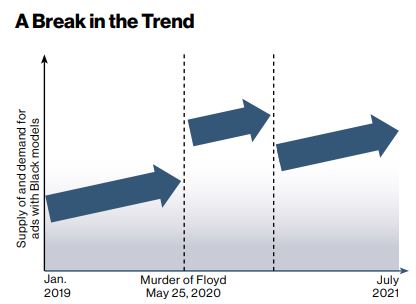
In the dataset, which encompassed 31 months of ads from 3,484 unique advertisers, 7.5% of the ads featured at least one Black model; 25.6% featured at least one model who was neither Black nor white; and 67.3% of the ads featured all white models. While the figures demonstrate an under-representation of Black models relative to the Black population share of 12.4% according to the 2020 U.S. Census, the researchers also found a positive long-term trend in both the supply (number of advertisements) and demand (click-through rates) of advertisements that included at least one Black model.
Social movements can influence the supply and demand of advertising.
Both the supply of and demand for advertisements featuring Black models were steadily increasing over time, suggesting an already-existing industry shift toward more equitable representation. And, during the six months immediately following the murder of George Floyd, there was a spike, due to heightened public attention to social inequality. (See graphic.)
The study also found that ads featuring Black models consistently outperformed all-white ads before, during and after the peak of the Black Lives Matter movement. While the race of audience members could not be determined from the real-world dataset, follow-up lab experiments found that ads featuring at least one Black model performed better with consumers from all races. In fact, white consumers demonstrated a particularly strong preference for ads featuring Black models.
Conclusions
This study, which proves societal events can greatly influence the advertising industry, follows up on earlier research in the field that has shown advertising can also change attitudes toward people of other races. While advertisers were already (slowly) increasing the inclusion of Black models, the murder of George Floyd and the following social unrest affected—at least temporarily—decisions within the advertising industry.
More importantly, by showing that consumers favorably react to minority models in advertising, especially in times of high attention to racial inequality, the new research suggests there is a win-win to be had. Diversity in advertising pays—not just because audiences want to see depictions of themselves in the ad, but because they want to see representations of a diverse society. Therefore, advertisers can play an influential role in reducing racial prejudice in society while improving the effectiveness of their ads.
Explore more Bernstein-sponsored research that highlights real-world applications for leaders.