Official Logo of Columbia Business School
Academics
  • Visit Academics
  • Degree Programs
  • Admissions
  • Tuition & Financial Aid
  • Campus Life
  • Career Management
Faculty & Research
  • Visit Faculty & Research
  • Academic Divisions
  • Search the Directory
  • Research
  • Faculty Resources
  • Teaching Excellence
Executive Education
  • Visit Executive Education
  • For Organizations
  • For Individuals
  • Program Finder
  • Online Programs
  • Certificates
About Us
  • Visit About Us
  • CBS Directory
  • Events Calendar
  • Leadership
  • Our History
  • The CBS Experience
  • Newsroom
Alumni
  • Visit Alumni
  • Update Your Information
  • Lifetime Network
  • Alumni Benefits
  • Alumni Career Management
  • Women's Circle
  • Alumni Clubs
Insights
  • Visit Insights
  • Digital Future
  • Climate
  • Business & Society
  • Entrepreneurship
  • 21st Century Finance
  • Magazine

Playing for Excellence? How Gamified Training Impacts Employee Performance

The paper from Columbia Business School, “Learning or Playing? The Effect of Gamified Training On Employee Performance,” explores the impact of gamified learning on business outcomes. The study was co-authored by Ryan W. Buell of Harvard Business School, Wei Cai of Columbia Business School, and Tatiana Sandino of Harvard Business School.

Based on Research by
Ryan W. Buell, Wei Cai, Tatiana Sandino
Published
September 7, 2023
Publication
Research In Brief
Focus On
Leadership & Organizational Behavior
Jump to main content
Article Author(s)
Wei Cai, Assistant Professor of Business

Wei Cai

Assistant Professor of Business
Accounting Division
Rodin's The Thinker statue, on Columbia's Morningside campus
Topic(s)
Strategy, The Workplace

About the Researcher(s)

Wei Cai, Assistant Professor of Business

Wei Cai

Assistant Professor of Business
Accounting Division

View the Research

Learning or Playing? The Effect of Gamified Training On Employee Performance

0%

Key Takeaways

  • Gamified employee training offers demonstrable improvements over traditional methods concerning course completion, employee knowledge retention, and office-level performance outcomes.
  • Firms that introduced gamified training and successfully implemented it saw several benefits, including the retention of more clients, added clients, and increased revenue.
  • The benefits of gamified employee training are most substantial in offices where leaders are highly engaged with the training initiative and nurture employee participation or in offices where employees are already motivated to improve their performance.

Adapted from “Learning or Playing? The Effect of Gamified Training On Employee Performance” by Ryan W. Buell of Harvard Business School, Wei Cai of Columbia Business School, and Tatiana Sandino of Harvard Business School.

Research

According to new research, gamified learning, which adds fun, game-like aspects to educational activities, can be highly effective in employee training. Research data shows that gamified training supports the efficient acquisition of new concepts, amplifies problem-solving skills, and helps employees connect the dots between specific actions and positive business outcomes. In addition, researchers found that these types of engaging training experiences have produced demonstrable impacts

on office performance, with office-level results showing added clients and increased client retention after gamified training. Yet the success of gamified training depends on employee engagement and the ability or willingness of leaders to inspire and nurture employee use of gamified training tools.

“In the first specification, the implementation of the system increased fees collected by 35.8%, number of clients by 16.3%, and number of opportunities from new clients by 22.3%. In the second specification, the implementation of the system increased fees collected by 27.1%.”

Employee engagement with gamified training at a firm, whether preexisting or inspired by their leader’s training use, occurred with:

  • An increased likelihood of more engagements with clients that would generate revenue
  • The addition of new clients
  • An increase in revenue from existing clients
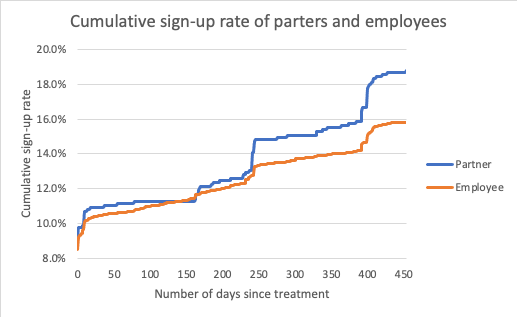
A graph depicting cumulative signup rate (more details in caption)
Moderating Effect of Leader Engagement

The below graph plots the cumulative sign-up rate of partners (blue line) and employees (orange line) each day after the implementation of the gamified training platform. The x-axis is the number of days since the implementation. The y-axis is the cumulative sign-up rate. The x-axis ends at 450 days since treatment because nobody signs up after that.


Because employee and leader engagement can be challenging to gauge and has a meaningful impact on the performance and revenue results derived from gamified training, the researchers suggest several points to consider:

Engagement is essential

Leaders must show employees the value of gamified training to inspire engagement. Still, they must also ensure that employees are ready to work with new tools by gauging their willingness to log on and their desire to improve their performance. In the absence of employee motivation, leaders should adapt training to focus on overall engagement in addition to training.

Leaders inspire engagement

Leaders can play a central role in drawing them into fun activities that are also valuable training. The best results occur when leaders and employees are highly engaged.

Patience is critical

Performance improvements may take time but may gradually materialize as employees engage with the platform and develop their skills over time.

Conclusion

Gamified training effectively delivers educational experiences that employees enjoy and translate into improved performance. Even for a less-engaged workforce, incorporating game elements such as challenges, rewards, and competition can stoke employee engagement and deliver powerful performance results, provided that leaders are committed to inspiring employees to learn through play.


Download the Research in Brief 

About the Researcher

Wei Cai, Assistant Professor of Business

Wei Cai

Assistant Professor of Business
Accounting Division

About the Researcher(s)

Wei Cai, Assistant Professor of Business

Wei Cai

Assistant Professor of Business
Accounting Division

View the Research

Learning or Playing? The Effect of Gamified Training On Employee Performance

You Might Like

Data/Big Data, AI and Transformative Tech, Marketplace
Date
April 21, 2025
Online real estate listings
Data/Big Data, AI and Transformative Tech, Marketplace

Uncovering the Costly Bias in Marketplace Testing

Statistical bias could be misleading your product and feature testing, according to research from Columbia Business School Professor Hannah Li, but solutions might be easier than you think.
  • Read more about Uncovering the Costly Bias in Marketplace Testing about Uncovering the Costly Bias in Marketplace Testing
Algorithms, Analytics, Artificial Intelligence, Business and Society, Business Economics and Public Policy, Data and Business Analytics, AI and Transformative Tech, Digital IQ, Finance, Marketing, Marketplace
Date
April 17, 2025
Close-up computer monitor with trading software
Algorithms, Analytics, Artificial Intelligence, Business and Society, Business Economics and Public Policy, Data and Business Analytics, AI and Transformative Tech, Digital IQ, Finance, Marketing, Marketplace

Designing Smarter Economic Systems: A New Approach to Mechanism Design

Award-winning research from Professor Laura Doval tackles the “limited commitment” problem in economics, offering a model that helps governments and firms adjust rules and strategies based on new information over time.
  • Read more about Designing Smarter Economic Systems: A New Approach to Mechanism Design about Designing Smarter Economic Systems: A New Approach to Mechanism Design
Data and Business Analytics, Data/Big Data, AI and Transformative Tech, Digital IQ, Marketing, Media and Technology
Date
April 04, 2025
Shopping for travel online
Data and Business Analytics, Data/Big Data, AI and Transformative Tech, Digital IQ, Marketing, Media and Technology

How Real-Time Click Data Drives Smarter Personalization

New Columbia Business School research reveals how analyzing real-time customer journey data — from search queries to filtering behavior — can predict preferences with remarkable accuracy, even without historical data.
  • Read more about How Real-Time Click Data Drives Smarter Personalization about How Real-Time Click Data Drives Smarter Personalization
Business and Society, Economics and Policy, Globalization, Management, Social Impact
Date
March 27, 2025
Depressed woman in business
Business and Society, Economics and Policy, Globalization, Management, Social Impact

When Economic Struggles Foster Self-Interest, Not Universal Compassion

A Columbia Business School study shows that experiencing a recession in young adulthood leads to lasting support for wealth redistribution—but mostly for one’s own group.
  • Read more about When Economic Struggles Foster Self-Interest, Not Universal Compassion about When Economic Struggles Foster Self-Interest, Not Universal Compassion
Save Article

Download PDF

More to Explore
Share
  • Share on Facebook
  • Share on Threads
  • Share on LinkedIn

External CSS

Official Logo of Columbia Business School

Columbia University in the City of New York
665 West 130th Street, New York, NY 10027
Tel. 212-854-1100

Maps and Directions
    • Centers & Programs
    • Current Students
    • Corporate
    • Directory
    • Support Us
    • Recruiters & Partners
    • Faculty & Staff
    • Newsroom
    • Careers
    • Contact Us
    • Accessibility
    • Privacy & Policy Statements
Back to Top Upward arrow
TOP

© Columbia University

  • X
  • Instagram
  • Facebook
  • YouTube
  • LinkedIn