
A healthy democracy requires people with opposing views to engage with each other and work together. In recent years in the United States, however, increasing political polarization has been preventing engagement and cooperation, leading to increasingly dysfunctional politics. The divide has meant that Democrats and Republicans increasingly view each other as immoral and unintelligent. At the same time, what we read, like, and engage with has become a matter of public record because of social media.
Mohamed A. Hussein, assistant professor of marketing at Columbia Business School, hypothesized that given this current political context, being receptive to political opponents may now have a reputational cost despite a substantial body of research, including studies by Hussein, showing that open-mindedness is generally a quality people like in others. To test this hypothesis, Hussein and his co-researcher conducted seven main and nine supplemental studies with more than 9,000 respondents.
Key takeaways:
- Being receptive to political opponents — whether simply reading online articles or actually attending rallies — leads to reputational costs, regardless of the specific ideas being discussed.
- Receptiveness has less of a reputational cost when the political opponent is portrayed as an atypical member of their party or when they are humanized with details about their personal life.
- A mere willingness to listen to the other party has become a socially punishable offense, which can drive polarization even more.
- Public figures trying to maximize the reach of their messaging should stress that they are atypical members of their party.
How the research was done: The researchers took to the field, using natural language processing tools to gather data on Reddit from groups like R/Liberals, R/Conservatives, R/Democrats, and R/Republicans. They measured how receptive to other ideas the posts were and then the number of thumbs-up and thumbs-down reactions they received.
Most of the research, however, was conducted by setting up and presenting hypothetical scenarios to participants. A made-up person from a participant’s own political party — John — would engage with someone from the opposing party in different ways. The researchers recorded the participant’s reaction to and judgment of John.
The conditions they changed in different studies included:
- How John engaged with the opposing party member — for example, was he simply reading an article they posted or attending a rally?
- How stereotypical the person from the opposing party was — for example, were they a gun-toting Texas Republican or an R&B-loving California Republican?
- How humanized the opposing-party member was — for example, did the participant learn that the opposing-party member liked to hike with their dog in their free time?
- Who the opposing-party member was
- What issues John was engaging with the opposing-party member about
- What the opposing-party member was saying about those issues
- Whether the participant entered the study holding the belief that members of the opposing political party are immoral
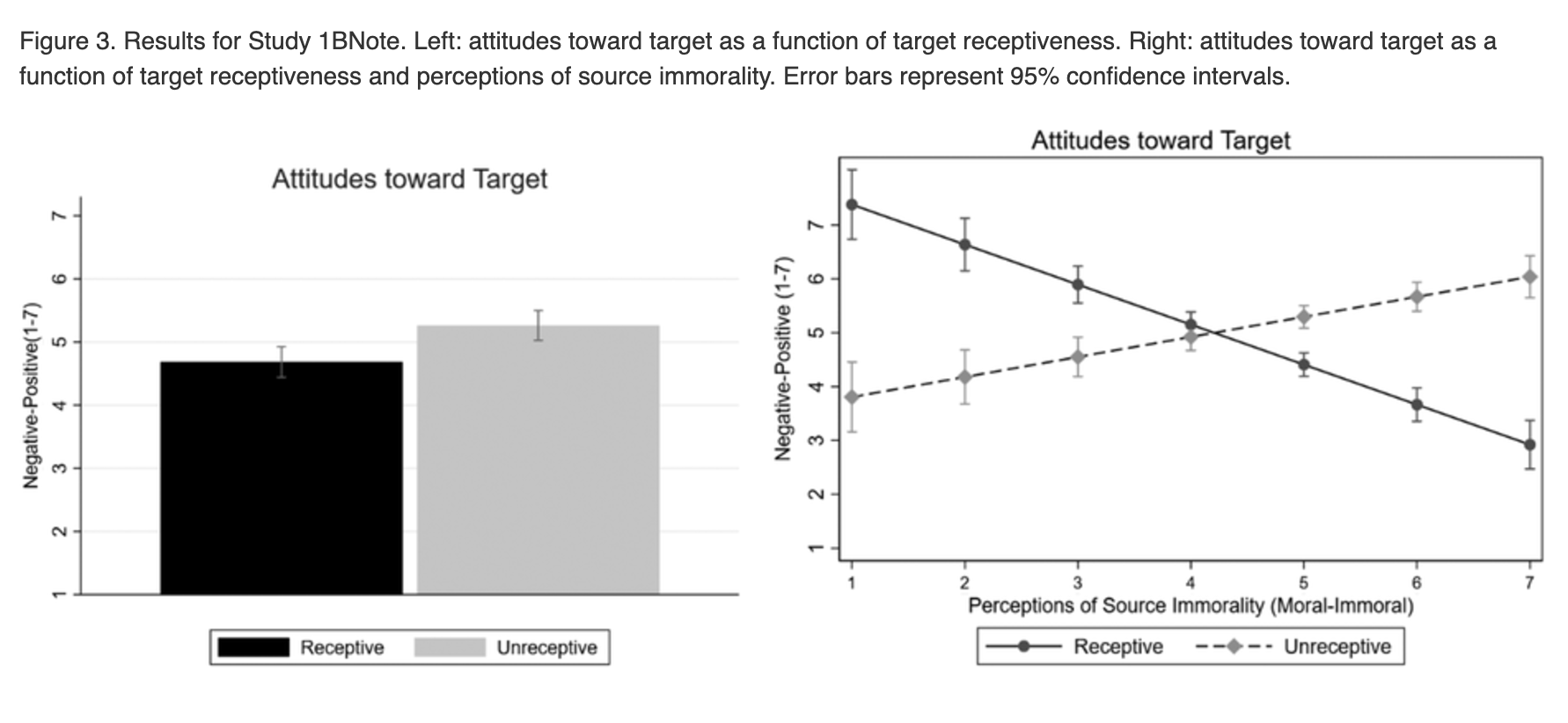
What the researchers found: Across conditions, the studies consistently showed that being receptive to political opponents backfires — it has a reputational cost among peers in their own party. The effect was remarkably robust, and it remained consistent across political topics, who John was listening to, and how actively engaged John was. Whether John was listening to someone about abortion or gun control, whether John was listening to a random person on Twitter or the president, whether John was merely reading an article online or attending a rally, the reputational cost remained.
One element of this remarkable consistency that surprised Hussein was that the social cost hinged more on party than on what information the person was being receptive to. Even when the information John was receptive to remained the same, social cost was observed when the information came from political opponents but not from people within his party––regardless of whether the participant agreed with the messaging or not.
“So, it’s not about the information itself; it’s about who it’s coming from,” explains Hussein. “In other words, punishing receptiveness is driven by an us-versus-them mentality. It’s really about our group versus their group and the negative stereotypes that people have about the opposing group, regardless of what they’re saying.”
Two conditions attenuated the participants’ dislike for John: If the opposing-party member he was engaging with was humanized — if the participant learned some details about their life — and if the opposing-party member was described as an atypical member of their party.
Why it matters: These findings may hold a clue as to what is causing the yawning political gap in the United States and why it is growing wider. If people are scared that being receptive to or engaging with the other party will hurt their reputation among their in-party peers, they will likely refrain from doing so. Of course, when people refrain from listening to or engaging with each other, it only fuels polarization.
Another implication of these findings is that to gain a broader political audience, someone who wants to spread their message or drum up support should signal that they are not a typical member of their party. According to the findings, this will prevent people from automatically applying stereotypes that shut down receptiveness.
As Congress averts one government shutdown after another caused by gridlock, finding a path toward more cooperation is more urgent than ever. “It seems like being bipartisan — crossing the aisle in any way — is risky business,” Hussein says. “So, how can we help public figures cross the aisle without facing backlash? That would be an exciting next question to tackle, and one we are actively working on.”
Adapted from “Reputational Costs of Receptiveness: When and Why Being Receptive to Opposing Political Views Backfires” by Mohamed A. Hussein of Columbia Business School and S. Christian Wheeler of Stanford University
