It seems Americans can't agree on much these days, but just about everyone thinks political polarization has gone too far. It’s hard to deny that polarization and virulent disagreement have dominated the airwaves, the op-ed pages, and social media, leaving many Americans to conclude that political discussion is invariably hostile and unproductive. These perceptions have driven some to despair about the state of the country and the prospects for national unity.
But do Americans’ negative perceptions of political debate necessarily correspond with reality? Or are debates more likely to be congenial discussions with friends and family than bitter online disputes? Modupe Akinola, the Barbara and David Zalaznick Professor of Business in the Management Division at Columbia Business School, teamed up with fellow researchers, including S.T. Lee Professor of Business in the Management Division at Columbia Business School Sheena S. Iyengar, to answer that question.
Key Takeaways:
- Americans overestimate the frequency of political debate. This misperception correlates with loss of hope in the future of the country.
- Most Americans debate important issues, ranging from reproductive rights to vaccination, with close friends and family. Most of these conversations don’t happen online.
- Rather than relying on sources that may have a vested interest in portraying debates as relentless and bitter, Americans should use their own experience to guide their views on the current state of political debate.
How the research was done:
The researchers conducted three studies as part of their paper:
- In the first study, the researchers asked survey participants, sourced from Amazon’s Mechanical Turk crowdsourcing web service, to recall their last political debate, what topics it concerned, where they observed or participated in it, and their feelings after the debate ended.
- In the second study, two groups of participants from a large university’s research lab and from Mechanical Turk received a list of 20 high-profile debate topics (e.g., vaccination and reproductive rights). Participants then shared which topics they debated, with whom they debated, and how they felt after the conversations ended. Postdebate feelings were reported on a seven-point scale.
- In the final study, participants were again recruited from Amazon’s Mechanical Turk. Respondents were randomly assigned to one of two groups: predictors and experiencers. The first group predicted what percentage of all Americans engaged in political debates in a given month; the second group recalled the number of debates they had participated in. Predictors also completed a four-question survey that gauged their level of hopelessness about the future of the United States.
What the researchers found:
The typical American political debate isn’t an online battle that leaves everyone feeling discouraged. Debates most often occur between friends and family members, and the emotions that arise are not predominantly negative. Rather, the average postdebate feeling was generally positive in the research lab sample and neutral in the online survey sample. Interestingly, some topics, like voting rights, seem to lend themselves to more positive postdebate emotions than other topics, like policing or reparations.
In the researchers’ samples, the two most debated topics were reproductive rights and vaccinations, in line with the current news at the time of the study; roughly two-thirds of the sample debated at least one of these topics in the past year. The majority of the 20 high-profile topics were debated by less than half of the participants over a 12-month period.
That such conversations are relatively rare might be surprising. Indeed, Americans tend to overestimate the frequency of political debates both in person and online. For example, predictors estimated that 39.9 percent of Americans engaged in political debates with their co-workers in a given month. The experiencer survey shows that in fact only 13.96 percent of respondents engaged in such a conversation.
Finally, the researchers also noted grounds for future study. Because many of their findings were correlational, further research might be conducted to determine whether a causal relationship exists between misperception of political debates and feelings of hopelessness about America’s political future. Similarly, there’s room for a longitudinal study in which the researchers would directly observe debates, rather than relying on participants’ self-reporting.
Why the research matters:
Although their findings are correlational and preliminary, the authors believe an accurate understanding of political debates in the United States would be healthy for both individuals and society.
“When we have greater clarity on the reality that people aren’t always debating online on social media, then maybe that helps restore hope in this idea of elections, hope in general, which then might shape election behavior, Akinola says.
After all, she concludes, “productive dialogue and debate don’t need to be contentious. It’s really about learning and growing.”
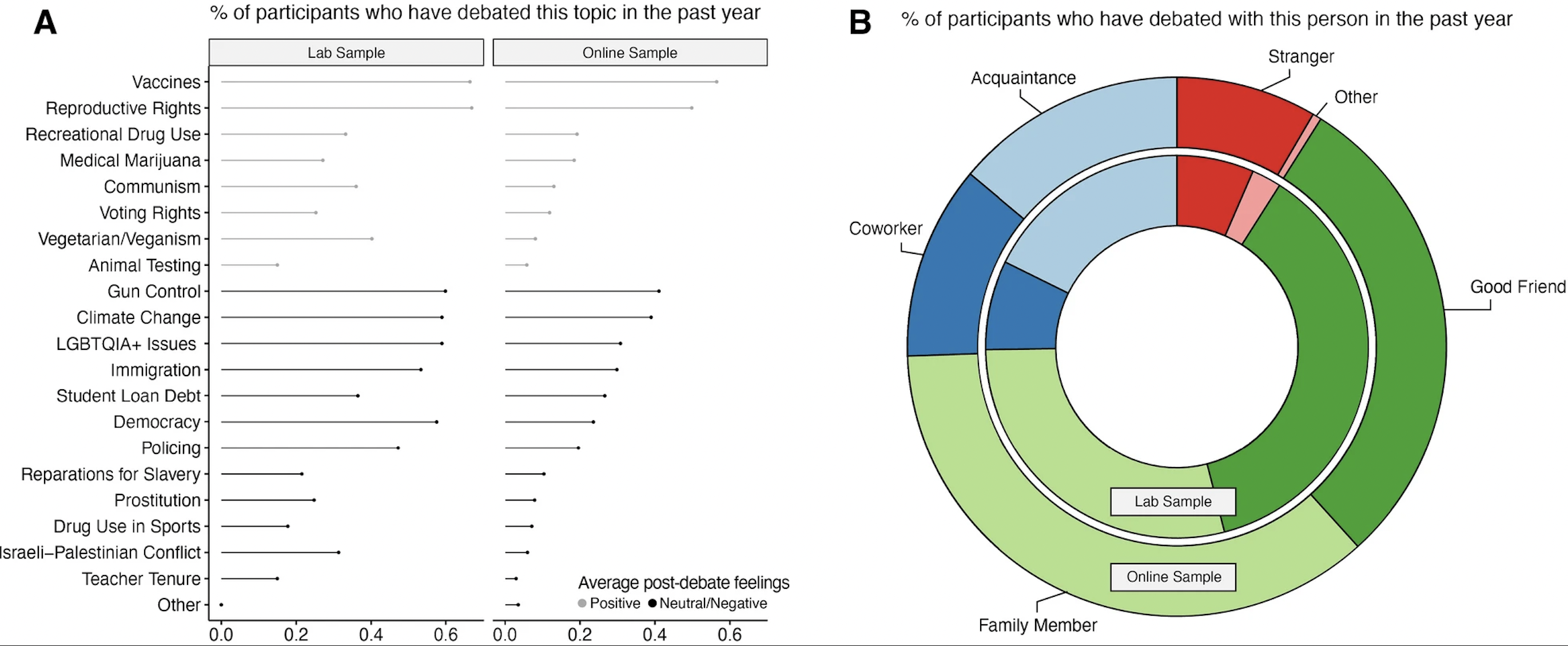
Topics and debate partners in lab and online samples. Figure presents the results of Studies 2a-2b which asked participants about their experience debating a series of issues over the past year. Panel (A) displays the frequency of debate topics in our sample with the most common debate topic being vaccines. Gray lines indicate debates that the average respondent felt positive after this debate; black lines indicate that the average respondent felt neutral-negative following this debate. Panel (B) displays debate partners with the most common partner in both samples being family members followed by good friends.
Adapted from “Americans misperceive the frequency and format of political debate,” by Erica R. Bailey of the Haas School of Business at the University of California, Berkeley, Michael W. White of Columbia Business School, Sheena S. Iyengar of Columbia Business School, and Modupe Akinola of Columbia Business School.

