Official Logo of Columbia Business School
Academics
  • Visit Academics
  • Degree Programs
  • Admissions
  • Tuition & Financial Aid
  • Campus Life
  • Career Management
Faculty & Research
  • Visit Faculty & Research
  • Academic Divisions
  • Search the Directory
  • Research
  • Faculty Resources
  • Teaching Excellence
Executive Education
  • Visit Executive Education
  • For Organizations
  • For Individuals
  • Program Finder
  • Online Programs
  • Certificates
About Us
  • Visit About Us
  • CBS Directory
  • Events Calendar
  • Leadership
  • Our History
  • The CBS Experience
  • Newsroom
Alumni
  • Visit Alumni
  • Update Your Information
  • Lifetime Network
  • Alumni Benefits
  • Alumni Career Management
  • Women's Circle
  • Alumni Clubs
Insights
  • Visit Insights
  • Digital Future
  • Climate
  • Business & Society
  • Entrepreneurship
  • 21st Century Finance
  • Magazine
Insights
  • Digital Future
  • Climate
  • Business & Society
  • Entrepreneurship
  • 21st Century Finance
  • Magazine
  • More 

Tracking AI’s Impact on Creativity, Leadership, and Innovation

Insights shared at Columbia University’s AI Summit show how the technology is redefining the creative process and influencing executive decision making.

Published
March 13, 2025
Publication
Digital Future
Focus On
Artificial Intelligence (AI), Business & Society, Business Analytics, Digital Future, Digital Future Initiative, Media
Jump to main content
Article Author(s)

Jonathan Sperling

Affiliated Author
ChatCEO event

Professor Stephan Meier, left, introduces ‘ChatCEO: How AI is Influencing Leadership and Labor.’

Category
Thought Leadership
Topic(s)
Artificial Intelligence, Business and Society, Data and Business Analytics, AI and Transformative Tech, Entrepreneurship and Innovation, Media and Technology

About the Researcher(s)

Stephan Meier

Stephan Meier

James P. Gorman Professor of Business; Chair of Management Division
Management Division
Sheena Iyengar

Sheena Iyengar

S. T. Lee Professor of Business
Management Division
Andrea Prat

Andrea Prat

Richard Paul Richman Professor of Business
Economics Division

0%

Columbia University hosted two discussions on its Manhattanville Campus as part of the Columbia AI Summit, featuring cross-disciplinary insights from faculty on using AI as a tool to enhance human ingenuity, as well as the technology’s latest impact on leadership strategy. 

During the AI Summit’s “AI and Creativity” discussion, faculty members noted how AI is pushing the boundaries of what’s possible in business, humanities, engineering, and the arts. The session also showcased how the University’s academic programs are integrating traditional traditional curricula with AI, empowering students to think from fresh, transformative perspectives. 

Later, Stephan Meier, the James P. Gorman Professor of Business in Columbia Business School’s Management Division, introduced “ChatCEO: How AI is Influencing Leadership and Labor.” During the panel, speakers  discussed the dual nature of AI as a source of both opportunity and disruption in today’s workplaces. AI tools are revolutionizing internal communications by automating the summarization of complex documents, distilling vast datasets into actionable insights, and even reshaping company culture surveys for real-time feedback. However, the use of AI is not without ethical challenges posed by opaque algorithms and over-reliance on the technology without adequate human oversight. 

Together, the events offered key insights into the delicate balance between opportunity and disruption inherent in AI adoption.


AI as a Catalyst for Innovation

Researchers who spoke during the “AI and Creativity” session opened a window into how AI is redefining artistic expression and innovation. Rather than threatening the role of human ingenuity, AI is being leveraged as a powerful tool that augments the creative process, according to the speakers.

Sheena Iyengar, the S. T. Lee Professor of Business in CBS’s Management Division, has dedicated her career to studying choice and innovation. During the discussion, she explained how AI and machine learning are being leveraged to help people generate more novel and meaningful ideas, combining diverse sources of information in new ways.

Drawing on historical parallels, she highlighted how technological disruptions—like photography in the 19th century—were initially met with fears of obsolescence but ultimately led to artistic reinvention. Just as painters like Picasso evolved their styles in response to photography’s rise, today’s creatives can use AI to explore new frontiers of expression and problem-solving.
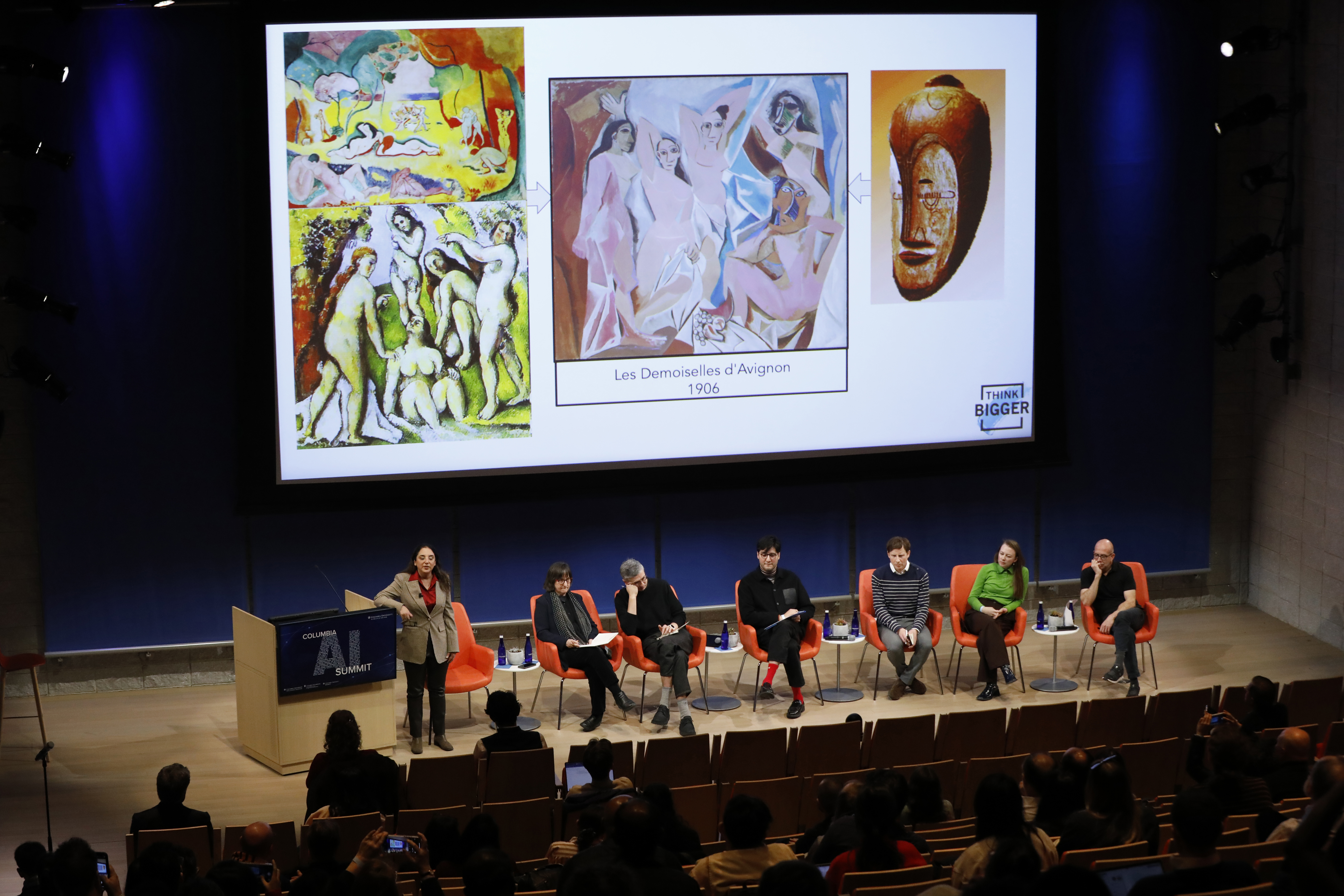
Professor Sheena Iyenger speaks during the AI Summit’s “AI and Creativity” discussion
Professor Sheena Iyengar, left, speaks during the AI Summit’s ‘AI and Creativity’ discussion.


Iyengar calls her method for fostering innovation, which she has recently enhanced with generative AI, Think Bigger. The method involves six key steps: define a problem, break it down, compare wants, search for solutions both within and outside the box, map out choices, and refine ideas through an iterative process. 

According to Iyengar, this process once required weeks of research and synthesis, but with AI, it can be accelerated significantly. 

Read more: AI-Generated Digital Twins: Shaping the Future of Business

“I used to teach this the hard way, the long way, and we had students spend weeks searching. But just this past July, we rolled out a generative AI app that literally does those six steps. And we found that in a five-day bootcamp, you can actually get students to now create entrepreneurial ideas which they can actually get credit for,” Iyengar said.

By leveraging AI to scan vast knowledge repositories, identify analogous solutions from different industries, and recombine insights in novel ways, people can generate breakthrough ideas in a fraction of the time, Iyengar noted. She added that AI-assisted idea generation has led to tangible innovations—such as an AI-powered system that helps restaurant-goers detect allergens in their food and another that aids in early detection of learning disabilities in children. 

Transforming Leadership and Organizational Decision-Making

A recurring theme during the ChatCEO panel was the potential of AI to support strategic decision-making through enhanced data analysis, real-time feedback, and even the automation of routine tasks such as summarizing lengthy reports or distilling large datasets into actionable insights.

Andrea Prat, the Richard Paul Richman Professor of Business in CBS’s Economics Division, offered a nuanced perspective. He emphasized that while AI has the potential to improve efficiency, its true value lies in its ability to measure and analyze previously intangible aspects of corporate life—most notably, organizational culture.

Traditionally, business leaders have relied on surveys, anecdotal feedback, and limited data to assess workplace sentiment and company culture. However, Prat highlighted research into how AI-driven tools, such as natural language processing applied to platforms like Glassdoor, can extract meaningful insights from unstructured data, identifying trends in employee sentiment across companies and industries. By using machine learning to filter out noise and detect patterns, AI can provide leaders with real-time, objective measures of workplace culture—something that was previously difficult to quantify.

Prat underscored that these AI-generated insights can drive accountability by allowing executives to track cultural changes over time, benchmark against competitors, and proactively address emerging workplace issues. This shift toward data-driven leadership has the potential to improve employee engagement, refine management strategies, and ultimately enhance organizational performance. However, he also cautioned against over-reliance on AI without human interpretation, stressing that while AI can surface patterns, it is up to leaders to contextualize and act on them effectively.

Prat emphasized that organizations should have a clear understanding of how AI functions, its capabilities, and the reasoning behind its outputs before integrating it into their operations.


Explore more insights from Columbia University's AI Summit.

About the Researcher(s)

Stephan Meier

Stephan Meier

James P. Gorman Professor of Business; Chair of Management Division
Management Division
Sheena Iyengar

Sheena Iyengar

S. T. Lee Professor of Business
Management Division
Andrea Prat

Andrea Prat

Richard Paul Richman Professor of Business
Economics Division

You Might Like

Artificial Intelligence, Data and Business Analytics, Data/Big Data, AI and Transformative Tech, Digital IQ, Marketing, Technology
Date
April 08, 2025
A woman shopping in a grocery store
Artificial Intelligence, Data and Business Analytics, Data/Big Data, AI and Transformative Tech, Digital IQ, Marketing, Technology

How Gen AI Is Transforming Market Research

Generative AI is revolutionizing market research by offering unprecedented ways to understand customers, assess competitors, and extend data-driven decision-making organizationally. Research with pioneering companies reveals four key opportunities: gen AI supports existing practices by making them faster and more scalable; replaces traditional methods with synthetic data that can match conventional results with greater accuracy; fills insight gaps by providing evidence for decisions previously based on intuition; and creates innovative applications like digital twins for testing customer interactions. Survey data shows 45% of market researchers already use gen AI, with most employing it to analyze transcripts and data. While acknowledging limitations around bias and representativeness, this framework helps business leaders navigate gen AI's transformative potential in gathering customer and market insights more efficiently and effectively than ever before.
  • Read more about How Gen AI Is Transforming Market Research about How Gen AI Is Transforming Market Research
Algorithms, Data and Business Analytics, AI and Transformative Tech, Marketing, Marketplace, Media and Technology
Date
April 02, 2025
TikTok logo on a smartphone
Algorithms, Data and Business Analytics, AI and Transformative Tech, Marketing, Marketplace, Media and Technology

Why a TikTok Ban Would Boost Meta’s Ad Prices—and Hurt Small Businesses

In new research, Professors Dante Donati and Hortense Fong find that the brief TikTok outage in January benefited Meta as advertisers turned to its platforms to reach users. Small businesses, less able to switch, lost out.
  • Read more about Why a TikTok Ban Would Boost Meta’s Ad Prices—and Hurt Small Businesses about Why a TikTok Ban Would Boost Meta’s Ad Prices—and Hurt Small Businesses
Artificial Intelligence, Business and Society, Distinguished Speaker Series, Leadership, Organizations, The Workplace
Date
March 21, 2025
Walmart Chief People Officer Donna Morris, left, with Professor Stephan Meier
Artificial Intelligence, Business and Society, Distinguished Speaker Series, Leadership, Organizations, The Workplace

Walmart’s Donna Morris on Building High-Performing Teams in the Age of AI

During a conversation hosted by Columbia Business School’s Distinguished Speaker Series, the multinational retailer’s Chief People Officer shared how leaders can use AI and people-first strategies to drive workplace innovation and resilience.
  • Read more about Walmart’s Donna Morris on Building High-Performing Teams in the Age of AI about Walmart’s Donna Morris on Building High-Performing Teams in the Age of AI
Artificial Intelligence, Business and Society, DFI News & Write-Ups, AI and Transformative Tech, Future of Work, Marketplace
Date
March 13, 2025
Columbia AI Summit workshop
Artificial Intelligence, Business and Society, DFI News & Write-Ups, AI and Transformative Tech, Future of Work, Marketplace

AI-Generated Digital Twins: Shaping the Future of Business

During a Columbia AI Summit satellite workshop, faculty shared cutting-edge research on the opportunities and challenges of AI in business decision-making.
  • Read more about AI-Generated Digital Twins: Shaping the Future of Business about AI-Generated Digital Twins: Shaping the Future of Business
Save Article

Download PDF

More to Explore
Share
  • Share on Facebook
  • Share on Threads
  • Share on LinkedIn

External CSS

Homepage Breadcrumb Block

Official Logo of Columbia Business School

Columbia University in the City of New York
665 West 130th Street, New York, NY 10027
Tel. 212-854-1100

Maps and Directions
    • Centers & Programs
    • Current Students
    • Corporate
    • Directory
    • Support Us
    • Recruiters & Partners
    • Faculty & Staff
    • Newsroom
    • Careers
    • Contact Us
    • Accessibility
    • Privacy & Policy Statements
Back to Top Upward arrow
TOP

© Columbia University

  • X
  • Instagram
  • Facebook
  • YouTube
  • LinkedIn