Many of us might remember the past six months as a time of nail-biting drama and chaos in the world of finance. In late 2022, the spectacular collapse of cryptocurrency exchange FTX served as something of a precursor to some of the tumultuous developments that defined the start of 2023: In March, Silicon Valley Bank’s failure sent shockwaves through the global tech sector and beyond. Just days later, Credit Suisse’s downfall roiled markets before UBS acquired it, saving it from the brink.
But while all these events have underscored the fact that the world of money is not for the faint of heart, they’ve also shed light on a more important and less obvious truth: Traditional models of finance may well be functional, but they’re not optimal. In many cases, a makeover is overdue.
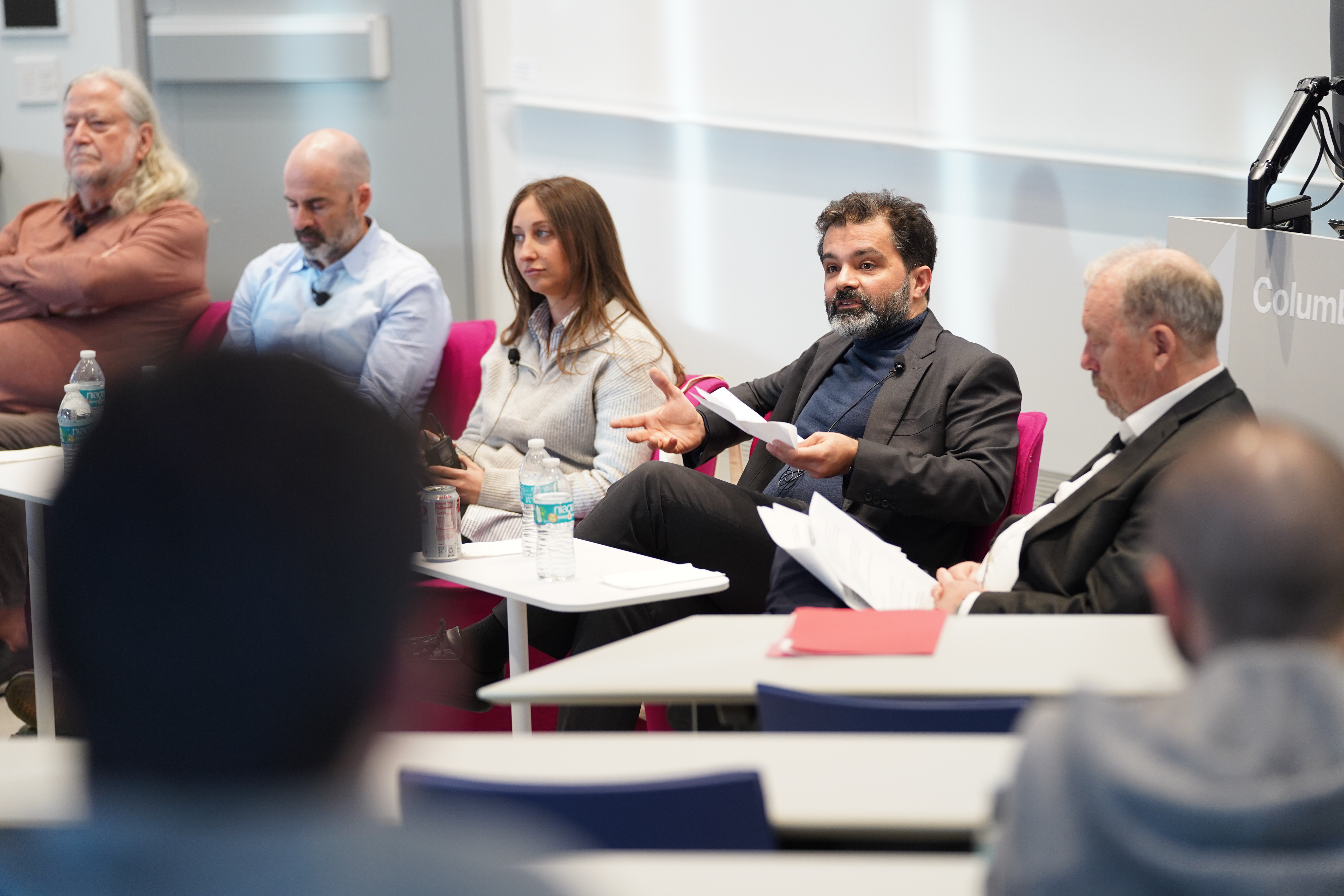
There are, of course, many ways in which that can be done, including changes to organizational culture and operational strategy, or better regulation. But at an event held at Columbia Business School’s David Geffen Hall in mid-March, a panel of experts suggested that integrating blockchain technology into legacy structures might be one of the most efficient and exciting ways to future-proof finance.
As part of the discussion, hosted by the School’s Digital Future Initiative and moderated by Todd H. Baker, a senior fellow at the Richard Paul Richman Center for Business, Law, and Public Policy at Columbia University, experts from industry and academia explored blockchain’s potential in traditional finance.
“All is certainly not roses in crypto,” acknowledged panelist Ciamac C. Moallemi, the William von Mueffling Professor of Business at CBS, at the outset of the conversation. But he agreed with fellow speakers that blockchain’s potential —particularly in the traditional finance space—is varied and underappreciated.
Here are three takeaways from the event:
1. Settlements can be simpler
Considering the clout of the global finance sector, it might be surprising that some of the most integral parts of the services it supports are, in some ways, still so primitive, argued Moallemi.
“Think of settlements,” he said. “The time it takes to settle a trade in the traditional finance world is generally still about two days. This is primitive compared to the blockchain world, where settlement can essentially happen in real time and can be visible to all.”
And these advantages are not just for institutions, he explained. Every consumer can benefit from the composability that blockchain allows, enabling a frictionless experience for individuals who want to manage their assets and investments without worrying about different accounts, with different interfaces and passwords. For example, if a saver wants to obtain a margin loan from a brokerage but not from the brokerage that manages their assets, blockchain technology could be the answer.
Morgan Krupetsky, director of business development for institutions and capital markets at Ava Labs, also highlighted this advantage. By implementing blockchain technology, “trade confirmations and reconciliation can effectively occur in real time,” she said, which provides the additional benefit of reducing counterparty and other types of risk.
2. Open and transparent doesn’t have to mean risky
Our world today runs on the most powerful commodity imaginable: data. Data sets are everywhere. Because of the technology available to us, they drive how we live, love, learn, work, travel, socialize, and more. Data are our lifeblood, whether we know it or not.
But in traditional finance, data remain tightly held, said Moallemi: “It’s still a fundamentally opaque system. If you’re trading US equities, for example, you still have to literally buy relevant data from the stock exchange in order to know what’s going on. In the blockchain world, by contrast, things to a large extent are open and free.”
He added, “A great thing about the blockchain world is that you can look at the source code to understand how it works. You can audit it. It creates accountability. If you want to know how Nasdaq works, well, good luck!”
Krupetsky ventured one step further. “This is fundamentally about democratizing finance and opening up capital markets,” she said. “It’s about consolidated databases and a single source of truth.”
3. Crypto can be a valuable resource for the here and now
Underpinning perhaps all the advantages of integrating blockchain into legacy financial systems is that today’s world—and the interconnected nature of it—simply demands it.
Indeed, Aaron Brown, a crypto entrepreneur who formerly served as managing director and head of financial markets research at AQR Capital Management, noted that while we rely on versions of exchange for most things in life, many of us don’t realize that large and important parts of the economy—“like intellectual property or music or arte”—don’t actually fit efficiently and neatly around the concept of money. “There are, of course, regulations and intense legal structures in place, but again, these tend to be wedded to the physical, to physical assets,” Brown said.
“There’s tremendous value out there if we had more sophisticated ways of making metered exchanges that aren't based on money,” he added. And that is where blockchain technology might well be the solution.
Tom Brown, a partner and general counsel at venture capital firm Nyca Partners, applied the same argument to something perhaps even harder to navigate in the context of a world in which the pace is set by the speed of innovation, the sophistication of technology, and the interconnectivity of it all: our own identity.
“As we interact and live in a digital space, it becomes very important to identify yourself to digital counterparties,” Brown explained, adding that it’s a matter of safety and security. “Blockchain technology can provide a solution.”
For Krupetsky, the most compelling case traditional financial players should consider when deciding whether to leverage the power of blockchain or continue doing things as they always have is that in the long run, everyone will be integrating the technology.
“More and more financial institutions will move on chain, to the point that we’ll eventually stop differentiating between ‘trad-fi’ and ‘de-fi,’ ‘on chain’ and ‘off chain.’ It will all just be ‘finance,’” she said.
And as someone who considered the concept of a cryptocurrency way back in the 1970s, Brown said he’s seen for himself how “sometimes these visionary, clever, mathematical ideas really do come to fruition.”
From the vantage point of now, he noted, it’s impossible to know what the next decades hold. Who would’ve thought 25 years ago that social media would be such a dominant part of our lives? As such, Brown said, it’s up to us to appreciate that technologies like blockchain truly do have the potential to be the foundation of an entirely new industry; one that none of us have even thought of.
Watch the full panel discussion here:
