
Key Takeaways:
- Status is not a zero-sum proposition: An increase in one person’s status does not mean a decrease in someone else’s status.
- Highlighting someone else’s contributions to your success will not only increase their status but also your own.
- When we are status-insecure, we are less likely to share status and highlight the role others play in our successes.
- Status insecurity can lead to a vicious, self-defeating cycle. An unwillingness to acknowledge others’ contributions to your success can, in fact, contribute to a lowering of your own status. Sharing status, by contrast, creates a virtuous cycle that expands the status pie for you and others.
Adam Galinsky, vice dean and the Paul Calello Professor of Leadership and Ethics at Columbia Business School, has spent much of his career investigating status, approval, and self-respect.
“For two decades, I’ve been studying the consequences of having high versus low status," he says. "When you have high status, people laugh at your jokes and open doors for you. But if you’re of low status, people literally and metaphorically close doors in your face. We all have a deep need to be respected and admired by others. It’s fundamental to the human condition.”
So, when Maren Hoff, a doctoral candidate in the Marketing Division at Columbia Business School, came to him and requested an independent study on power and status, he was happy to collaborate.
Galinsky and Hoff realized that although status insecurity was something that most everyone had experienced and could recognize, few people had bothered to research or even define it. For their paper, authored with Derek Rucker of the Kellogg School of Management at Northwestern University, they defined status insecurity as “the psychological state of uncertainty and self-doubt in one’s ability to meet the fundamental goal of maintaining or improving the extent to which one is respected and admired in the eyes of others.”
Because status is conferred by others, we need other people to respect us, and we raise the status of others by elevating them. As such, status sharing sits at that intersection. For Galinsky and Hoff, status sharing occurs when people attribute their status and success, in part, to other people or external factors. The authors theorized that people who were feeling insecure in their status would be less likely to engage in status sharing. The status insecure come to believe that status is zero-sum, where a gain in one person’s status necessitates a decline in someone else’s. Galinsky says, “It takes courage to be generous, because there’s this fear it will undermine your status."
Galinsky and Hoff believed that this zero-sum belief about status was wrong and that sharing status actually increases the status of both parties, thereby “growing the status pie.” By contrast, not sharing begins a vicious cycle in which the non-sharer’s status actually decreases. Galinsky and Hoff conducted more than a dozen studies, both qualitative and quantitative, and found robust evidence in favor of their vicious-cycle model. Whereas status hoarding triggers a vicious, self-defeating cycle that lowers one’s status, status sharing activates a virtuous cycle, where the status of both the sharer and the recipient is boosted. Despite the jaundiced beliefs of the status insecure, status is not zero-sum.
From the Classroom to the Island
The researchers devised a diverse set of 16 studies to test their vicious-cycle model. The studies were both observational and experimental, with data culled from sources as disparate as a university classroom and a television reality show. For Galinsky, one particularly striking feature of the research is its mix of the quantitative and qualitative.
The major qualitative piece of the research was a study involving 255 new MBA students, who were asked to recall, and write about, a time in which they felt insecure in their status. From those responses, the authors identified 10 different sources of status insecurity, including competence concerns, public failure, and infuriating environments. Students shared examples from work, their social lives, and even their academic careers.
Galinsky and Hoff followed the qualitative study with an archival study that employed novel data and new methods. The data set included every “final speech” from 29 seasons of the reality TV competition Survivor. The speeches, given by two or three players in a season’s final episode, are intended to persuade a panel of fellow contestants to select the speaker as the winner of the $1 million prize.
Using bespoke ChatGPT prompts, the study analyzed whether or not the speakers engaged in status sharing, partially attributing their success on the show to the support of other players. Galinsky and Hoff also analyzed what level of status security or self-confidence the speeches demonstrated. The results supported their vicious-cycle thesis: Status-insecure language predicted lower levels of status sharing, while status-sharing language predicted receiving higher status. This initial study used novel data and methods, but because it was correlational, it could not causally support their model.
Galinsky and Hoff's next set of studies involved a role-playing component. Participants were told to imagine they were consultants preparing a pitch; some were told they were insecure about whether their bosses and clients respected them, while others were told they were secure. The participants were informed that they had received assistance from a colleague. Later, participants learned they received a compliment from their client and faced the dilemma of whether to highlight their own skills or acknowledge their colleague’s contributions. The status-insecure participants highlighted their own contributions and ignored their colleague’s help, causally establishing that status-insecure people are less likely to offer credit.
Further studies added deeper nuance and addressed potential concerns about the model. One study differentiated between status insecurity and self-esteem insecurity, while another sought to demonstrate that zero-sum beliefs are a critical part of the equation linking status insecurity to lower status sharing. One culminating study, which combined several previous studies and involved 1,800 new participants, demonstrated that status hoarding is ultimately self-defeating; in contrast to the beliefs of status-insecure individuals, status sharing increases one’s own status.
Nice Guys Finish First
Although Galinsky jokes that the number, breadth, and ingenuity of the studies resulted in a “monster” paper, the research’s applicability to business, and to day-to-day life, is as straightforward as it is important: Failing to share credit or admit receiving help doesn’t make you look like a lone genius; it makes you look selfish and insecure. Attempts to claim credit for yourself, and to treat collaborations like competitions, mostly backfire, further reducing your status. In contrast, sharing credit with colleagues, peers, supervisors, or subordinates “grows the status pie,” according to Galinsky. Status is not a zero-sum proposition — one person’s gain need not be another’s loss.
Naturally, the researchers put their findings into practice: Galinsky praises Hoff for being “on the methodological cutting edge,” and the acknowledgments section that opens the paper is a full page long.
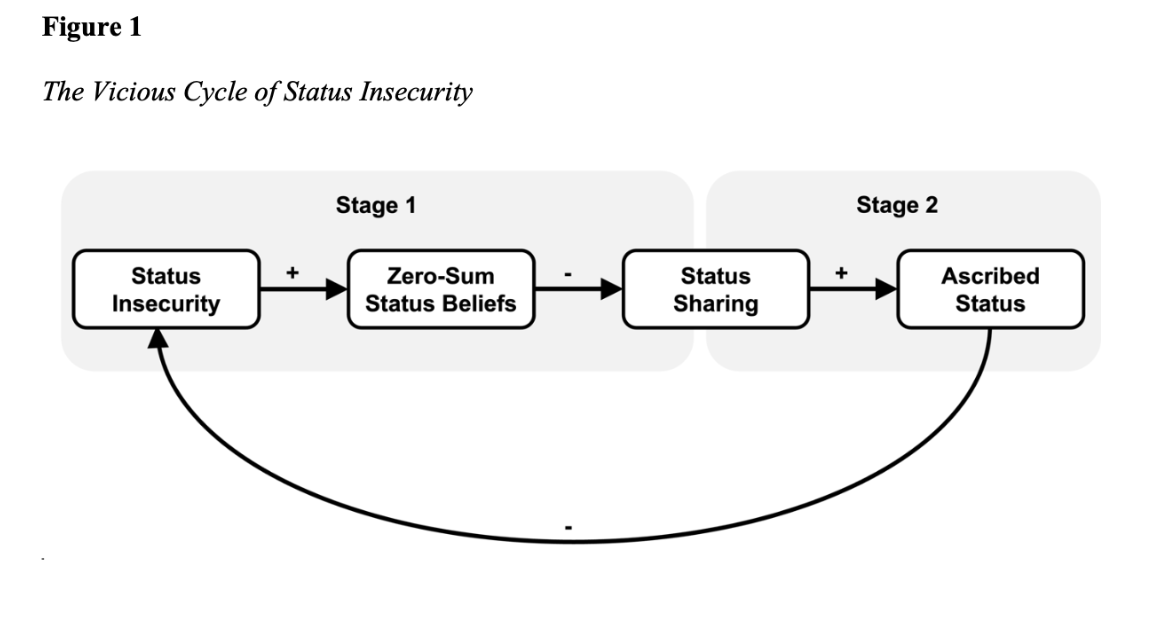
Adapted from The Vicious Cycle of Status Insecurity, forthcoming in the Journal of Personality and Social Psychology by Maren Hoff of Columbia Business School, Adam Galinsky of Columbia Business School, and Derek Rucker of Kellogg School of Management at Northwestern University
Find out about Adam Galinsky's new book Inspire: The Universal Path for Leading Yourself and Others.

